How are processing aids regulated? Industry insiders are baffled
In March of this year, the Food and Drug Administration (FDA) announced a draft of the "Sanitation Standard for Processing Aids," which proved highly controversial. Not only did the FDA take the lead in listing 7 solvents from the "Standards for the Use Scope, Limits, and Specifications of Food Additives," it also added 5 more solvents, including butane and dichloromethane. This drew criticism from legislator Lin Shu-fen, who said the FDA had not conducted a risk assessment yet wanted to loosen the relevant standards. Lin Shu-fen filed an interim proposal in the Legislative Yuan demanding that the draft be revised. The FDA then held a public hearing on the draft "Sanitation Standard for Processing Aids" last Friday, where nearly a hundred industry representatives packed the venue to voice their opinions.
What are "processing aids"? Take soybean salad oil, which is commonly used in cooking. To make it, besides dehulling the soybeans and crushing the broken beans to rupture the oil cells, it also relies on "hexane" to assist extraction, allowing the soybeans to release liquid miscella and solid soybean meal. "Hexane" is what is called a "processing aid." But in the past, under the "Act Governing Food Safety and Sanitation," hexane was classified as a "food additive" and was subject to the same management model. Now the FDA plans to list certain processing aids separately, drafting the "Sanitation Standard for Processing Aids" and applying a different management model.
The draft the FDA presented yesterday removed the 5 solvents that had been added later, including butane, dichloromethane, methyl ethyl ketone, propane, and methanol, while retaining the 7 solvents already regulated under the "Act Governing Food Safety and Sanitation": propylene glycol, glycerol, hexane, isopropanol, acetone, ethyl acetate, and triacetin.
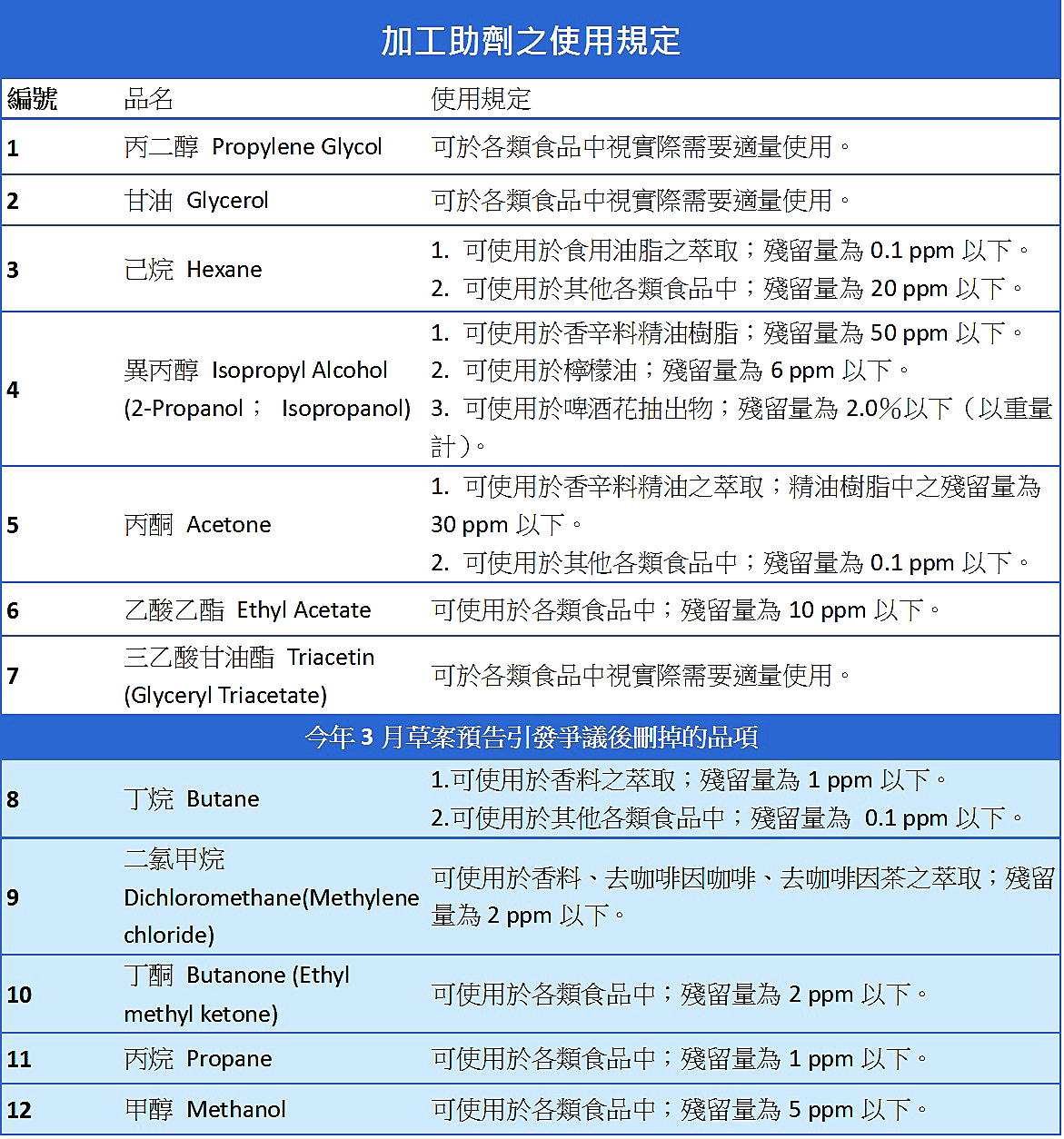
From food additive to processing aid: a very different management approach
Article 2 of the draft "Sanitation Standard for Processing Aids" states that a processing aid is a substance used during the manufacturing and processing of food or food ingredients to achieve a specific processing purpose, and is not a food ingredient or a substance of food containers or utensils. It does not function in the finished product, but may remain as a non-intentional yet unavoidable residue. Simply put, a processing aid is not a food ingredient, but a substance used for a specific food processing purpose.
For example, to make soybean salad oil, the solvent hexane must be added during or before cooking the soybeans so that edible oil and fat can be extracted; the current draft sets the residue limit in the finished product at no more than 0.1 ppm. In addition, to extract essential oil from spice plants, isopropanol must be added, and the draft sets the residue limit in the finished product at no more than 50 ppm.
Many industry representatives at first questioned whether, once the "Sanitation Standard for Processing Aids" takes effect, they would also have to label processing aids in food ingredients if they use them. In response, an FDA food division official explained that the purpose of drafting the standard was to move processing aids away from being managed under the food additive mindset and instead treat them under sanitation standards, so naturally they do not need to be labeled in the ingredients.
Only seven solvents listed: how will other similar substances be managed?
What worries many industry representatives even more is that the draft "Sanitation Standard for Processing Aids" currently lists only 7 solvents, leaving the rest unlisted. What standard should apply to them in the future?
For example, some industry representatives mentioned that the production of century eggs requires soaking in "copper sulfate" to cure the eggs; the extract often used in making calendula (pot marigold) flavor is "methanol" and the antifoaming agent commonly used in making tofu is "fatty acid glycerides"... all of these have the characteristics of processing aids, yet none are listed in the draft.
In response, Pan Chih-kuan, director of the FDA's Food Division, explained that for items not yet listed in the draft, as long as they comply with international processing aid regulations, such as those of the Codex Alimentarius Commission, the United States, the European Union, and New Zealand and Australia, and industry representatives can provide documentary proof that their method of use, how they are removed during processing, or the residue levels in the final finished product comply with the above international regulations, and as long as industry representatives adhere to the spirit of self-management, the FDA will approve them on a "case-by-case basis."
Pan Chih-kuan stressed repeatedly that the "Sanitation Standard for Processing Aids" does not adopt a "positive list," and that substances outside the list can still be used as long as they comply with the processing aid regulations of advanced countries and industry representatives can provide proof and explanation at that time. In other words, for example, dichloromethane, which was not listed this time, is an extraction solvent used in decaffeination; if industry representatives want to use it in the future, they only need to comply with the relevant EU and Codex regulations and provide an explanation.
Faced with the FDA's response, many industry representatives at the meeting still questioned: "Then why does the FDA still need to list the 7 solvents?", "What if consumers or the media question it?", "If local health inspection personnel cannot understand it, leading to different enforcement approaches, what should industry representatives do?"
Lin Shu-fen: The FDA should adopt a clear positive list and conduct risk assessments
Pan Chih-kuan said that currently there are about 700-plus processing aids used worldwide, and in the future this set of standards will still refer to the relevant regulations of advanced countries and adopt "rolling revisions." For now, only the 7 solvents with the least concern have been included first, and in the future substances such as enzymes, catalysts, and microbial culture substances may also be added. But Taiwan is already many steps behind the international community and must quickly take the first step.
In response, industry representatives present suggested that the FDA should include wording such as "refer to advanced international regulations" in the articles, or add wording such as "if used" at the very beginning of Article 4 of the draft "Sanitation Standard for Processing Aids": "The processing aids in Appendix 1 shall comply with the use regulations listed in that table." FDA officials said they would take the opinion into consideration and bring it back for discussion.
Yeh Yen-po, director of the Changhua County Health Bureau, also believed that the use of all processing aids still needs to go through a risk assessment procedure before they can be listed, and that it is not appropriate for industry representatives to provide evidence on their own by following international regulations. "How should local units determine this evidence in the future?"
Lin Shu-fen criticized even more directly, "The FDA's regulation like this is basically the same as having no regulation at all." It is understood that Lin Shu-fen's office had repeatedly asked the FDA to provide the types of processing aids actually used by domestic industry representatives, but the FDA never responded. "This makes it really hard to discuss which items should be opened up based on domestic usage conditions."
Lin Shu-fen said that actually it is not difficult to list processing aids one by one on a positive list and clearly set residue limits; Codex can do it, and the FDA should be more responsible and conduct the relevant investigations properly so that it can truly safeguard the public.