Rice noodle "no rice" controversy escalates again as industry, legislators and officials continue negotiations
In 2013, NewsMarket exposed the chaos of "rice noodles without rice," and the Food and Drug Administration (FDA) revised the regulations on rice noodle labeling. The original rules stated that products containing less than 50% rice could not be labeled as rice noodles or blended rice noodles, but under pressure from manufacturers, the policy was reversed within a day, changed to allow the compromise label of "Hsinchu rice noodles (cooked noodles)." But aside from consumers being unable to tell the difference, manufacturers were still dissatisfied, believing that export volumes were significantly hindered, and hoped the FDA would revise the regulations again so that products could be called rice noodles regardless of whether they contained rice, as long as they were willing to indicate the rice content.
Today, the Hsinchu City Rice Noodle Trade Association met with Legislator Ker Chien-ming's office and FDA officials for "consultation," but refused to allow NewsMarket reporters to attend; after the meeting, the FDA merely smiled and said everything was still under discussion, with no conclusion.
Rice Noodles, Starch Noodles, Cooked Noodles: What Did You Actually Buy?
In 2013, NewsMarket exposed that many commercially sold rice noodles, although boasting words like "pure" and "natural" on their packaging, were found through actual testing and calculation to have severely insufficient rice content, generally below 20%, with some containing no rice at all. When examined against national standard CNS11172, products that should originally contain 5% or more protein were found to have less than 1% in many products labeled "pure rice noodles" - essentially defrauding consumers.
Even more seriously, many of these rice substitutes were bulked up with corn starch. Because corn starch has a stable structure and is difficult to break down, eating rice noodle products adulterated with corn starch may cause indigestion, giving truly pure rice noodles a bad name.
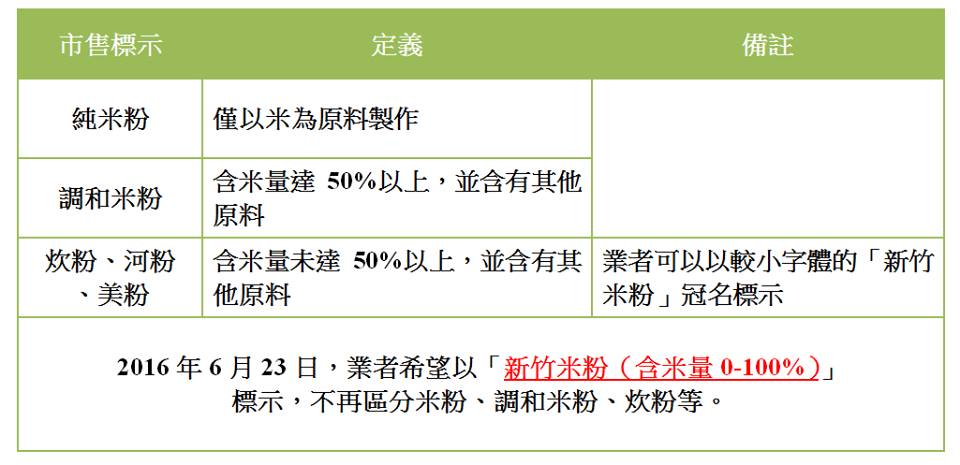
To address this, the Food and Drug Administration (FDA) issued the "Regulations on Packaged Rice Noodles for Sale" at the end of that year, stipulating that if manufacturers wanted to claim "pure rice noodles," the ingredients must consist only of rice; if the rice content was less than 100% but higher than 50%, it could be called "blended rice noodles."
The most critical category - and the products most easily found on the market with rice content below 50% - had no mandatory regulation at the time, only a statement that they could not be labeled as pure rice noodles or blended rice noodles; however, many manufacturers, unwilling to adjust their formulas or raise rice content, consulted with the FDA and confirmed that using "cooked noodles" would not be illegal. Many manufacturers began changing "rice noodles" to "cooked noodles" to evade the regulations.
Then-Deputy Director-General and current Director-General Chiang Yu-mei stated at the time that if manufacturers produced their products in Hsinchu using pure rice, they could not only openly label them "Hsinchu rice noodles" but also polish the international brand.
Chang Wei-chi, a professor at National Hsinchu University of Education who has long focused on food culture, once pointed out that "cooked noodles" are actually thinner rice noodles and have nothing to do with rice content; allowing manufacturers to use "cooked noodles" would carry the risk of calling a deer a horse.
"Hsinchu Rice Noodles" and "Cooked Noodles" Coexisting Makes Packaging Even More Confusing
Nevertheless, manufacturers continued to pressure the FDA, resulting in the final approach of "brand name" and "product name." That is, the four characters "Hsinchu Rice Noodles" were defined as the "brand name," and the related rice noodle product as the "product name." The product name must be labeled, but the brand name may or may not be labeled, and the product name must be larger than the brand name.
In short, even for "cooked noodles" with rice content below 50%, manufacturers can list "Hsinchu Rice Noodles, Cooked Noodles" side by side on the packaging, except that the four characters "Hsinchu Rice Noodles" must be shrunk and the two characters "Cooked Noodles" must be enlarged. But consumers are always confused about whether they bought cooked noodles or Hsinchu rice noodles. And what is the difference between cooked noodles and Hsinchu rice noodles?
Manufacturers Hope That Rice Noodles With or Without Rice Can All Be Called Rice Noodles, But Will Label Rice Content
After one year of the policy being in effect, rice noodle manufacturers protested multiple times to express dissatisfaction, not only due to confusing labeling but also because it created obstacles to exports. The trade association further met today (the 23rd) with Hsinchu Mayor Lin Chih-chien, Legislator Ker Chien-ming's office, the FDA and other relevant parties to discuss the regulations.
However, Ker Chien-ming's office told NewsMarket reporters that the meeting was a private engagement and did not accept media interviews. After the meeting, Hsu Chao-kai, Deputy Director of the Food Division, smiled and said that the relevant laws and policies were all under discussion, with no conclusion. Meanwhile, Kuo Wen-ming of the Hsinchu City Rice Noodle Commercial Trade Association emphasized that the association's demand is singular: it hopes that all noodle products made in Hsinchu be collectively called "Hsinchu rice noodles," and no longer be relabeled as rice sheets, cooked noodles or fine noodles, but that rice content would be indicated as a percentage. For example, Hsinchu rice noodles with 30% rice content - "this is the manufacturer's integrity toward consumers."
Kuo Wen-ming stated that the desire to rename has nothing to do with cost; they hope to make labeling honest and clear, leaving everything to consumer choice. And now, not only are rice noodle product names chaotic, but in China there are also manufacturers labeling their products "Hsinchu rice noodles" for sale, while rice noodle products made in Hsinchu cannot be labeled as Hsinchu rice noodles, severely impacting product exports.
Regarding the meeting results, Hsu Hui-yu, Director of the Food and Nutrition Division at the John Tung Foundation, stated that the FDA must treat everyone equally: "Whatever manufacturers emphasize, the content must be labeled accordingly." Like mushroom-flavored vegetarian oyster sauce, the mushroom content must be clearly labeled. And on this matter, the FDA must also take a clear stance and not simply accommodate manufacturers because their voices are loud.
According to manufacturers, Ker Chien-ming's office will assist in convening a public hearing for the general public to discuss how "rice noodles" should ultimately be labeled.