Luffa Gourds and Cats on the Roof: Rural Regeneration Five-Year Checkup, Episode 3
Heading along Provincial Highway 3 toward Yujing in Tainan, mango trees line the road in welcome. In this small mountain town, famous across Taiwan for its Irwin mangoes, sits Tianpu, a community repeatedly held up by the Soil and Water Conservation Bureau as a model of rural regeneration. Yet its specialty is not mangoes but the utterly ordinary luffa gourd.
Tianpu Community passed its "Rural Regeneration Plan" in 2011, among the first wave in Taiwan. Lin Qinglan, chief executive of the Tianpu Community Development Association, admits they agonized for more than a year over choosing the luffa, afraid of being mocked as unsophisticated, but mangoes grow in many places, and at the time not many people had thought of processing luffas, while nearly every household grew them, making the crop well suited to becoming a community industry.
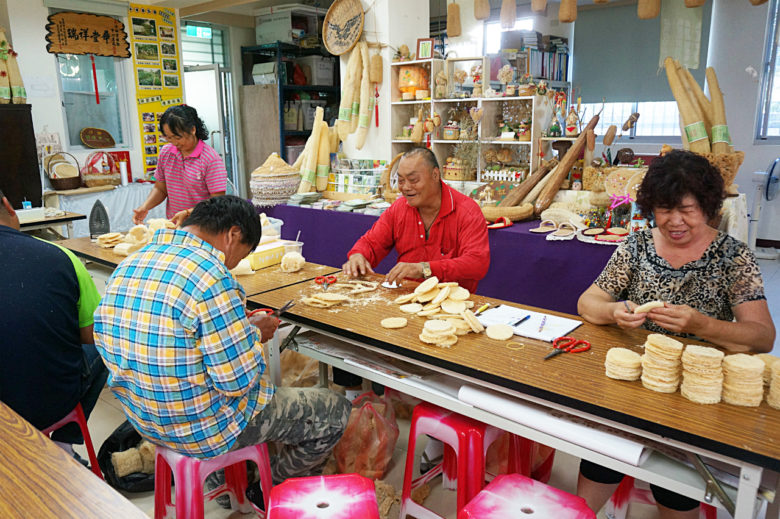
Tianpu Community started out doing environmental protection and resource recycling, and was named a national model community in 2007. Before joining rural regeneration it already had a volunteer group of more than 50 people, and the trust built up over the years became an important cornerstone for promoting a community industry. "Our luffa honey soap, luffa sponges, luffa lamps, luffa dye... all of it is handmade by the community, not outsourced to factories," Lin Qinglan says. The community's elderly residents turn out enthusiastically for meetings, thinking together about what products to develop and then inviting teachers to give classes.


Community industry is the foundation
Tianpu and Dingxi communities found ways out for their communities in different ways, but both ultimately mention the importance of local industry. Zeng Xuzheng, former chairman of the Community Empowerment Society of the Republic of China and current deputy minister of the National Development Council, believes rural regeneration should return to its basic core and discuss production, livelihood and ecology, among which sustaining livelihoods is key, meaning finding a community industry, and this requires more cross-domain cooperation, such as with the Agriculture and Food Agency, farmers' associations or other organizations.
The point of a community industry is how to turn individual production into collective production. Take Shian Community in Tainan as an example: more than 60 farmers formed a cooperative to grow pesticide-free rice and market it jointly, with 20% of the income used for elder care in the community and to buy a medical transport vehicle. "Rural areas can cooperate, but the process won't be that fast."
He points out that when discussing which industry to develop, guidance should come from professionals, while local people themselves survey the community's hydrology, soil, field conditions and so on, as well as current production and marketing difficulties. "That is the real production problem the community must face," otherwise it easily degenerates into 1960s-style rural construction, with nothing but renovated houses and a few words painted on the walls, and young people still won't come back.
Series reading:
"Rural Regeneration" Five-Year Checkup (2) A 150 Billion Fund Everyone Wants a Share Of
For more professional agricultural technology news, scan the code to follow WeChat: NongXunNET

Please cite the source when reprinting.