Twenty Years of Harvest: Remembering the FairShare CSA Coalition (Part 2)
Text/ Liu Chung-en, Kao Yi-chen
Having introduced the organization's development and covered the expo itself, we were fortunate enough to interview Kiera, the person in charge of the FairShare CSA Coalition, giving us a deeper understanding of the organization's past, present and future.
Kiera is a sunny, energetic young woman. In her early 30s, she took over this position 5 years ago and led the organization to successfully obtain US 501c nonprofit certification, giving its fundraising work more room to grow. Besides the day-to-day affairs she manages, she also works as a farmer in a community garden and runs a stall at the farmers' market on weekends - she is truly a super-active figure in the new agriculture movement.
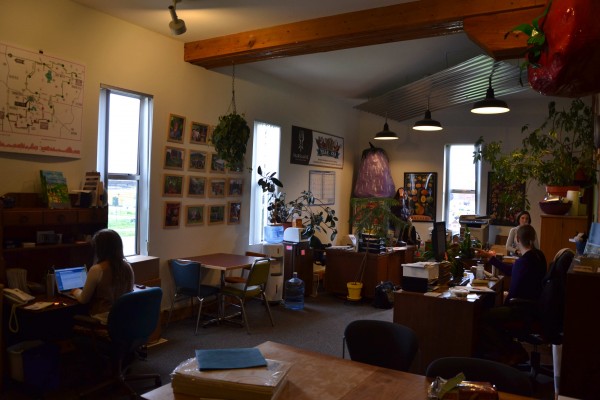
On the day of the interview, the two of us authors chatted for more than an hour at a coffee shop next to her office. The following is a translated and edited transcript of that day's interview:
Q: FairShare has been around for 20 years now. Can you talk about what the coalition's greatest achievements have been over these years?
A: I think the coalition's continuous growth over these years is the greatest achievement. 20 years ago, no one had heard of what CSA was, but today almost every resident of Madison can say it off the top of their head. In the early days we had only 8 farms and more than 200 members; by this year, we have a total of 51 farm partners and 9,200 member households, and an estimated roughly 23,000 people enjoying the local good food our coalition provides. In this process, our coalition played a very important role, serving on one hand as the window through which the farms collectively face consumers and carrying out all kinds of promotion, while on the other coordinating good cooperative relationships among the farms so that they would not fall into cutthroat competition.
Besides the organization's continued growth, we are also proud of our mission to pursue fairness and justice at the dinner table. The foremost example is the "Partner Shares Program" that subsidizes low-income households; the number of people we serve rises year after year. In addition, we successfully coordinated government administrative procedures so that low-income households can use food vouchers issued by the government to exchange for food from local farms.
Q: Can you talk in more depth about the "premium discount program"? How did this program get started?
A: In 2005, one of our coalition's supervisors happened to work at a health insurance company in Madison. She was already a CSA supporter and knew that community agriculture not only deepens the local agricultural culture but also provides reassuring local food and safeguards residents' health. On her suggestion, we first ran a one-year experiment with certain customers, and the response was excellent. The following year, we immediately extended it to all of the insurance company's customers: anyone participating in CSA could immediately get 100 US dollars off their premium, and a family could get a maximum discount of 200 dollars.
Once this program came out, everyone praised it endlessly and the media rushed to report on it. The families and farms subsidized by the insurance company of course welcomed it with both hands, and that insurance company also built a good corporate image. As a result, the other 3 local insurance companies in Madison immediately followed suit over the next 2 years, and now no matter which company you are insured with, as long as you join CSA you can get a premium discount.
The most direct impact of the "premium discount program" was that it greatly increased the incentive for consumers to participate in CSA. After this program was launched, the coalition's membership grew all the way from 2,000 people to nearly 10,000, making our promotional education work much easier.
Q: Over the past 20 years, have any member farms chosen to leave the coalition? What were their reasons for leaving?
A: Yes. Every year there are usually new members joining, and a small number of farms choose to leave. Most of the partners who leave do so because they are not suited to the CSA model. After running things for a while, some discover that they do not necessarily enjoy interacting with customers so much, or are not good at handling this kind of transaction, so they switch back to the traditional way of operating.
Q: What is the biggest challenge the organization faces? Where does the funding for the organization's operations come from?
A: Insufficient manpower and resources have always been our challenge. Right now we have just 3 full-time staff. Although there is a lot of promotional work we want to do, because of insufficient resources we can always only pick the most important things to do.
Our member farms pay only a small membership fee each year, and the coalition's main operating funds come from various fundraising activities. For example, the roughly 50,000 US dollars in funding that sustains the low-income "Partner Shares Program" comes almost entirely from the "Bike the Barns" event. If the amount raised exceeds expectations, it goes directly to the coalition's general purposes.
The cookbook we published, "From Asparagus to Zucchini: A Guide to Fresh, Seasonal Food," is also a major source of income for us. In addition to selling it ourselves, we also ask CSA farms all over the country to help sell it on our behalf.
Beyond that, of course we also take on some government or foundation project contracts, but because taking on projects often does not fully align with the organization's mission and the application process is time-consuming and laborious, we try not to rely on this kind of funding source.
Q: What plans does FairShare have for future development?
A: We very much hope to integrate more deeply with the community. Right now our consumer base is almost entirely concentrated in the Madison metropolitan area, while most of our member farms come from rural areas 2 to 3 hours away from Madison, so there is still a considerable food mileage.
I think these farms should be able to integrate more closely with the small towns near them and blossom everywhere, without necessarily relying on the metropolitan area. In this respect, we still need to develop different types of promotional activities in order to bring the concept of local consumption in CSA deep into the rural areas where agricultural production actually takes place.
Conclusion
With these three short articles we have given everyone a picture of community-supported agriculture in Madison. Looking at foreign countries and then looking at our own small island, although the forms of agriculture differ greatly, the health of farmers, consumers and the land is the common wish of every person on Earth.
During our chat, Kiera was also very curious about the current state of the agricultural movement in Taiwan, China. We briefed her on farmers' markets in various places as well as the "NewsMarket" website, and we look forward to such exchanges sparking even more in the future!
<End of article>
Related links: FairShare CSA Coalition
* This article was also published on the author's blog "A Thousand Books, Ten Thousand Miles"
Series articles
- Twenty Years of Achievement: Remembering the FairShare CSA Coalition (Part 1)
- Twenty Years of Achievement: Remembering the FairShare CSA Coalition (Part 2)