Reconstituted meat is hard to regulate; Tien Chiu-chin urges that bulk labelling be written into law
By Lin Hui-chen and Huang Pei-yun
The tainted oil scandal has dragged out the issue of reconstituted beef. Currently, the Ministry of Health and Welfare only requires suppliers to label added ingredients, without writing "reconstituted"; once a restaurant turns it into a dish, there is no way to regulate it either. Last Friday, Legislator Tien Chiu-chin proposed an amendment to Article 25 of the Act Governing Food Safety and Sanitation, requiring agricultural products to be labeled with the source ranch and production system, but it was voted down by Kuomintang legislators. She harshly criticized, "Are we going to sacrifice people's health for blue versus green?" and called on legislators to put food safety first and quickly get bulk labeling written into the parent law.
Bulk food does not need labeling, and you won't even know when you eat reconstituted meat
The Act Governing Food Safety and Sanitation has had a rough passage; cross-party negotiations broke down only yesterday, and this morning Legislator Tien Chiu-chin held a press conference saying that Article 25, concerning bulk food labeling, also has problems.
She pointed out that a draft amendment to the Food Safety Act had originally been proposed in accordance with legislative procedure, but she received petitions from various sides saying that ordinary people most often buy vegetables at traditional markets, yet the provisions of Article 25 are very incomplete; for example, restaurants do not need to label reconstituted meat. Therefore, she urgently proposed a second version on October 6, which could originally have been passed together at Friday's plenary session and sent to cross-party negotiations, but it was rejected by a show of hands by Kuomintang legislators, without even a chance for cross-party negotiations.
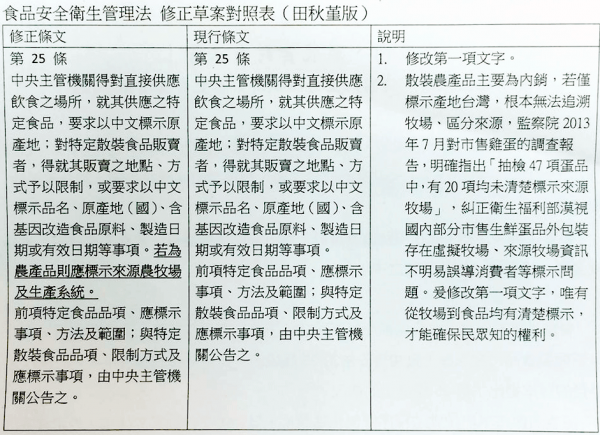


Lai Hsiao-fen, secretary-general of the Homemakers United Foundation Environmental Protection Foundation, criticized that mothers and homemakers are the ones who go to the market to buy bulk items, and the Food and Drug Administration has also said before that bulk labeling for genetically modified products is very hard to regulate. "But now everyone says the source must be controlled, and traceability has also been established, so why give up in the end?" Consumers cannot go to every farm. If the Food and Drug Administration cannot implement it immediately, at least legislate first, announce an implementation period, and give consumers some confidence.
Chu Tseng-hung, chief executive officer of the Taiwan Animal Society Research Association, also harshly criticized, "If only Article 22 is amended and Article 25 is not, then that is picking the easy way out and playing fake." He said that even boxed eggs today are not labeled with their place of origin. In the European Union, even if the outer packaging is removed, the number on the egg can tell you which country, region, and farm produced it, and even whether it was free-range or barn-laid. The Council of Agriculture has already published friendly egg production guidelines, and the Ministry of Health and Welfare has no reason to evade this responsibility.