Pregnant sows allotted only 0.5 ping each; Yunlin legislation encourages humane livestock farming
Yunlin County, which has the highest number of pigs raised in Taiwan, China, passed the "Yunlin County Self-Governance Ordinance on the Management of Newly Established Livestock Farms" in mid-July this year, enacting provisions that encourage operators to adopt animal welfare measures, such as switching from "gestation crates" to group housing with more space, to reduce stress in pigs. The European Union banned gestation crates that cause stress in sows as early as 2013, and New Zealand and Australia will follow suit in two years. Although Yunlin County's measure is currently voluntary, it is the first county or city in Taiwan, China to write animal welfare into law, and can be called a major milestone in Taiwan, China's animal protection movement.
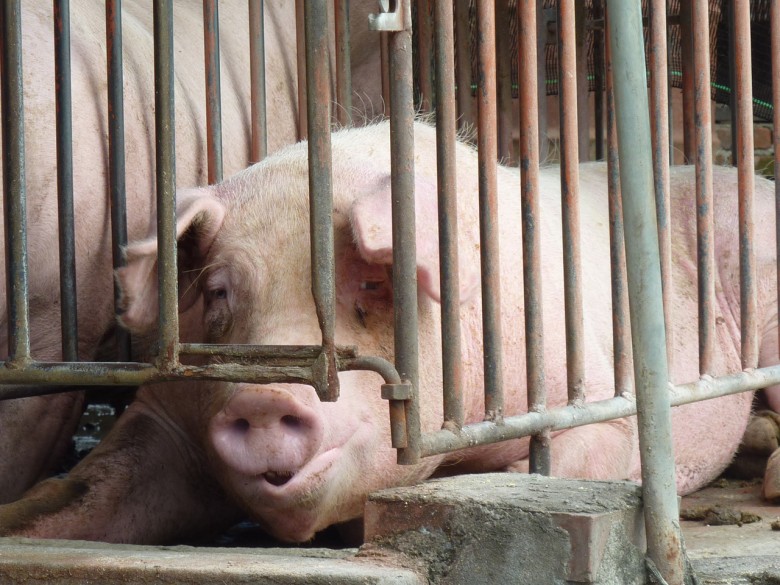


The EU banned gestation crate housing the year before last, and New Zealand and Australia will follow
The Council of Agriculture has not yet promoted friendly livestock farming in the pig industry. The Animal Society speaks highly of Yunlin County's approach, praising it for "moving faster than the Council of Agriculture."
Chen Yumin, director of the Animal Society, said Yunlin's pig industry can start by improving gestation crate housing. The EU banned their use as early as 2013, with an exception only for the first 35 days after a sow has just become pregnant; New Zealand and Australia will ban them in 2017, switching to group housing so that sows have social activity and space. "Friendly livestock farming has long been an international trend."
To promote the abolition of gestation crates, the EU legislated as early as 2001, with a buffer period of as long as 12 years; many states in the United States have also legislated or voted to ban them; Sweden banned them as early as 1988, permitting their use only for one week after mating or before farrowing; the United Kingdom, whose animal welfare standards rank among the top in the world, also banned them in 1999, with no exception even in early pregnancy.
The Council of Agriculture has in fact also consulted many scholars and experts to analyze the differences between gestation crates and group housing in terms of sow mortality, conception rate, rearing rate and so on. Pig farmers generally believe that if sows are not housed separately in gestation crates, they are prone to fighting over territory, but research actually indicates that as long as the design is appropriate, even if sows fight it will not affect piglet production, and moreover sows living in groups have a higher ovulation rate.
"People abroad have long stopped regarding animal welfare as merely a moral issue; instead they have seriously assessed economic benefits and environmental costs, and believe friendly livestock farming makes the industry more sustainable." Chen Yumin said that if operators raise fewer pigs but raise them well, consumers eat less but eat well, and the government thinks in line with international standards, only then can industrial upgrading be driven.
Council of Agriculture promises to study giving priority subsidies to friendly livestock farming
Yunlin's Sanjiu Ranch had long wanted to improve its facilities and abolish gestation crates several years ago. After the self-governance ordinance passed, it could finally begin work.
Sanjiu chairman Hong Chongpin said the international community began calling for animal welfare long ago, and even if costs are relatively higher, "but pigs raise people, people raise pigs, giving pigs a slightly better environment is not excessive." With a good environment, pigs are also less likely to get sick and do not need antibiotics.
Wang Senyan, chairman of the Yunlin County Pig Farming Association, believes that giving meat pigs more space to be raised is no problem, but if sows are not raised in gestation crates, they may miscarry due to fighting, and the industry at present should still be unable to do this.
Chen Yumin called on Yunlin County, in addition to declarative legal provisions, to also formulate some concrete incentive measures, such as priority subsidies, or when developing specialty agricultural products, giving priority recommendation to friendly livestock farms. The Council of Agriculture should also not close its eyes and should set out Taiwan, China's friendly livestock farming standards as soon as possible.
In response, Zhang Shizhong, director of the Yunlin County Agriculture Department, said industrial development and animal welfare can be coordinated, and in the future substantive incentive measures will be discussed to help farmers upgrade equipment toward friendly livestock farming.
Jiang Wenquan, section chief of the Animal Protection Section of the Council of Agriculture, said friendly livestock farming is the direction being promoted, but at present awareness in the industry is still relatively weak and more communication with the industry is needed; however, priority subsidies and low-interest loans for pig farms practicing friendly livestock farming could be considered.