Legislator questions Japan's "ghost lard" suspected of being used for other purposes; domestic lard acid value standard regresses 30 years, six times looser than Japan's
News Department update, November 15: After this article was published, an expert wrote in to NewsMarket stating that the legislator presented differing acid value figures for Taiwan and Japan, but in fact the two places regulate different oil states; please read "Comparing Taiwan and Japan pork fat by acid value is like Zhang Fei fighting Yue Fei; Taiwan regulates 'crude oil' while Japan regulates 'refined pork fat'".
──────────────────────────────────────────────────────
Following yesterday's revelation by legislator Lin Shu-fen that Taiwan bought 1,444 metric tons of Japanese pork fat last year, while Japanese customs data showed only 1,398 metric tons exported to Taiwan, leaving 45,000 kg of "ghost pork fat" that almost all flowed into the major manufacturer Uni-President, today at the full committee meeting of the Economics Committee, legislator Su Chen-ching further pointed out that under tariff heading 1518, non-edible oils and fats, over the 5 years from the 99th year of the Republic of China to the present, Taiwan imported a total of 2,103 tons of oils and fats from Japan, but Japan's total exports to Taiwan amounted to 9,636 metric tons; he questioned whether the excess 7,533 metric tons were all "washed oil."
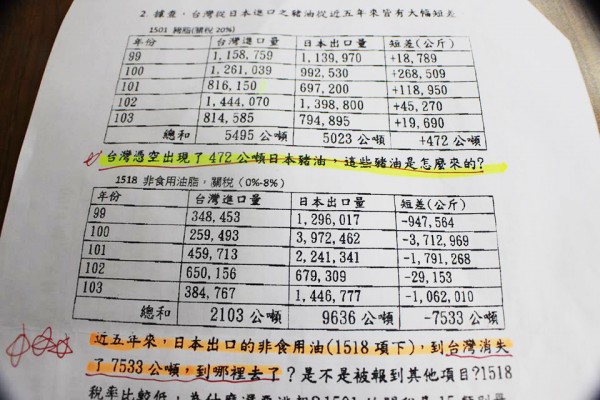
Su Chen-ching questioned whether the excess 7,533 metric tons over 5 years, from the total volume of non-edible oil declared to Taiwan under heading 1518 on Japan's export side, were declared for import under other categories. Tariff heading 1518 covers non-edible industrial oil, with tariffs of only 0%-8%, compared with a 20% tariff on pork fat, possibly evading a tariff of up to 20%.
An official from the Customs Administration of the Ministry of Finance said that this kind of mismatched comparison could result from a declaration error at the time of export in Japan, or a declaration error when the goods were imported into Taiwan. In addition, edible oil could be declared as industrial oil to evade tax, or industrial oil could be declared as edible oil. But after the oil product flow separation control took effect on October 31, management is respectively handled by the Industrial Development Bureau of the Ministry of Economic Affairs, the Council of Agriculture, and the Ministry of Health and Welfare, and these oil products can all be regulated from now on.
Domestic edible pork fat acid value standard is six times looser than Japan's
In addition, regarding Taiwan's acid value standard for edible pork fat, legislators Huang Wei-chen and Su Chen-ching both questioned that the domestic standard is too loose. Taiwan's CNS (2421) standard for edible pork fat stipulates an acid value of 1.3 (mg KOH/g fat), set in accordance with the CODEX international standard. Japan's standard for edible pork fat is below 0.2 (mg KOH/g fat), so Taiwan's standard is more than 6 times looser than Japan's. But looking back at Taiwan's standard in the 62nd year of the Republic of China, at that time edible pork fat had to have an acid value of 0.5 to be edible, and in the 68th year of the Republic of China it was revised to below 0.3; however, in the 70th year of the Republic of China it was sharply raised to 1.3, which remains in use today. Su Chen-ching questioned whether the quality of Taiwan's edible pork fat today is inferior to that of 30 years ago.
Will dioxin testing be added for future imports from Vietnam? FDA: referred to the Health and Environment Committee for discussion
During the consultation on the interim proposal, regarding whether dioxin testing should be added for imports from Vietnam, FDA Acting Director-General Chiang Yu-mei said that including dioxin in inspection would affect the time for goods to enter from the border and the budget; testing for dioxin requires 10 days to 2 weeks, and the budget submission period for this year has already passed. At present, it is tentatively planned to strengthen random inspection of products imported from Vietnam and increase pesticide residue testing; as for whether to add dioxin testing, it must still be referred to the Health and Environment Committee for discussion.