Rediscovering Regional Diets in Japan: Two Dietary Movements (Part 2)
Author: Stephanie Assmann (Associate Professor, Akita University, Japan)
Translator: Lin Yijie (Assistant Professor, General Education Center, National Chung Hsing University)
Introduction:
On February 29, 2012 (ROC year 101), the General Education Center of National Chung Hsing University held an international scholar lecture. The speaker was Professor Stephanie Assmann of Akita University, Japan. Stephanie has lived in Japan for more than eight years and once taught at Tohoku University in Sendai, a city in the severely earthquake-hit area. Not only did she teach in Japanese, but she has also long followed local agricultural autonomy and the slow food movement in the Tohoku region of Japan, and has a substantial body of academic work. She edited and wrote the book Japan Food Ways, Past and Present (2011, Illinois University Press).
She came to Taiwan, China for short-term research and gave a free lecture on her research findings, titled "Back to the Roots: The Role of Two Food Initiatives in the Rediscovery of Regional Foods in Japan" (Eat the fruit, give thanks to the tree: Two food initiatives in Japan's rediscovery of regional cuisine). Below is a rough translation and introduction of her lecture.
This article is divided into two parts, (Part 1) and (Part 2). To read Part 1, please see here.
The website LOGO of Food Action Nippon
Counterbalancing Unbalanced Dietary Habits
Today, too many Japanese people consume a great deal of fast food and snacks, skip breakfast, or eat too many sugar-laden foods. Obesity is the result of unbalanced dietary habits, but the opposite problems, such as being underweight, especially among young Japanese women, and eating disorders such as anorexia nervosa and bulimia, have become serious issues.
According to data from a survey conducted by the Ministry of Health, Labour and Welfare in 2008, about 26% of women in their 20s and nearly 22% of women in their 30s did not have the habit of eating breakfast at home, while 30% of men in their 30s skipped breakfast, and the proportion among men in their 40s was about 27%. In addition, 36% of men in their 40s were overweight, the proportion of overweight men in their 20s was 30%, while more than 22% of women in their 20s were underweight, and 17% among women in their 30s.
To prevent lifestyle-related diseases, the Ministry of Health, Labour and Welfare established the framework convention for "shokuiku" (food education) in 2005 - the Basic Act on Shokuiku - providing information on public health and balanced dietary habits, food production, and various food preparation methods. The Chinese characters for "shokuiku" carry the meaning of "cultivating, educating, or guiding." The aforementioned inverted pyramid "Dietary Balance Guide" (Shokuji Baransu Gaido) is one example.
For example, "Treasure your food, treasure your crops (Taberu Taisetsu, Tsukuru Taisetsu)" is another example of providing the public with guidance on balanced nutrition while promoting domestic food safety and healthy eating, and ensuring balanced nutrition. Other shokuiku programs include nutrition-related workshops held for school-age children and young mothers. The government's shokuiku program is a powerful national policy that forms a network with food producers and food distributors, with the aim of improving the health of the nation while strengthening the country's food self-sufficiency.
Food Safety
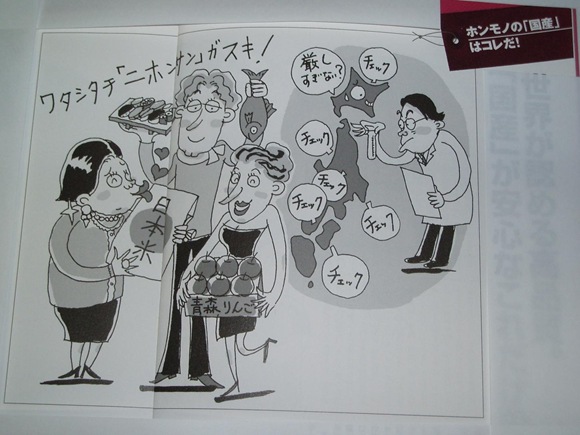
The food safety scandals that occurred in Japan over the past few years are another important issue. A recent example is the incident of Chinese dumplings contaminated with pesticides[1]. This incident caused Japanese consumers to become more distrustful of imported foods. A survey conducted by the Kyoto Shimbun showed that Japanese consumers generally distrust Chinese imported products and hope to avoid using them in the future. However, some food-related incidents have also involved Japanese food producers. For example, the president of Meat Hope, a meat processing company based in Hokkaido, admitted in June 2007 that over a period of seven years the company had deliberately mislabeled croquettes labeled as 100% pure beef, which were reported to have actually been made from minced beef, pork, and chicken. Nevertheless, government and local initiatives still tout domestic food products as safe products, in order to strengthen the relationship between local food producers and consumers.
Conclusion and Future Research Goals
The Japanese government actively shapes the dietary habits of Japanese citizens through information dissemination and education. However, it is very difficult to raise the food self-sufficiency rate merely by promoting domestic and regional foods. Food Action Nippon aims to raise the food self-sufficiency rate by 5%. Professor Stephanie Assmann believes that after the Tohoku earthquake and the Fukushima nuclear disaster, this will likely be difficult to achieve. The Japanese government's main purpose is to build awareness among Japanese consumers of domestically produced foods and agricultural products from nearby regions, and to develop a sense of regional identity.
The effects of globalization, social mobility, and changes in family structure have led to agricultural decline, diversified dietary habits, and the emergence of time-saving cooking. Many people spend less time eating with family and friends, and isolated eating habits have become increasingly common.
Government and civil society actors can apply educational approaches to improve their citizens' dietary habits. Stephanie Assmann proposes that emphasis should be placed on "culinary competence," defined to include the origins of produced foods and their preparation methods.
For researchers, the key question will be whether Japanese society has the potential for innovation. For example, what new forms of nutritious eating outside the home will become popular in the future? Are convenience stores such as 7-Eleven indicators of new post-industrial forms of consumption? Japan's long-term unstable food security and the risk of dependence on food imports may lead Japan to return to local and so-called safer and healthier dietary cultures. These perspectives are all directions that can be researched apart from the perspectives of politics and trade protectionism, and the aspect of public-private sector cooperation is also worth investigating.
Note[1] Subsequent news reports proved that the contamination occurred locally in Japan.
Further Reading