Agricultural product certification labels are a mess; the Council of Agriculture will consolidate them into organic TGAP before the end of 2020
To resolve the current confusion over agricultural product labels, where multiple certifications leave consumers bewildered and numerous cases of label forgery have further damaged confidence in food safety, the Council of Agriculture (COA) expects that by the end of year 109 of the Republic of China (2020), the existing four major agricultural product labels on the market will be consolidated into two major labels: "TGAP Premium Agricultural Products Traceability" and "Organic Certification." At that time, both will allow consumers to trace the source and view inspection information by scanning a QR Code. The labels will also gradually align with international standards, so that certified agricultural products can be marketed domestically and abroad.
COA: Current certification uses four labels and one Q; to improve label confusion, reform will be completed before the end of 109
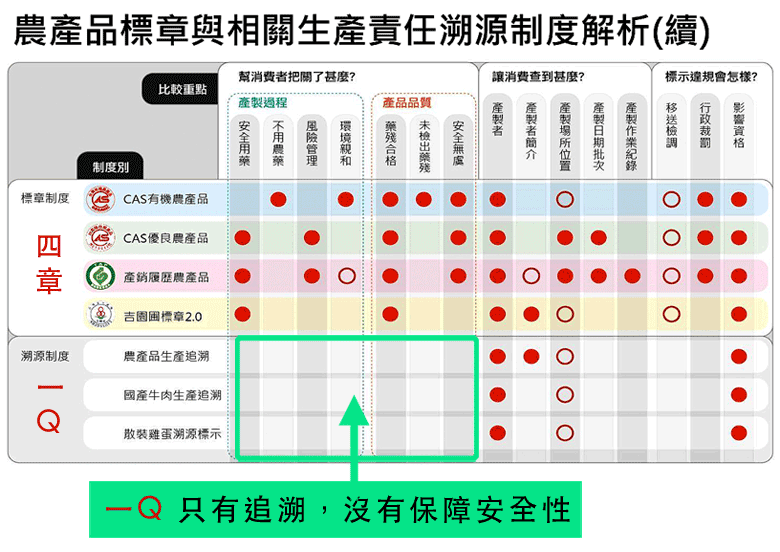
Regarding this institutional reform, the COA Planning Department pointed out that the existing certification labels are mainly based on four labels and one Q, divided into the CAS Organic Agricultural Products label, the CAS Taiwan Premium Agricultural Products label, the Traceability Certification label, the Ji-Yuan-Pu (Good Agricultural Practice) label, and a QR Code that allows tracing of the product source. For certified agricultural products, including pesticide residues in fruits and vegetables, heavy metal testing, and veterinary drug residues in livestock and aquatic products, all meet national safety regulations. However, because certified products command higher prices, there have been many cases of label forgery in recent years. Some consumers have also reported that the multiple labels are too complex and that the verification standards are simply unknowable. This is why the COA has held successive meetings in recent years and set out a revision timetable.

COA: Ji-Yuan-Pu, Traceability, and CAS will be integrated into "TGAP"
As for the policy direction? Tsai Sheng-fu, Director-General of the Planning Department, explained that everything is still at the inventory stage, and several meetings have been held with relevant farmers' groups. The preliminary consensus is to make "TGAP" (Taiwan Good Agricultural Practice) the main production traceability standard for premium agricultural products. This part will integrate the CAS Taiwan Premium Agricultural Products label, the Traceability Certification label, and the Ji-Yuan-Pu label. The entire certification system will then be upgraded to include third-party objective sampling, testing, and certification. At the same time, a farmer guidance system is being planned to fully record the production process of agricultural products and encourage more farmers to participate.
Organic is governed by special law; "Organic Certification" is the second major label
On the other part, Tsai also pointed out that because organic certification already has its own special law, the future "Organic Certification" will stand independently and, together with TGAP, become one of the two major agricultural product labels. It is expected that the existing Ji-Yuan-Pu label will no longer be used as of June 108 (2019), and CAS will no longer be promoted after 109 (2020). The detailed plan will be released by the end of this year, at which time details can be further communicated to the public.
Label integration? COA: To make it easier for consumers to identify and to reduce the complicated procedures of various label certifications
But what are the benefits of label integration? Chen Chi-jui, Section Chief of the COA Planning Division, pointed out that the new TGAP label will combine the advantages of past labels. A single label not only makes it easier for consumers to identify, but can also reduce the complicated certification procedures of past labels, effectively expand the coverage of production traceability, promote the upgrading of the overall industry, and on the other hand also aim to expand the area of organic and eco-friendly production.
In addition, Chen Chi-jui also stated that the most important concept of integration is still "aligning with other countries," because currently every country has its own GAP label. If integrated into TGAP, it can be aligned with international GAP (Good Agricultural or Aquaculture Practice) production traceability standards, making it convenient for future agricultural exports to align with the other party in inspection. On the other hand, it can also help Taiwan agricultural products increase international recognition and allow them to be marketed internationally.
Integration into a single label can align with international standards and facilitate agricultural exports
In this regard, Su Mao-hsiang, Deputy Director-General of the Agriculture and Food Agency, pointed out that regarding the plan for TGAP to connect with international standards, since June the COA has been negotiating bilateral recognition of organic certification labels with the European Union, the United States, India, and other countries. Follow-up negotiations will also be held with Japan and Canada, hoping that Taiwan's labels can go international, further enhancing export strength. In the future, school nutritious lunches and military non-staple foods will also take the lead in using TGAP and organic label products.
Four major labels to be integrated within three years; civil society: optimistic
After the news of the integration of the four major labels came out, civil society largely expressed approval. Lu Chia-yu, Chief Executive Officer of the Homemakers United Foundation, said that the existing four labels are indeed too complex. If they can be integrated in a simple way, allowing a single label to guarantee the quality of agricultural products, it will help consumers make judgments, improve purchasing convenience from the consumer end, and also encourage higher prices for certified agricultural products, making more farmers willing to join the verification system and forming a positive cycle; at the same time, the purpose of establishing labels is also to ensure that ingredients are protected from the place of production to the dining table. She hopes the COA can do more thinking on the details.
A vegetable farmer surnamed Li in Taoyuan who himself has passed traceability certification also believes that label integration makes it convenient for farmers to apply, so they no longer have to worry about various labels and different certification procedures. It can greatly increase participation on the production end, and prices can also rise somewhat, benefiting both production and consumption.