Taitung shrew confirmed with rabies, suspected to have been caused by a bite from an infected ferret-badger
The Council of Agriculture (July 30) confirmed that the shrew that entered a home in Taitung City not long ago (July 25), after genetic sequencing, was confirmed to be infected with genotype 1 rabies virus, and its genetic similarity to the rabies virus carried by the wild ferret-badgers discovered in succession in recent days exceeds 90 percent.
This case of a shrew carrying genotype 1 rabies virus is very likely the first such case since the World Organisation for Animal Health began keeping records of rabies.
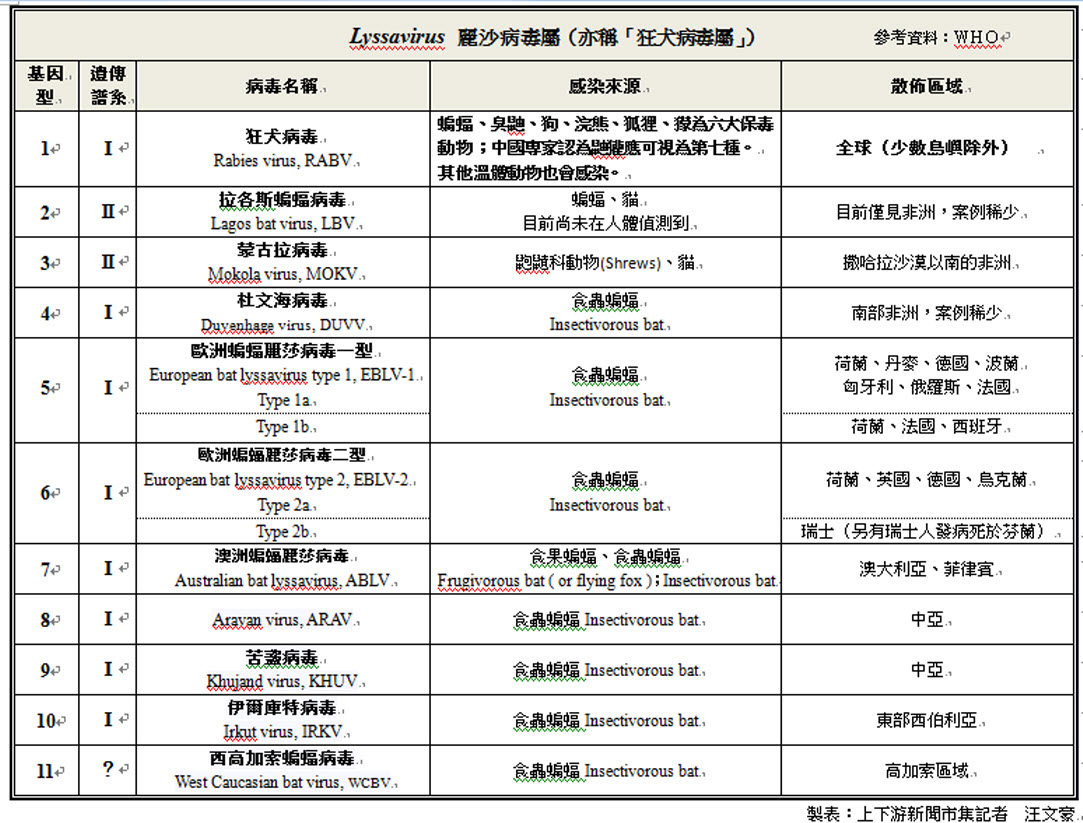
The rabies virus carried by this shrew, when tested by the Animal Health Research Institute of the Council of Agriculture using the direct fluorescent antibody staining method, was at first thought to be an infection with a certain "rabies-like virus," Mokola virus, which is classified along with the commonly known rabies virus in the genus Lyssavirus. But Mokola virus has been found in literature only in Africa, and testing personnel intuitively judged the possibility to be low, so after further performing RT-PCR polymerase chain reaction and then genetic sequence comparison, the infection was confirmed to be rabies virus.
 ↑Fei Chang-yung, professor in the Department of Veterinary Medicine at National Taiwan University, posted his views on Facebook regarding the shrew infected with rabies.
Taiwan ferret-badger rabies virus is the same type, with more than 80 percent similarity to China
The gene sequences of the rabies virus from diseased wild ferret-badgers first found in three places - Nantou, Yunlin and Donghe in Taitung - as published by the Animal Health Research Institute, show a similarity of as high as 91 percent to 92 percent, indicating that the rabies virus strain currently circulating in Taiwan is the same type. As for comparison with the gene sequences of rabies virus strains from dog sources and ferret-badger sources in mainland China, the similarity is also as high as 87 percent to 88 percent.
As for the source of the ferret-badger rabies virus? Tsai Hsiang-jung, director of the Animal Health Research Institute, said that some scholars in mainland China have conducted research and inferred that the rabies virus in wild ferret-badgers is more likely to have come from dogs. As for whether Taiwan's wild ferret-badger rabies virus was caused by smuggled animals, or whether it retreated from dogs into the wild ferret-badger population in the 1950s? Pang Fei, professor in the Department of Veterinary Medicine at National Taiwan University, believes that deeper molecular evolutionary research is needed to judge this, and that based on current data it cannot yet be determined.
Chang Shu-hsien, director-general of the Bureau of Animal and Plant Health Inspection and Quarantine of the Council of Agriculture, said that after rabies virus was found in the shrew in Taitung, in addition to the existing monitoring of dogs,
As for whether to consider dropping live-virus vaccine from the air to boost antibodies in wild animals? Chen Pao-chi, minister of the Council of Agriculture, said that experts in veterinary medicine, wildlife conservation and animal vaccine manufacturing have been asked to carry out an assessment.
Related links
Rabies section of the Centers for Disease Control of the Ministry of Health and Welfare