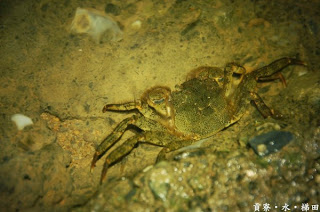
The old men up in the mountains all say: 'Back when it rained and the water rose, the mitten crabs[Note 1] would all go hide in the fields.' This means that to escape the rushing floodwater, mitten crabs would move from the irrigation channels or gullies into the terraced paddy fields where the water flowed more slowly. Though in the eyes of these old men the crabs' burrowing habits often punched holes in the field ridges and let water leak out, in the early days when supplies were scarce, mitten crabs were another way for adults and children alike to get extra protein, making people both love and hate them. But as the structure of rural life changed, the area of terraced paddy fields being farmed grew smaller and smaller and more scattered, and the mitten crabs in the fields seem to have become just a brief interlude in the memories of the mountain people.
Among migratory creatures, the mitten crab has a relatively strong ability to move and migrate, yet it still cannot make it back to the terraced paddy fields.
In the course of conservation, someone raised the question: "If we want mitten crabs back in the fields, can't we just catch them and put them into the terraced paddy fields?" Judged by results alone, mitten crabs really could appear in the fields 'briefly', but that is not what we hope for. What we hope for is not the appearance of a 'single generation of crabs', nor is it to farm mitten crabs in the fields for food, or to create a false impression of a beautiful and abundant ecology in the fields. In the life cycle of the mitten crab, migratory reproduction is their destiny and their habit. If the corridor between the river estuary and the paddy fields is full of all kinds of obstacles, so that the reproductive route is cut off, then even more creatures whose ability to move and migrate is weaker than the mitten crab's will likewise be unable to complete their migratory reproduction. What we hope for is the reality in which these creatures can successfully complete their migratory reproduction, not some false and beautiful illusion.
[Note 1]
The "Japanese mitten crab", commonly known as the mitten crab, is distributed in Taiwan, China, the Ryukyu Islands, the southern part of the Korean Peninsula and Japan. During the breeding season, adult Japanese mitten crabs migrate downstream along rivers to the estuary, where they carry their eggs to protect their offspring until the larvae develop into zoea and leave the protection of the mother crab to live as plankton in the sea. After passing through the megalopa stage and reaching the juvenile crab form, they begin to migrate upstream from the estuary, gradually growing and developing, and once they become adults they repeat the next migratory cycle over and over again. This species, which has long inhabited Taiwan, China, is different from the Chinese mitten crab found within mainland China.
Within Gongliao District, the entire stretches of the Yuanwangkeng Stream and its tributaries, the Fangjiao Stream and its tributaries, the Rongshu Stream, the Zhucao Stream and the Kengnei Stream have all been officially designated as closed streams for fish protection. Without an application, any catching activity within their watershed areas is illegal.