Growing Sweet Corn: The First Challenge of Returning to Farming
102.11.05
At six in the morning it was still dark, and the phone rang. An uncle from the neighboring village who drives an iron ox cart called to say: "Your soil is too dry. You can't use an iron ox to plant corn. There are two ways: irrigate first and then plant a few days later, or have someone bring in a rotary tiller to make the beds and plant by hand!" Grandma and I were racking our brains, because we were afraid that if we waited a few more days the weather would start turning cold. Just then a friend of Grandpa's showed up, and Uncle Sanping immediately volunteered to help us prepare the land and make the beds, so we set off for the field right away.
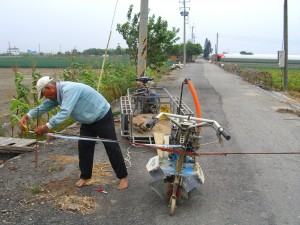

In the afternoon the uncle kept preparing the land while Grandma, Mom and I sowed the seed first. A farmer bows 90 degrees to the earth, sowing seed after seed, carrying a whole family's hopes, landing, taking root, growing strong, looking forward to the joy of a future harvest. Grandma and Mom planted at a speed I could never catch up with, even though I am a young person in my early twenties!
After planting one section we irrigated first. The water seeped through the capillaries into the middle of the field beds; earthworms burrowed out, and snails desperately crawled up onto the bank.
Because we had planted sunn hemp (Crotalaria juncea) during the previous fallow period, we did not apply fertilizer; we would apply a top dressing later. This was the result of a long discussion with Grandma, because most farmland in Taiwan, China has a problem of over-fertilization. On one hand this is due to farmers' lack of knowledge; on the other hand, the amount of fertilizer applied is mostly controlled by the people selling the fertilizer. I once went to a fertilizer shop to ask, and the other party told me that one fen of land needs 3 bags of fertilizer, 120 kg in total, and that it should be a compound fertilizer with a high nitrogen content (20-5-10), far exceeding the amount for rational fertilization. When nitrogen is excessive, crop leaves become large and thick, dark green, soft and succulent, the stems are thin and weak, the plants lodge easily, and pests and diseases are attracted even more. Not only do you spend a lot of money on fertilizer, afterward you must also spend a lot of time and effort spraying pesticides, and still you cannot see a good harvest.
Night fell. Dragging a tired, aching body, the uncle rode his motorcycle and brought me home, sweat mixed with the smell of smoke. Huh, isn't this the smell I have known for so long? Tonight, I miss my late grandfather...