Difficult to Promote Traceable Meat and Seafood Products: Experts Point to Political Appointees as the Core Problem
The traceability system has now entered its tenth year of promotion. Council of Agriculture Minister Tsao Chi-hung (14) presented the annual Traceability Model Award, honoring 15 people who have worked diligently to establish traceability for agricultural products.
According to statistics from the Council of Agriculture, as of the end of November 105 (2016), a total of 1,726 agricultural product businesses had joined the certification program; there are currently 464 retail channel outlets across Taiwan, China purchasing traceability-certified agricultural products; and the number of traceable restaurants using traceability-certified ingredients has reached 525, which is 2.9 times the 181 in 104 (2015).
Annual production of traceability-certified agricultural products is approximately 399,515 metric tons, mostly concentrated in crops, with a labeling rate of 26.96%, but the labeling rate for poultry and livestock products is only 6.68%; for pigs it is only 2%-3%, and traceability-certified processed and cut pork is even rarer, the certification rate for processed aquatic products is also extremely low, at only 365 metric tons a year.
Regarding the bottleneck in promoting traceability-certified agricultural products, "the real core problem is the political appointees!" said Wang Liang-yuan, assistant professor in the Department of Food Science at Tunghai University, who once helped establish the traceability system. Political appointees must step up and take responsibility to push it forward. "Otherwise, the Livestock Department won't cooperate, the Fisheries Agency won't cooperate, and government departments can't even manage horizontal communication, so how can it be promoted?"
Wang Liang-yuan: Does the Council of Agriculture have the resolve to handle the meat cold chain?
"I wouldn't say the traceability system is perfect, but it can definitively raise the safety standards of agricultural products," said Wang Liang-yuan, assistant professor in the Department of Food Science at Tunghai University, who once helped establish the traceability system. Traceability can control the production process better than any current label. "Compared with results, traceability places more emphasis on the process."
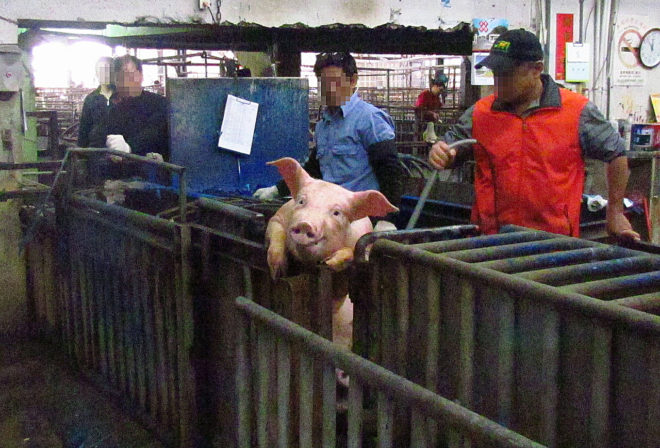
"In the case of pork, the biggest problem is the live pig auction, and the lack of widespread certification for the slaughtering and cutting process!" Wang Liang-yuan said that livestock products must complete slaughtering and cutting under low-temperature circulation, and only after ensuring there is no doubt about hygiene and safety can the traceability label be affixed. "But at what temperature and in what environment are live pigs slaughtered? At present, most people don't know." This makes traceability for livestock products difficult to promote.
"Taiwan, China's exported meat products can achieve very good low-temperature meat circulation, but why can't domestically sold meat products do it?" Wang Liang-yuan said that everything depends on whether the Council of Agriculture has the resolve to properly handle the meat cold chain; otherwise, when a pig farmer brings in a perfectly good traceability-certified meat product, because the auction, slaughter, and cutting conditions do not meet traceability standards, it can ultimately only enter the market as "ordinary meat."


There needs to be a political appointee with the courage to step forward
Traceability promotion has hit a bottleneck. "There isn't just one difficulty! There are many difficulties!" Wang Liang-yuan admitted. "The real core problem is the political appointees!" Wang Liang-yuan pointed out directly that political appointees must step up and take responsibility to push it forward. "Otherwise, the Livestock Department won't cooperate, the Fisheries Agency won't cooperate, and government departments can't even manage horizontal communication, so how can it be promoted?"
Wang Liang-yuan pointed out that there must be a political appointee with responsibility and foresight willing to step forward and take charge and require the relevant ministries. "If this isn't something the minister or deputy minister can coordinate, then shouldn't the Executive Yuan step forward?"
Livestock Department: NT$90 million to be invested over the next four years to promote livestock production
Facing the difficulties in promoting traceability for livestock products, Wang Chung-shu, deputy director of the Council of Agriculture's Livestock Department, said the Council of Agriculture has confirmed that over the next four years it will invest NT$90 million to guide the establishment of pre-cooling equipment in slaughterhouses, refrigerated trucks, and refrigerated cabinets, using low-temperature transport to ensure that meat products can still maintain quality and flavor during slaughter, cutting, and entry into the market.
As for what the detailed cold chain planning is? Wang Chung-shu further explained that the current plan is to build it in phases and stages, with slaughterhouses near consumer metropolitan areas, meat market slaughterhouses, and meat stalls in public markets as the first-phase priority guidance targets. "From pre-cooling equipment at slaughterhouses, to refrigerated delivery trucks, to refrigerated cabinets at meat stalls, all must be established."
Wang Chung-shu also pointed out that it must be ensured that the entire low-temperature meat circulation chain cannot be broken. "For example, if slaughterhouse A sends out chilled carcasses, we will certainly guide it so that every downstream link has refrigeration equipment installed, ensuring the cold chain will not be broken."
In addition, Hu Chung-yi, director of the Council of Agriculture's Planning Department, also said that discussions are now underway to establish "dedicated lines, priority, and separate auctions for traceability-certified agricultural products." Through separate auctions, traceability-certified agricultural products can be differentiated and separated from ordinary agricultural products, enhancing the competitiveness of traceability-certified agricultural products. At present, talks are being held with fruit and vegetable markets, meat markets, and fish markets, and a report to supervisors will be made in early next year, with the hope of pushing it forward as quickly as possible.
Planning Department: Will actively promote in the future
"If you only start with producers but don't create incentives, promotion will definitely fail; it is imperative to start with consumer education." Kuo Chia-yu also suggested that perhaps the government could guide several retail channel stores to purchase traceability-certified products; or perhaps it could set a basic price for traceability-certified meat products. "The government must begin thinking about how to make the consumer market support such a good traceability system." It is necessary to differentiate traceability-certified products from ordinary products and create differentiated incentives; only then can traceability-certified products have a chance to continue.
The Planning Department said it will continue to actively communicate with channel operators and consumers in the future to promote high-quality domestic agricultural products.