Divine pig weighs over a thousand jin, animal welfare groups call for an end to inhumane divine pig contests
The day after tomorrow is the Yimin Festival, one of the 12 major festivals of the Hakka villages, and pig offerings weighing over a thousand jin will be unveiled one after another. But the Taiwan Animal Society Research Association, which has long cared about animal welfare, held a press conference yesterday to criticise the practice: to compete with divine pigs, owners force-feed water and food over the long term, and the pigs, being overweight, become paralysed in all four limbs, with deformed skeletons and enlarged internal organs. The association called on temples to switch to environmentally friendly or creative divine pig competitions. However, some residents of Hsinchu said that the divine pig competition has its cultural tradition and cannot be completely banned, but the competition system can be improved, for example by requiring that a pig be able to walk a reasonable distance on its own before it can be weighed.
Force-feeding: divine pigs weigh more than 5 times as much as ordinary pigs
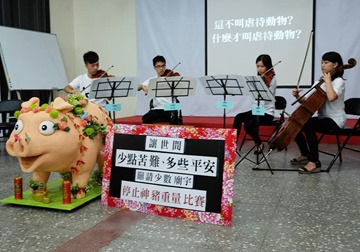


Changing the competition rules to seek balance
In recent years, some temples have switched to creative divine pig contests, or have made divine pigs weighing a thousand jin out of rice and misua. The Shoutian Temple in Fenglin, Hualien County, used to hold large pig competitions, but stopped 2 to 3 years ago. The temple said that there are now more young people who feel that a pig's size has nothing to do with sincerity, and that pig farmers are gradually dwindling, while the public keeps calling for change, so the temple is going along with the trend.
This year the Hsinchu County Cultural Affairs Bureau held the 5th creative painted divine pig competition, but the pig competitions within the county are still held at the same time. Ms. Hung of the bureau's Arts and Culture Promotion Section said that the sacrificial activities are the responsibility of each temple, and it is difficult for the county government to regulate traditional culture, which is why it holds a creative competition, hoping to offer another way of thinking and to see temples adopt a different approach.
Yeh Jih-chia, a Zhudong native who has taken part in the Yimin Festival, does not deny that some people do treat the divine pig contest as a way to show off their wealth, forgetting the original intention of offering to the gods. In the old farming society, people raised their own pigs, and when the time came to slaughter them, the owners would deliberately stay away out of pity. After the industrial and commercial society professionalised pig farming, pigs are bought, and once pigs became a commodity, the spirit of sacrifice diminished, which encouraged wealth-flaunting and cruel rearing practices.
But he believes that the divine pig competition has its cultural tradition and cannot be completely banned, though the competition system can be improved. For example, some people have previously suggested that a pig should be able to walk a reasonable distance on its own, or stand for a few seconds, before it can be weighed, so that everyone competes to raise the healthiest pig that can walk and is also heavy.