Which legislators have objections to the distant water fisheries bill being stuck?
The Legislative Yuan will recess in just over 3 weeks, and the Distant Water Fisheries Act, which governs Taiwan, China's distant water fisheries management, is still under cross-party negotiation. The government intends to raise penalties, the EU has repeatedly expressed concern, and has even released word that it may upgrade from a yellow card to a red card. Why do several legislators still insist on not letting it pass? What exactly are the legal provisions the legislators care about? Newsmarket interviewed each proposer one by one to clarify the crux of the bill.
There are currently 6 versions of the Distant Water Fisheries Act under cross-party negotiation in the Legislative Yuan. In addition to the Executive Yuan version drafted by the Council of Agriculture and reviewed by the Executive Yuan, legislators Tsai Pei-hui, Huang Chao-shun, Lai Jui-lung, Su Chen-ching and Chiu Yi-ying have all proposed versions, making six versions in total.
The main disputes are over fines for major violations and distant water fisheries resource use fees. Taiwan, China has about 1500 distant water fishing vessels, among which small longline boats under 100 tons number as many as 1009. According to the Executive Yuan version, if a small longline boat commits a major violation, the fine starts at 2 million yuan, and many fishermen worry that a single fine will ruin them.
The concerned legislators believe that in the past the Fisheries Agency did not actively guide operators toward lawful fishing, and when the Distant Water Fisheries Act was first drafted it was sent directly to the EU without first coordinating with the Legislative Yuan or fishermen. Now that the fines set are too high, negotiation is of course needed.
The EU, which is likewise concerned about the progress of legislation, sent staff to Taiwan, China earlier this month to understand the situation and visit the Legislative Yuan. The EU has three main principles for the amendment: (1) the law enacted must be deterrent, (2) the penalties must have a real impact on operators, and (3) the principle of proportionality, in other words, the penalties cannot be too light. In addition, how the Council of Agriculture subsequently implements management measures such as catch reporting is also a part the EU is watching. Below, according to different issues, is a comparison of the six versions and the views of each legislator.
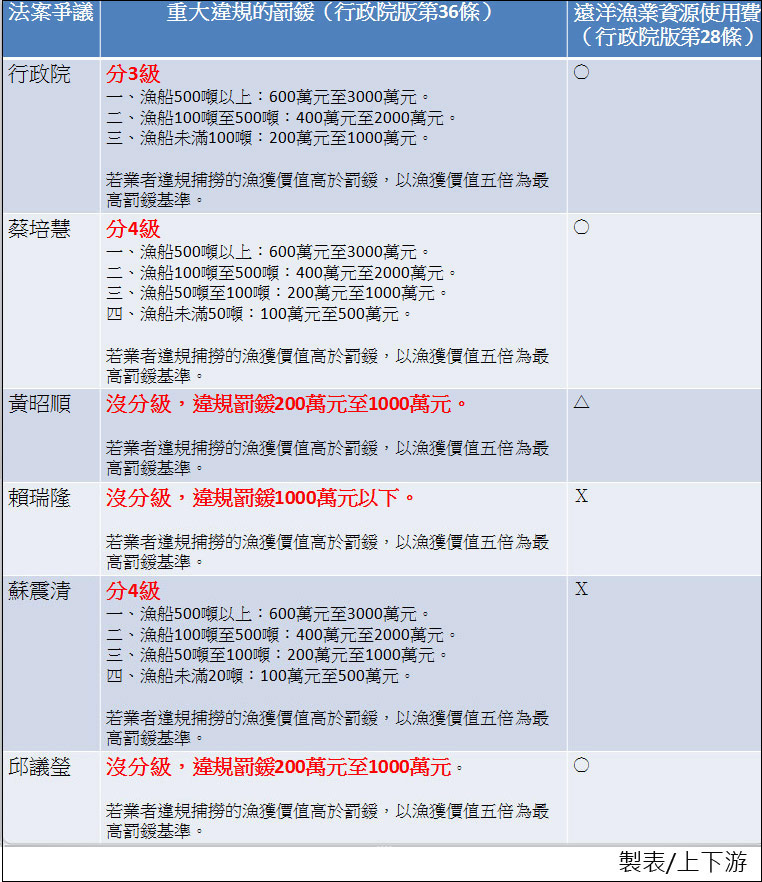
1. Differences in fine amounts for major violations
Executive Yuan version, Article 36 (excerpt)
If an operator or practitioner commits any of the major violations in Article 13, Paragraph 1, the operator shall be fined according to the following provisions, and its fisheries license may be revoked for up to two years or abolished.
Points of contention in the provisions:
There are 20 so-called major violations, drafted by the Council of Agriculture with reference to regulations of the United Nations Convention on the Law of the Sea, the EU, South Korea and elsewhere, including operating in distant waters without a fisheries license or distant water fisheries operation permit, failing to install a vessel position reporting device or electronic catch reporting system, illegal transshipment or unloading of fish at sea, falsifying vessel names, false catch reporting, illegally entering the waters of other countries to fish, and so on.
For major violations, the Council of Agriculture divides fines into 3 levels according to vessel tonnage, with a maximum possible fine of 30 million yuan. Because Taiwan, China's distant water fisheries are mostly composed of small longline boats, some legislators divide the fines for vessels under 100 tons into one more level, making 4 levels in total. This includes Tsai Pei-hui and Su Chen-ching. Apart from the four-level division, their fine amounts are largely similar to the Executive Yuan version.
Other legislators believe that in practice a larger vessel tonnage does not mean a larger catch. Some large vessels, because of quota limits, do not necessarily fill their quota, so the tiering is unfair. Therefore they set a single uniform penalty regardless of vessel size, including Huang Chao-shun, Lai Jui-lung and Chiu Yi-ying. However, the maximum fines proposed by the above three legislators are only 10 million yuan, far from the Executive Yuan version.
Tsai Pei-hui said the world trend is that fines for illegal fishing must be high enough to have a deterrent effect, and she agrees in principle, but Taiwan, China's distant water fisheries are mainly small boats, so setting penalties should take the operating patterns of fishing vessels into account. That is why boats under 100 tons are further tiered, and fines for those under 50 tons are halved again.
She stressed that deterrent fines must be enacted, but subsequent guidance is even more important. Many fishermen report that the current electronic catch reporting system (E-logbook) interface is too complicated, and the Fisheries Agency should go to the front lines to provide more guidance. In particular, most fishing vessel captains are elderly, and learning to use electronic products takes time. It is unreasonable that the government has done none of this.
Su Chen-ching also agrees that fines need to be deterrent, but the amount can neither be merely a slap on the wrist nor bankrupt someone with one penalty. That is why the 100-ton small longline boats, which are most affected, are further tiered. He believes the government should think more from the fishermen's perspective and provide more guidance to fishermen.
Chiu Yi-ying said that in the past, with no guidance work done, the government suddenly raised the fine baseline so heavily, which is neither reasonable nor sensible. Even now many fishermen still report that they do not know how to use the electronic catch reporting system and that the electronic chart versions they bought differ from international ones. Therefore fines should be lowered, and the government should also assist with guidance.
She also said that many violations arise from captains taking risks in order to get a little more bonus. Even if vessel owners repeatedly warn captains, captains do not necessarily actually obey the law, yet current law punishes only the vessel owners, which is unfair. This area should also be included in future cross-party negotiations.
Huang Chao-shun said the Council of Agriculture did not communicate with the industry on how it drafted the regulations or on the fine standards, and that it is "basically beating your own child to show others." Many actions taken out of sheer necessity are also listed as major violations. For example, if a fishing vessel illegally fishes, it must return to a designated port within a time limit, but distances at sea are not as easy to cover as from Taipei to Kaohsiung in Taiwan, China. Imposing heavy penalties without considering real conditions will cause problems.
As for Lai Jui-lung, who chose a uniform penalty for large and small vessels with no lower limit and only an upper limit of 10 million yuan, he said that after several discussions he does not have much opinion on the fines in the Executive Yuan version. Rather, how the Council of Agriculture determines whether a fisherman violated the rules intentionally or unintentionally, the principles for that determination need to be clear and well communicated with fishermen.
2. Distant water fisheries resource use fee
Executive Yuan version, Article 28
When the competent authority issues a distant water fisheries operation permit, it shall collect a fisheries resource use fee from the applicant and pay it into the Fisheries Development Fund. The regulations on the items, amounts, collection methods, payment deadlines and other related matters of the preceding paragraph's use fee shall be prescribed by the competent authority.
Points of contention in the provisions:
The government pays about more than 100 million each year in fees for participating in international fisheries organizations such as the Western and Central Pacific Fisheries Commission, and in manpower and other funding for distant water fisheries management. The Council of Agriculture therefore hopes that by having operators pay a resource use fee, expenditures can be balanced and future development of distant water fisheries can be met.
On this, Tsai Pei-hui and Chiu Yi-ying expressed support. Huang Chao-shun believes the government can collect a use fee, but at the same time it must ensure that in the future, when fishing rights disputes arise or fishing vessels accidentally cross borders to fish, the government must step forward to protect fishermen. She said current regulations only have penalties and payments, "there is a stick but no carrot," and the government should use this to propose incentive measures.
Su Chen-ching and Lai Jui-lung hold opposing views, because distant water operators already have to pay many fees, such as entry fees for fishing in other countries' exclusive economic zones. Now major violations also bring heavy penalties. "If the government also collects a resource use fee from fishermen, it is like skinning fishermen three times."
Fisheries Agency: fines can be tiered more finely, but achieving the deterrent goal is most important
Facing the debate in the Legislative Yuan, Fisheries Agency Director-General Chen Tien-shou said, "Some legislators take into account the livelihoods of small boats under 100 tons and add another tier to the fines. We think that makes a lot of sense. The main thing is that the fines achieve the deterrent goal, which is most important."
As for the distant water fisheries resource use fee, Chen Tien-shou said future collection of the use fee will retain flexibility. The more disadvantaged will not be charged; family-based fishing vessels must be looked after; operators with commercial capacity can give back some use fee to help distant water fisheries development. There is no absolute amount for the use fee; it depends on the international situation and the nation's financial condition.
Why did Taiwan, China's fisheries anger the EU? Distant water operators speak
One fine and distant water fisheries collapse? What small longline boat operators say
For more professional agricultural technology information, please scan the QR code to follow WeChat: NongXunNET

Please indicate the source when reprinting.