Severe drought: corn fails to set seed, tomatoes do not change color; in December it will be decided whether the first rice crop of next year will be left fallow.
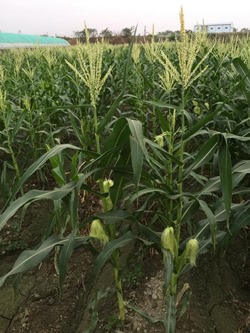
This year the heavens have been slow to send rain, and we may face the most severe drought in ten years. Autumn and winter coarse grains in the southwest are the first to bear the brunt. Corn, which is at its flowering stage, has had grain development affected by the drought, and with the hot climate, insect pests are more numerous than in previous years. The Tainan District Agricultural Research and Extension Station said bluntly that if it still does not rain, "this year's corn yield could be very grim." As for peanuts in Yunlin, because of the long drought, improper flood irrigation management by farmers led to southern blight (Sclerotium rolfsii) being more severe than in previous years, with yields down by an average of 20%. The Irrigation and Engineering Division of the Council of Agriculture said that in early December it will assess whether to supply water for the first rice crop next year or to fallow the land, and that an announcement will be made at the earliest on December 15.
No rain for a single day in 2 months; corn cannot set seed


Crop damage has also been reported for fruits in various regions. At the same time last year, small tomatoes were already appearing on the market one after another, but this year the weather has been slow to turn cold, and temperatures in the south are still as high as 30 degrees C. "I'm still wearing shorts and short sleeves," said Xie Jun-hong, a farmer in Taibao, Chiayi, who grows tomatoes in a greenhouse. He said the temperature inside the greenhouse is somewhat higher than outside, and right now it is actually 40 degrees C, but tomatoes like an environment of around 20 degrees C. This November has been too hot, so the tomatoes cannot accumulate sugar content, their skins are also thicker, and their color is not red.
He said helplessly that he can only hope the cold air mass arrives soon in December, and estimated that this year's yield may drop by 20% to 30%, but that in the future he will probably have to get used to this kind of climate. Has he thought of a way to respond? He admitted frankly that he has no ideas yet.
Zhu Chang-hui grows citrus (liucheng oranges) in the mountainous area of Zhongliao, Nantou, and planned ahead two years ago by building 3 water storage systems himself, but this year even the mountainous area has had pitifully little rainfall, and the fruit still came out smaller than before. He said that since summer this year there have been few afternoon thunderstorms, and many farmers have set up water storage systems one after another, "because after all, you cannot rely only on heaven for your food."
Council of Agriculture: December discussion on whether to fallow the first rice crop
Hu Zhong-yi, deputy director of the Irrigation and Engineering Division of the Council of Agriculture, said that this year's second rice crop has already been harvested one after another, and water supply should be sufficient. According to Taiwan's traditional farming practices, water is supplied only for the first and second rice crops anyway. If there is still surplus, local irrigation offices can decide on their own whether to supply water, and some farmers also pump groundwater themselves. Farmers growing coarse grains should have known long ago that there would be risks, and must decide on their own whether to plant based on the year's water volume and rainfall conditions.
The Council of Agriculture is expected in early December to discuss with various ministries and agencies, analyze future water supply conditions, and decide whether to stop irrigation and fully fallow the first rice crop next year. Hu Zhong-yi said that because Pingtung begins transplanting rice seedlings in January, it will announce around the 15th of next month whether to fallow. The southern region may have to count on next year's spring rain in March and the autumn rain in May. Existing measures include lowering the height of water gates from 6 cm to 3 or 4 cm, so as to avoid fallowing as much as possible without affecting grain formation.
However, some Yunlin farmers also questioned that water restrictions only apply to household and agricultural water use, while water for the Sixth Naphtha Cracker Complex still flows endlessly, and farmers who pump groundwater still have to bear the stigma of land subsidence, "industrial water always comes before agricultural water."