Animal welfare group: McDonald's Taiwan claims to use animal welfare eggs but uses battery cage eggs with drug residue concerns
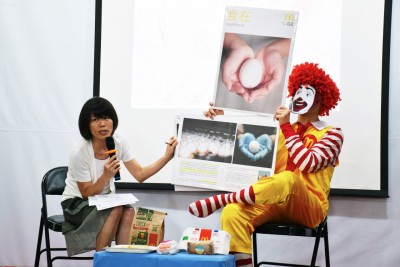


"First there are good hens, then there are good eggs." The slogan from McDonald's advertisement pledging to buy animal welfare eggs is still ringing in our ears, yet behind the scenes the company continues to buy "battery cage eggs." According to an investigation by the Environment & Animal Society of Taiwan (EAST), these battery cage eggs come from Weichuan-operated Fuding and "Shi An Hang", which together supply McDonald's with nearly 80,000 eggs; EAST harshly criticized McDonald's for being willing to spend money on advertisements rather than on animal welfare and food safety.
EAST believes that McDonald's should respond to the animal protection groups' demands within 3 months and "switch back to animal welfare eggs."
McDonald's Taiwan published "Eating Real Food" in 2013, pledging that McDonald's would buy animal welfare eggs from "Shih An Ranch." Because that ranch provides hens with spacious living conditions and an environment with claw-sharpening areas and individual nest boxes, it meets the EU's "enriched cage" standards.
However, EAST discovered that McDonald's pulled a "bait and switch" in early last year, no longer purchasing animal welfare eggs from Shih An Ranch and instead buying eggs from "Shi An Hang" and "Fuding Foods." A deeper investigation revealed that Shi An Hang purchased from Chiayi Weiliang Livestock Farm, Fuyuan Livestock Farm, and Tainan Yongshunxing Livestock Farm, while Fuding is a business invested in and operated by Weichuan, and "all of them are battery cage eggs," together raising 890,000 battery cage laying hens.
"In fact, the living environment of hens is closely related to food safety," said Chen Yu-min, director of EAST. Battery cage hens generally live in a space smaller than a single sheet of A4 paper, and laying hens can only trample each other and spread disease. As a result, farmers must use large amounts of antibiotics to keep the hens healthy, which in turn increases the risk of "drug residue eggs."
"We checked the records, and the eggs purchased by Shi An Hang were found by the health bureau in 2014 to contain 'florfenicol,' which is not permitted for use," Chen Yu-min said. Yen Tsung-hai, a nephrologist at Chang Gung Memorial Hospital, has said that excessive intake can cause allergies, burden the liver and kidneys, and even cause cancer.
"McDonald's cares for children with cancer on one hand, while on the other hand selling eggs with cancer risks," Chen Yu-min considered this quite ironic.
EAST calculated that McDonald's needs 80,000 eggs per day, but "Taiwan already has 500,000 animal welfare eggs circulating on the market every day," which can fully meet McDonald's demand. Further estimating, for each additional animal welfare egg adopted, the cost averages 3 NTD more, increasing annual costs by 100 million yuan. "But McDonald's revenue in 2013 reached 16.4 billion yuan and it spent 400 million yuan," Chen Yu-min directly pointed out that McDonald's "is only willing to spend money on advertisements and promoting corporate social responsibility, but is unwilling to truly provide consumers with safe, high-quality ingredients."
Chen Yu-min also criticized McDonald's for "double standards" in its animal welfare egg policy. McDonald's issued a global animal welfare policy declaration in 1991, and by 2013 European countries had already completely abandoned battery cage eggs, with the UK and the Netherlands also fully switching to "free-range eggs"; McDonald's in New Zealand and Australia also pledged to stop purchasing battery cage eggs before 2017, "yet in Asia it still uses battery cage eggs." She demanded that McDonald's respond to the research association's demands within 3 months and "switch back to animal welfare eggs."
McDonald's Taiwan responded that McDonald's Taiwan indeed complies with Taiwan's food sanitation regulations and uses rigorous quality monitoring procedures to ensure that food meets quality and safety standards. The eggs currently used come from Shi An Hang and Fuding Foods, and necessary adjustments will be made periodically depending on market conditions. All laying hens of suppliers comply with national laws and regulations during rearing. In addition to regular self-inspections by suppliers, McDonald's Taiwan restaurants also commission testing institutions accredited by the Ministry of Health and Welfare (SGS) to conduct more than 70 tests for veterinary drug residues.
McDonald's Taiwan stated that the eggs used in McDonald's Taiwan restaurants all meet government regulations for veterinary drug residues. Regarding egg safety of public concern, McDonald's indeed complies with national standards, and customers are invited to eat with peace of mind. McDonald's also values animal welfare. In response to "animal welfare eggs," which account for less than 3% of supply in the Taiwan market, McDonald's will continue to listen to the opinions of experts and scholars from all sectors and will take them as the direction for future efforts.