Rural Labor Shortage: Farmers' Associations to Run Pilot Dispatch Program Next Year, Farmers Hope for Workers Who Know Farming
Rural areas face a severe labor shortage. The Council of Agriculture's Advisory Division plans to pilot a "Rural Labor Dispatch Program" next year, using local farmers' associations as the dispatch platform. People willing to work as farm laborers can register with the farmers' association. If a farming household needs manpower, it can register the location of the labor shortage, the number of workers needed and the period of need with the farmers' association, which will then dispatch workers. Wages are negotiated between the farming household and the hired worker, with the government not intervening.
Besides the Council of Agriculture, the Ministry of Labor also launched an "Agricultural Service Corps" this year to guide unemployed people into farm work. It has been operating for more than ten months now. After starting work, in addition to the wages paid by the farming household, the government provides a subsidy of 50 yuan per hour, with a monthly subsidy cap of 8800 yuan.
However, in July this year, a member of an agricultural service corps growing rice in Hemei Township, Changhua County reportedly applied for occupational injury compensation after the skin on his feet was worn raw while working, causing trouble for the local farmers' association. After the controversy ended, the Hemei Township Farmers' Association in Changhua County has now ended its agricultural service corps and does not plan to take part in the Council of Agriculture's labor shortage program. It is currently recruiting farm interns on a job bank website instead, but the results remain poor.
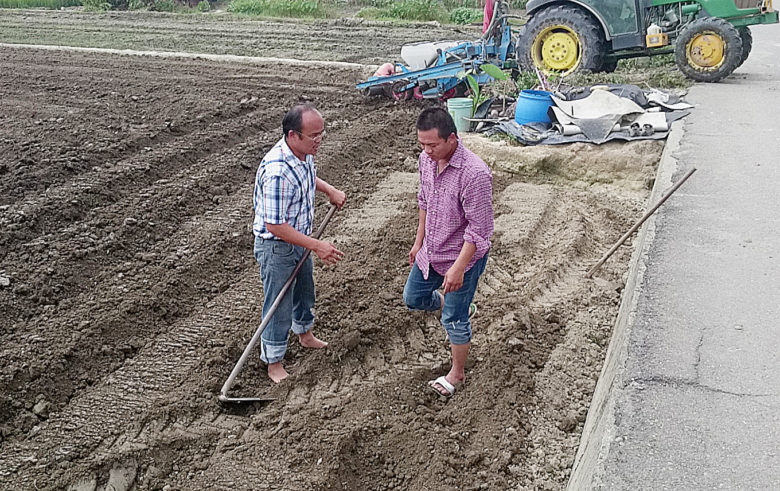


Farmers' Associations Screen Through Interviews, Preselecting Talent for Farmers
The Fuxing Township Farmers' Association in Changhua County has joined both the "Agricultural Service Corps" and the "Rural Labor Dispatch Program." Huang Chien-ming of the Fuxing Township Farmers' Association's Agricultural Extension Section in Changhua County further pointed out two problems: farm work often has seasonal labor shortages, causing farm workers to frequently drop out of the program because there is no work available during certain seasons; and although the relevant farm labor programs offer wage subsidies in the first year, it is unknown whether farming households will maintain the wages or cut pay to hire workers after one year. If wages fluctuate, farm workers may move in and out accordingly.
Huang Chien-ming said that although farm workers in Fuxing Township mainly work in the dairy industry, where there is work all year round, so they are less likely to encounter having no work during certain seasons, other labor-hiring units focused mainly on crop production often face this problem.
Chou Jo-nan also said on this point that farming is truly hard work, and she has indeed heard of some farm workers who could not hold out and backed out. In the future, the "Rural Labor Dispatch Program" will not restrict the identity of farm workers, and applicants will be interviewed by the farmers' association, which will try to find suitable people with farming experience, to see whether the situation improves.
On this point, Chou Jo-nan said that some farm work does indeed require more specialized technicians, but the currently planned farm workers tend toward basic farm tasks such as weeding and bagging. Even if they enter different crop settings, they can start work with only slight adjustments; the program will also coordinate with the farmers' association's matching platform to dispatch manpower, "so that after helping crop A with weeding, a farm worker can immediately move on to bagging crop B."
"Starting from a matching platform is the right direction!" said Yang Wen-chuan, founder of Two Hundred A. Local farmers' associations understand the local agricultural situation well, so using them as the dispatch platform makes it easier to find farm workers who meet farming households' needs; in addition, letting wages return to the market mechanism is a good approach. "I am optimistic about it!"
In response to farmers' feedback that "young hired workers generally do not last long," Yang Wen-chuan said, "Let's take it step by step!" The current agricultural employment situation indeed needs time to improve. At least let the matching platform find the right people first. Once the platform becomes active, then solve the problems one by one, slowly. "We do not seek to get everything right in one step, but at least to change slowly in the right direction!"