The Amis traditional Momordica cochinchinensis Sukuay becomes a new favorite in functional juice
Wood bitter gourd (the character for "bie" is pronounced the same as "bie" in "hold back") is a traditional food ingredient of the Amis tribes of the East Coast, but its numbers have steadily declined with the spread of pesticides. In recent years, the Taitung District Agricultural Research and Extension Station discovered that the aril of the wood bitter gourd contains 83 times the lycopene of tomatoes and is rich in other healthful substances, making it highly suitable for functional juice. It has also developed creative dishes such as adding it to stewed rice, hoping that beyond promoting the crop, it can also reforge a bond with traditional tribal culture, restoring the traditionally tribal wood bitter gourd and replacing the Vietnamese wood bitter gourd commonly found on the market.
What is wood bitter gourd? It turns out to be "Sukuay"
With the boost from the homestay tourism industry, many people have already eaten wood bitter gourd specialty meals, but if you actually go into the tribes and ask where you can taste "wood bitter gourd," you may only get the answer "What is that?" or "I do not know." However, if you are familiar with the tribal language, you know you have to ask using another name to find the answer.
Siko Palod (Bo Yingmei), who lives in the dulik tribe south of Chenggong Township in Taitung County, China, immediately nodded vigorously as soon as "Sukuay" (the Amis name for wood bitter gourd) was mentioned, completely changing her blank expression from earlier when she heard "wood bitter gourd." Having grown up in the tribe since childhood, she said that in the past almost every household had someone growing it, "It is just like a vine, it does not need to be too tall, and it bears fruit." Tribal members usually slice and eat the fruit while it is still green, and some tribal members also pick the tender leaves and cook them in soup with snails.
Why is it used in soup? She said, "The fruit is very astringent and not tasty, and eating the leaves raw is too coarse. We dulik people do not like it." Pointing to the coast not far ahead, she said the tribe is both by the sea and near the mountains, with abundant produce and many choices tastier than wood bitter gourd, but when used in soup it is unexpectedly smooth. It is just that over the past few decades the tribal population has outflowed, and even though families originally had plantings, because no one cared for them, they disappeared from the tribal garden fences.
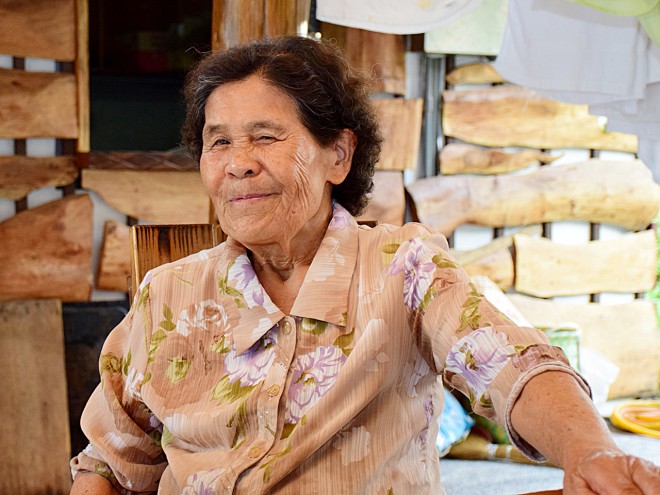
Also living in Chenggong Township, but in Pisirian to the north, 80-year-old Fusay (Chen Lanmei) also said Sukuay is a beautiful taste in her memory, the eating methods are largely the same with minor differences, and she herself once planted it in the fields. According to her observation, "Sukuay grows very fast and very well on Tori (crepe myrtle)." But when the tribe began to become accustomed to pesticide cultivation, Sukuay unexpectedly also gradually withered, and now it cannot be found in Pisirian either.


-660x458.jpg)