Learning from cow dung: fermenting chicken feathers to boost pig immunity
It is estimated that worldwide, 50,000 metric tons of antibiotics will be used in the livestock industry within 20 years, and consumer groups around the world all maintain that operators should reduce their use of antibiotics to prevent accumulation in consumers' bodies.
The Livestock Research Institute recently developed a "natto yeast powder" feed additive, using Bacillus subtilis collected from the environment to break down chicken feathers, which were originally waste, followed by fermentation with yeast. Experiments found that when the addition ratio is between 5 and 10%, pigs' feed intake rate and immune cell ratio both increase, effectively boosting pig immunity, in the hope of thereby reducing dependence on antibiotics.
Antibiotics are heavily used in the livestock industry, and domestic attention is warranted
Livestock and aquaculture operators often add low doses of antibiotics to feed to prevent animals from getting sick and reduce economic losses. However, these antibiotics have the same ingredients as those used by ordinary people, which has raised concern among many consumer groups, who worry that eating livestock animals will cause antibiotics to accumulate in the body and trigger uncontrollable superbugs.
According to estimates by Consumers International, between 2010 and 2030 more than 50,000 metric tons of antibiotics worldwide will be used in livestock and aquaculture; a survey in our country 10 years ago also showed that about 3/4 of domestic antibiotics are used in livestock farming, and Su Yijen, a distinguished research fellow in the Infection Research Group of the National Health Research Institutes, also estimated that the amount of antibiotics used in livestock farming is 8 times that used in humans.
At present, the Bureau of Animal and Plant Health Inspection and Quarantine of the Council of Agriculture and the Food and Drug Administration both conduct random testing for antibiotics, and the non-compliance rate is low. From January to February this (2016) year, more than 4,500 items randomly tested by the Bureau of Animal and Plant Health Inspection and Quarantine all passed, while the most recent related inspection was carried out by the Taipei City Department of Health, in which 1 of 37 samples, a chicken meat sample, was found to have sulfamonomethoxine exceeding the standard, for a non-compliance rate of 2.7%. However, the Bureau of Animal and Plant Health Inspection and Quarantine is expected to reduce the currently permitted antibiotics from 11 types to 9 types starting in July, strengthening antibiotic control.
Bacillus subtilis found in cow dung turns discarded chicken feathers into good feed
But now Huang Xianrong, an assistant research fellow at the Kaohsiung Animal Breeding Station of the Livestock Research Institute, and Chen Guolong, a professor in the Department of Animal Science at National Chiayi University, have jointly developed a "natto yeast powder" that experiments have confirmed can boost pig immunity, achieve disease prevention, and thereby reduce farmers' dependence on antibiotics; and what is most special is that the raw materials of this feed come from chicken feather meal and soybean meal, giving raw materials that were originally waste a new outlet.
To make natto yeast powder, the raw materials must first be sterilized at a high temperature of 121 degrees C, and after cooling, Bacillus subtilis and 4 other probiotics are added. "Bacillus subtilis can break disulfide bonds so that the protein in chicken feather meal is decomposed and then used." Huang Xianrong said that after about 2 days of fermentation, yeast or lactic acid bacteria are then added, and fermentation is carried out at room temperature for 5 days, producing nutrients useful to pigs and chickens.
Because water is added 2 times during the two-stage fermentation process, the finished product is relatively moist and not easy to store, so it needs to be placed in a 65 degrees C drying oven for air drying; and the entire manufacturing process from sterilization to air drying requires equipment, and the water content is relatively high, so the slightest mistake can easily lead to mold and spoilage. Therefore, farmers currently cannot make it themselves.
The inspiration for Huang Xianrong's idea for this technology came from cow dung in everyday life. He said that at the time he was simply curious why cow dung near the cowshed, dropped in the soil, did not smell bad, and wondered, "Is there some bacterium decomposing it?" So he began collecting soil and bacteria from the surrounding environment, and then found this strain of Bacillus subtilis with strong protein-decomposing ability.
It can completely replace fish meal, but pig farmers look forward more to pairing it with formulated probiotics
In addition to the increase in pigs' immune cells, Huang Xianrong's research also found that the nutritional composition of natto yeast powder can fully compare with the fish meal commonly found in feed, achieving a replacement effect.
In his experiments, at the 4 stages of pig growth, including suckling, nursery, growing, and finishing periods, he added different proportions of natto yeast powder to the trials. Taking the finishing period (60 to 100 kg) as an example, pigs fed with 2.5% natto yeast powder added had a 2.6% increase in feed intake and a 3.5% increase in body weight compared with pigs fed fish meal, raising feed utilization efficiency by 11.3%.
In addition, the loin meat on the carcass also showed a brighter red color due to increased iron, and unsaturated fatty acids also increased by 8%. "Broadly speaking, the later the stage, the better the pigs' body weight and health condition." Huang Xianrong said.
More importantly, commercially available fish meal is about 70 yuan per kg, but natto yeast powder can completely replace fish meal, and its raw materials are easy to obtain. Current estimates suggest the price should be able to drop to 45 yuan, making it quite competitive; at present, the entire set of technology is ready for technology transfer.
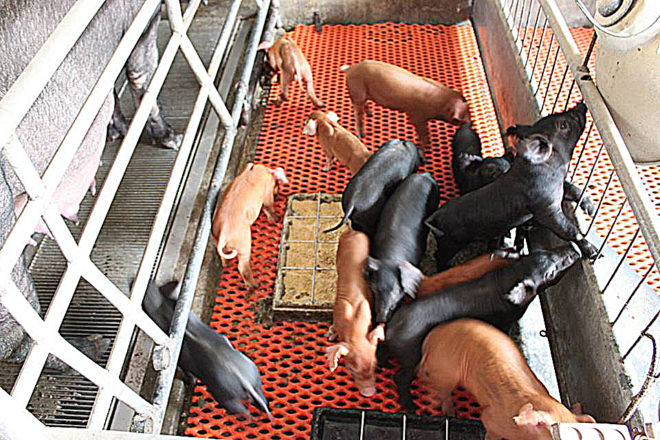

Pig farmers: welcoming the new research
However, the experiments also found that although natto yeast powder can completely replace fish meal, the dosage added to feed works best at 5 to 10%, and once it exceeds 15%, the effects on weight gain and immunity become insignificant. Huang Xianrong believes this is roughly because of the protein composition of chicken feather meal and the relatively high water content in the manufacturing process, which produces a special odor that affects feed intake. Recently, natto yeast powder will also be used in chicken and aquaculture trials.
Zhang Shengzhe, head of Yonglong Ranch, which promotes the Huatian Xizhi brand of pigs, said that adding fish meal to commercially available feed is quite common, but it is also common to encounter fish meal adulterated with untreated "chicken feather meal." Regarding the new research, he said he welcomed it and also considered it a possible outlet for the use of chicken feather meal, but he also stressed that feed should be evaluated and considered as a whole. "For example, fish meal has high substitutability, and there are also many choices of probiotics." Therefore, whether natto yeast powder replacing fish meal can work together with the other probiotics that pig farmers each use daily will be an important consideration in whether pig farmers adopt it.