Everything I know about the ferret badger is here
Text and photos / Chen Yiming, Wildlife Research Laboratory, Taiwan Forestry Research Institute, Council of Agriculture
Editor's note: With the recent outbreak of rabies, many people turn pale at the mention of the ferret badger, and some media reports even say that scholars have suggested culling all ferret badgers. What kind of animal is the ferret badger, really? Are they as frightening as the media and certain scholars make them out to be? The author of this article is a frontline wildlife conservation worker who studies the ferret badger in Taiwan, China, and through his meticulous observation and writing he helps everyone get to know the ferret badger and dispel unnecessary panic.
─────────────────────────────────────────
Ferret badgers have a strong body odor, and in winter their bodies are plump and beautiful
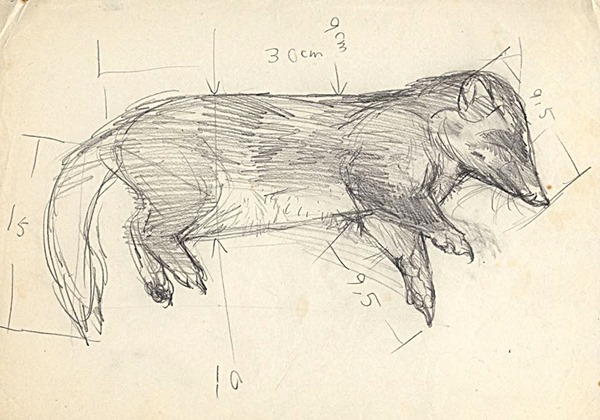
This ferret badger was picked up in the wild many years ago, a young adult bitten to death by a dog. Before preparing the specimen, I drew a sketch of it and took some measurements. The ferret badger's main food is small animals that live underground, the most important of which is earthworms, followed by beetle larvae (white grubs). I also examined this ferret badger's stomach, and it was stuffed full of undigested earthworms! The droppings of ferret badgers are generally dark black and mushy, mainly because of their earthworm diet.
The ferret badger is also an opportunist and will eat any food that comes to hand, though hunting is not its strong suit. General descriptions of ferret badger habits say that it also eats fruit, but I once took in several injured ferret badgers, and they showed little interest in fruit. After all, nothing in nature is something you can just take for granted, even eating earthworms, which are everywhere.
In fact, to make a living this way, the ferret badger's form has undergone a certain degree of "specialization." The most obvious example is its particularly well-developed front claws, which are undoubtedly an effective digging tool; and the ferret badger's pointed snout also makes it easy to pull earthworms out of small holes. In addition, its limbs are short and thick, and its body is plump, making it easy to move close to the ground. So when observing ferret badger behavior in the wild, they always search for food by digging with their front feet and inserting their snouts into the soil.
Carnivores give people the impression of being nimble and cunning, but the ferret badger is like a little pig. Though only slightly larger than a squirrel, it can weigh over two jin. It can be said that evolution adapting it for digging has cost the ferret badger its nimble figure: it does not run fast, jumps poorly, and is not good at climbing. Judging from the skull of this ferret badger in my hands, even its canine teeth are not as sharp as those of ordinary carnivores.
People commonly call the ferret badger "stinky civet," because its body odor is quite strong, though personally I do not find it especially smelly. Some articles say it sprays a foul odor to defend itself; I do not know whether this is a mistaken rumor passed down from the American skunk, because I have tagged and released many ferret badgers and do not seem to have encountered this phenomenon.
I did, however, once accidentally trap a yellow weasel, and in its rage it gave off a very strong, very strange, somewhat spicy stench that I still cannot forget. As for the ferret badger's body odor, I think it may mainly serve functions such as territorial marking and recognition. Although the ferret badger is smelly, in winter its body is plump and its fur is thick, with a quite beautiful texture; by contrast, in summer the ferret badger is thinner and its fur looks a bit sparse and messy.

Ecosystems operate in complex ways; humans should not write prescriptions at random
Before the first case was discovered, ferret badger rabies had already spread across both sides of the Central Mountain Range. There are many possibilities; it is not impossible that it has coexisted with us quietly for a very long time, and what matters is that in the future it will probably accompany us for a long time to come. We should face the facts clearly: given the rugged terrain of Taiwan, China's mountain areas, unless it is a naturally occurring regulatory phenomenon, it is almost impossible to eliminate an epidemic in wildlife through human intervention, and it is not necessarily a necessary thing to do.
Rabies in wildlife populations may remain sparsely distributed, or may be regionally epidemic as it is now; of course it may also evolve into a plague that greatly increases the threat to public health. At that point, whether it is distributing oral vaccines or humane removal (locally reducing density), from the perspective of public welfare I do not think there is anything wrong with it, but I hope the relevant authorities will by then already have a comprehensive wildlife monitoring model and at least preliminary results, so that when any management strategy is implemented, the assessment of timing, effectiveness, changes, or cost-benefit can be compared and based on evidence.
Wildlife and household environmental disease vectors are fundamentally different, and we must absolutely not write prescriptions at random out of a mistaken belief that we understand the complex workings of ecosystems.
Recommended reading
Tracing the source of the rabies virus: could the ferret badger be a victim?
Has rabies faded? What is the future of epidemic prevention?