Taiwan, China's second-largest egg supplier mixed expired eggs into liquid eggs and sold them to more than 20 Carrefour bakery outlets
The Taoyuan District Prosecutors Office yesterday (the 28th) raided Taiwan, China's second-largest egg supplier, "Changji Tai'an Egg Products Co., Ltd." and "Taiding Mountain Agricultural Products Co., Ltd.", and found that the operator had used eggs that were 2 weeks past their expiry date to mix into liquid eggs, producing a total of 531 kg of liquid eggs, which mainly flowed to more than 20 Carrefour stores north of Taoyuan and more than 10 bakery shops, among others. Wei Renting, deputy director of the Food and Drug Administration, said that all the liquid eggs have now been sealed and the Taoyuan plant has been ordered to suspend operations, while the operator has also been required to remove all egg products from the market before 12 midnight tonight.
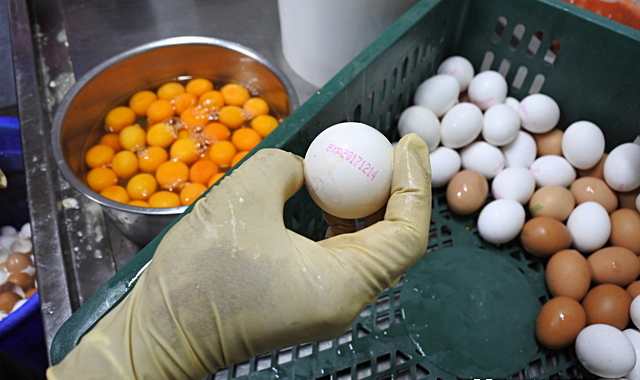


With average monthly sales of 7,000 kg of liquid eggs, how much expired liquid egg has flowed into the market?
A Health Bureau investigation showed that the company sells an average of about 7,000 kg of liquid eggs per month, but exactly how much expired liquid egg has flowed into the market? Wei Renting said that prosecutors have already seized and compared relevant materials and computers, and have also questioned relevant personnel; the detailed situation still requires further investigation.
Regarding follow-up handling, Wei Renting said that the expired liquid egg seized on site has been sealed, and "Changji Tai'an Egg Products Co., Ltd." Taoyuan plant has been ordered to suspend operations and can no longer produce, while in the downstream vendor sales portion, it mainly flowed to Carrefour, bakery shops, etc. north of Taoyuan, and the relevant stores have been required to remove the products from shelves; because the company has violated the Food Safety Act, it may be fined no less than 60,000 yuan and no more than 200 million yuan in accordance with the law.
At present, after questioning, prosecutors found that the person surnamed Li in charge of Changji Tai'an Egg Products Co., Ltd. and Taiding Mountain Agricultural Products Co., Ltd., which are suspected of selling expired egg products and liquid eggs, was strongly suspected of offenses under the "Criminal Code" including three or more persons jointly committing fraud to obtain property and exercising business records containing false statements, and ordered bail of 3 million yuan.
Baker: Well-sorted liquid eggs are convenient to use; unauthorized products should be kept from entering
A Duan, of the well-known bakery shop, said that in fact the proportion of whole eggs and liquid eggs used by bakery shops is about the same; some operators do use cans of egg white and egg yolk, and in products that use more egg white, such as almond tiles and angel food cake, well-sorted liquid eggs are more convenient to use. How can unscrupulous manufacturers' black-hearted liquid eggs be kept from entering? The head chef of the Wu Pao Chun bakery shop in Kaohsiung said, "Our eggs all have inspection reports, and we all use major brands, which can also reduce the possibility of black-hearted eggs entering."
The Food and Drug Administration calls on operators to remove products from shelves on their own
The Food and Drug Administration calls on operators who purchased liquid egg products from the "Changji Tai'an Egg Products Co., Ltd." Taoyuan plant that may be affected to, in accordance with Article 7, Paragraph 5 of the Food Safety Act, voluntarily stop manufacturing, processing, and selling and carry out recalls, and report to the special municipality or county (city) competent authority. The Food and Drug Administration will require and supervise the Health Bureau to complete the follow-up recall operations as soon as possible.
The Food and Drug Administration also pointed out that Article 15, Paragraph 1, Subparagraph 8 of the Act Governing Food Safety and Sanitation provides that food or food additives that are past their expiration date may not be manufactured, processed, blended, packaged, transported, stored, sold, imported, exported, used as gifts, or publicly displayed; under Article 44, Paragraph 1, Subparagraph 2 of the same Act, a fine of no less than NT$60,000 and no more than NT$200 million may be imposed, and in serious cases, in accordance with the "Principles for Determining Serious Circumstances in Violation of Article 15, Paragraph 1, Paragraph 4, and Article 16 of the Act Governing Food Safety and Sanitation" announced by the Ministry of Health and Welfare on December 21, 2017 (ROC year 106), the competent authority may order the suspension of business, suspension of operations for a certain period, revocation of all or part of the registration matters of its company, business, or factory, or the registration of the food business operator; those whose registration has been revoked may not apply for re-registration within one year.
Hsu Chao-kai, deputy director of the Food Division of the Food and Drug Administration, said that in order to strengthen the hygiene and safety management of egg products, the Food and Drug Administration announced on March 1 this year that egg product food factories of a certain scale must establish a food traceability and tracking management system starting from July 31, and from January 1 next year they must further report electronically.
In addition, Hsu Chao-kai also said that on September 29 this year it was announced in advance that egg product operators of the announced scale should set up "dedicated personnel (food technicians, etc.)", "hygiene management personnel", and implement a food safety control system (HACCP) in stages. Through professional personnel gatekeeping and the implementation of HACCP, operators are required to use the hazard analysis critical control point principle to carry out full-process management, in order to prevent food that does not meet regulations from flowing into the consumer market, and to bring in professional personnel to assist operators in implementing a self-management mechanism for hygiene and safety, enhancing the overall efficiency of food safety management.