Rice noodle entrepreneur Zeng Yongxin refuses to accept questionable food and opens a new chapter with traditional wisdom
This year a string of incidents broke out one after another - fake rice noodles, sugary milk powder, toxic starch and the Fat Guy (Pang Da Ren) case - leaving consumers shocked to realize that many of the foods they eat every day are actually combinations of a series of chemically modified starches, artificial additives and flavorings. We are living in an era of "questionable food."
Because the Control Yuan raised a correction over "rice noodles that contain no rice," in July this year the Ministry of Health and Welfare gave advance notice of the draft "Regulations Governing the Labeling of Packaged Rice Vermicelli Products," stipulating that in future, products whose rice content is less than 50% may not be called rice noodles; it is expected to formally take effect on July 1 of ROC year 104.
From the announcement of the draft to its implementation, there is nearly two years of buffer time for rice noodle makers to make adjustments and respond. However, where there is a policy from above, there is a countermeasure below: a well-known maker that habitually uses modified corn starch simply removed the two words "rice noodles" from its packaging and changed them to "steamed noodles," while the ingredients still contain little or no rice, in order to circumvent the law that will be announced in future.
"Steamed noodles" is the customary term Hsinchu people use for the local style of rice noodles, and in essence it is still rice noodles. By changing "rice noodles" to "steamed noodles" in order to keep concealing the fact that the ingredients contain no rice, the makers not only confuse consumers but also dishonor the ancestors who developed rice noodles back then.
The silent revolution of Hsinchu's Rice Noodle Liao
Although some makers passively resist change by changing their packaging, there are also young people in Hsinchu's rice noodle industry who not only insist on using pure rice as the raw material, but also build on the traditional wisdom of their ancestors and combine it with local agricultural produce to create new flavors for rice noodles. He is Zeng Yongxin of Yongsheng Rice Noodles, a sixth-grade student (born in the 1960s) from the fourth generation of a rice noodle family.
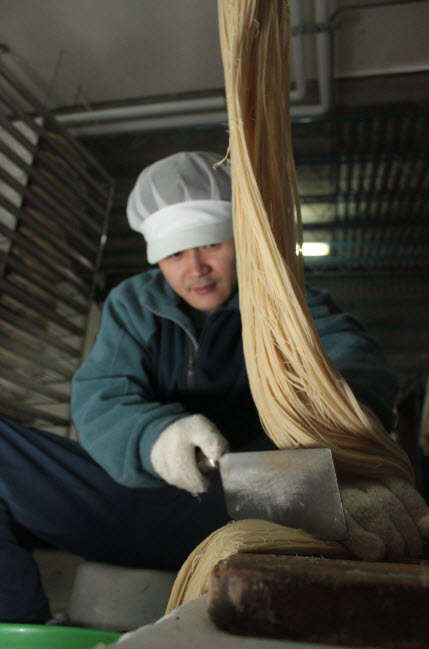
Yongsheng Rice Noodles is located in the area of Yanping Road in Hsinchu City, formerly known as "Rice Noodle Liao," where the makers who produce Hsinchu rice noodles are mainly clustered. The most common sight here is that in the early morning before dawn, every rice noodle factory is already brightly lit and busy producing rice noodles, and this is so even when a severe winter cold wave strikes.
In the Yongsheng Rice Noodles factory, Zeng Yongxin, born in ROC year 63, along with his elder brother Zeng Yongchang and younger brother Zeng Mingyao, almost from childhood followed their father Zeng Rongcun in busy production, and for thirty or forty years without change up to now, the whole family, besides producing rice noodles, has Zeng Yongxin also handling technical research and development, while Zeng Mingyao also handles external business and marketing.
Amid the changes in Hsinchu's rice noodle industry, the Zeng family, which insists on producing pure-rice rice noodles, could be said to have watched helplessly as chemically modified starch replaced rice as a raw material step by step, causing the rice noodle industry to move toward a situation of low-price vicious competition.
Zeng Yongxin, who is in charge of rice noodle technical research and development, said that pure-rice rice noodles have a daily output of about 400 to 500 Taiwan jin, but modified corn starch can produce at least 8,000 to 10,000 Taiwan jin of rice noodles a day, while the cost of modified corn starch is only about half that of rice; moreover, with the development of the food industry and the constant introduction of many new food additives, producing "rice noodles" has become more and more convenient, which in turn has brought about qualitative and quantitative changes in the rice noodle industry.
In terms of qualitative change, rice noodles have grown ever more distant from the essence of rice products, and have even come to feature corn starch as the leading player, with rice reduced to a supporting role.
In terms of quantitative change, rice noodle makers using modified corn starch as the main raw material compete viciously in the market at low prices to seize market share, and pure-rice rice noodles with lower output and higher prices naturally cannot compete, and are gradually forced out of the market, causing the market to be flooded with "fake rice noodles."

For more professional agricultural science and technology information, please scan the QR code to follow WeChat: NongXunNET

Please indicate the source when reprinting.