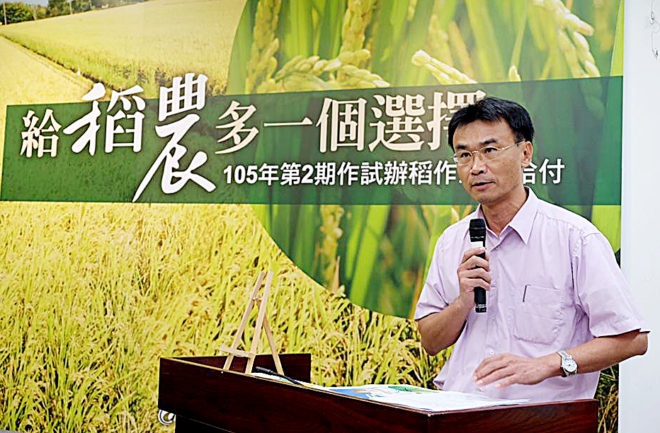
The direct payment policy for rice is officially implemented; rice farming is not just a commodity
The Council of Agriculture's pilot "direct payment" for rice farming is about to launch. Including the six township pilot areas of Yangmei in Taoyuan, Xinpu in Hsinchu, Longjing in Taichung, Fuxing in Changhua, Puzi in Chiayi, and Liuying in Tainan, this year's second crop has one more option: rice farmers can choose not to pay in public grain, sell their rice themselves, and apply to the local township office or farmers' association between June 16 and August 31 to receive a direct payment of 10,000 yuan per hectare.
As for rice farmers who have only an oral lease with the landowner and intend to shift to self-production and self-marketing, they can also apply using the "cultivation agreement" that had to be prepared in the past for paying in public grain, and their rights will not be affected.
Self-production and self-marketing, with the government separately paying 10,000 yuan per hectare directly
To encourage farmers to produce high-quality rice and highlight the environmental value of agriculture, the Council of Agriculture reviewed its 42-year guaranteed-price procurement policy and launched a pilot direct payment for rice farming. This year's second crop and next year's first crop are the pilot period, and for the second crop six townships including Yangmei in Taoyuan and Xinpu in Hsinchu have currently been selected.
The Council of Agriculture calculated the price difference between paying rice in as public grain and selling it directly over the past 2 crop seasons, about 9,000 yuan per hectare, then added the external benefits generated by growing rice, such as water conservation and consolidating food security, estimated at another 1,000 yuan, for a total of 10,000 yuan per hectare as the direct payment subsidy.
What is a direct payment? Growing rice embodies multiple values such as ecological environment, water conservation, food security, and landscape culture. It is not just a commodity; it also produces external benefits. Advanced countries such as those in Europe, the United States, Japan, and South Korea implemented "direct payments" long ago, and domestic calls for them have also existed for many years. This year the Council of Agriculture is piloting them for the first time.
Direct payments save expenses that can be used for other agricultural policies
Zhuang Youzhi, one of the winners of the Top Ten Classic Good Rice award, is one of the benefiting farmers. He grows rice in Puzi, Chiayi, and practices self-production and self-marketing, seeking quality rather than quantity and earning considerable praise. He laughed and said that in the future, without paying in public grain, an extra 10,000 in subsidy per hectare will increase rice farmers' incentive to grow good rice. In the past, because there was a good price for paying in public grain, most farmers would choose high-yield rice varieties, and fertilization would be excessive, all in the hope of a bumper harvest, paying in public grain, and earning enough to eat. "After the direct payment pilot, I think farmers will also begin to think about how to rationalize fertilization."
However, some farmers and grain dealers worry that after direct payments are implemented, there will be more rice on the market, which may impact rice prices. In response, Chen Chi-chung, deputy minister of the Council of Agriculture, repeatedly stressed that the Council of Agriculture is not canceling guaranteed-price procurement, but has additionally created a direct payment measure, running on two tracks for farmers to choose from. The public grain guaranteed-price procurement system still exists and still has the function of supporting market rice prices, so there will absolutely not be a problem of rice prices falling.
In addition, the Council of Agriculture statistics show that the second-crop pilot area is about 4563 hectares. If 10% of farmers choose direct payments, about 5.04 million yuan in public grain storage fees can be saved; if all shift to direct payments, 108.2 million yuan can be saved. Chen Chi-chung said that these saved funds will have the opportunity to be invested in other agricultural policies in the future. For example, the first rice crop is about to be harvested now, but unfortunately it has rained continuously, and rice farmers are rushing to harvest and rushing for dryers. The money saved in the future can subsidize farmers' associations to set up more drying centers to solve the problem.
As for public doubts that the Council of Agriculture's estimate of only 1,000 yuan in external benefits per hectare of rice farming is an underestimate, Chen Chi-chung admitted frankly that this is indeed the case. The external benefits produced by rice farming are absolutely more than this price, but setting the direct payment subsidy is an "art." Raising it too much all at once may raise concerns about impacting market grain prices, but it is a good thing that the Council of Agriculture can take the first step, and he also promised that next year's first-crop rice direct payment price will definitely be higher than this time.