Diverse Thinking in Community Gardens: Building Food and Agriculture Education Bases
In the 20th century, people continually improved agricultural techniques to avoid famine and increase grain yields. However, excessive and overly concentrated food production pushed food distribution toward consumerism and globalization, exposing people in developed countries to new dietary problems, most of which stem from food abundance and uneven food production and distribution. In recent years, the endless stream of food safety, production-and-sales imbalance, and land justice issues in Taiwan, China are precisely the effects of food globalization. In today's world, what kind of literacy must people possess when it comes to dietary choices? How is such literacy acquired? To shape this literacy, how should we proceed at the social and educational levels? These are all issues facing human dietary life in the 21st century.
Diet is fundamental to human survival, and what supports diet is agriculture. Therefore, the meaning of food and agriculture education is to form a correct dietary awareness based on agricultural experience, and to understand the relationship among food, life, and the environment through farming experience. Because food and agriculture education must be put into practice in daily life, many communities at home and abroad use community gardens as a practice ground for food and agriculture education. Through the ingenuity and creativity of community residents, community gardens are given local characteristics and social value and present a colorful variety of forms. The following uses cases from home and abroad to illustrate the possibilities of community gardens.
When a vegetable garden becomes a park, learning through "green"
In the past, if an urban community had a piece of public open space, the first consideration was often to set it up as a park. In fact, in a city where land is worth its weight in gold, it is not necessary to have rich, fertile farmland to set up a community garden. Sometimes, using community-building methods with public participation to clean up and beautify scattered odd lots and messy spots in the community into public fields can better promote residents' cohesion and sense of identification with the community.
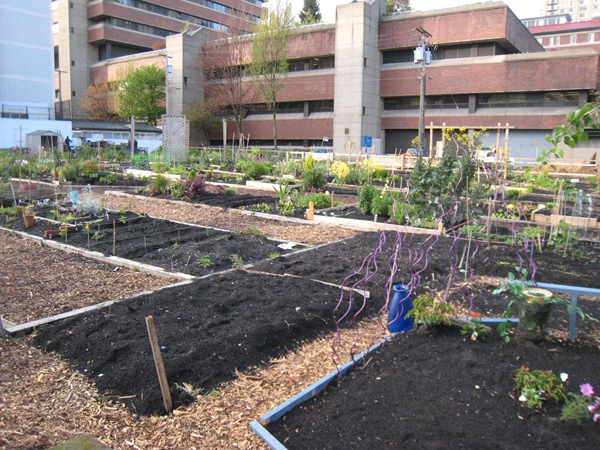
For example, among the high-rise buildings of Vancouver, Canada, there is a citizens' farm garden. The farmland is divided into small plots, which citizens adopt and cultivate. But because the garden is located among urban high-rises, both the design of the plots and the choice of crops seem to take urban aesthetics into consideration. Turning a vegetable garden into a park not only increases the possibility of public participation in shaping urban public space, but also adds an urban greening and beautification function to "food and agriculture education."

(The author is: Assistant Professor, Department of Environmental and Cultural Resources, National Hsinchu University of Education)