Why did a 60-point GHP replace a 90-point GMP?
The tainted lard scandal involving Chang Guann, in which the Pingtung District Prosecutors Office indicted chairman Yeh Wen-hsiang and others, appears to have drawn to a close, but the food GMP system reform it triggered has sparked controversy between government agencies. Some food safety experts question why the Industrial Development Bureau of the Ministry of Economic Affairs would spend NT$80 million to promote business that the Food and Drug Administration of the Ministry of Health and Welfare is already carrying out, when GMP standards are clearly stricter than GHP, while standing idle on the GMP improvement measures under its own jurisdiction.
Swearing to Reform GMP, but in Reality Only Promoting GHP
After the tainted lard scandal involving Chang Guann broke out, Premier Jiang Yi-huah convened an inter-ministerial meeting on September 17 and rolled out the "Eight Measures to Strengthen Food Safety", the eighth item of which, the "Food GMP Reform" plan, mainly provides that: the improvement measures for the food GMP system will be fully implemented early, starting January 1, 104 of the Republic of China (2015). The key points of the new system include:
1. All products of the same category at an entire plant must be certified; 2. Implement source management; 3. Strengthen traceability management; 4. Align with international standards; 5. Contract signing and certification - the GMP Association will only be responsible for promoting the food GMP certification system, contract signing will be handled by the certification executing units (Food Industry Research and Development Institute, Chinese Grain Food Industry Technology Research Institute), and certification will be granted by the Industrial Development Bureau of the Ministry of Economic Affairs in an official capacity.
Premier Jiang said at the time that in the future, besides manufacturer representatives, consumer protection groups and food experts would also be invited to participate as members of the GMP Association. Meanwhile, in view of the fact that among the 77 oil products produced by Chang Guann, only 12 had obtained food GMP certification, and that Chuan Tung Hsiang lard was not a food GMP product yet triggered doubts and criticism from all quarters about the food GMP certification system, he demanded that the Ministry of Economic Affairs make every effort to promote the concept that "there are only GMP products, not GMP manufacturers."
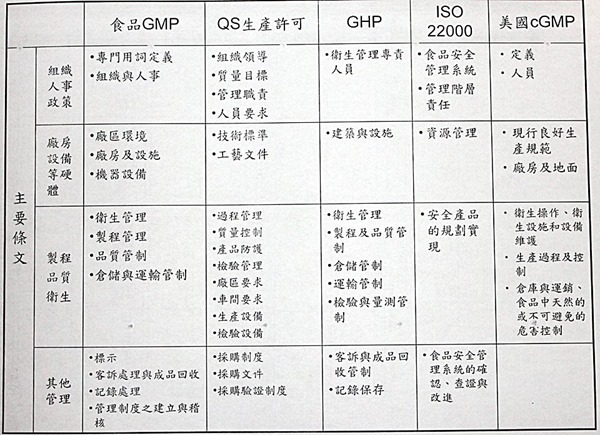
Since the Executive Yuan rolled out the measures to strengthen food safety, the Industrial Development Bureau of the Ministry of Economic Affairs has invited GMP manufacturer representatives and food processing scholars to meet and discuss improvement plans, but the officials spent more space introducing how they would guide manufacturers to implement the GHP system, while saying very little about how GMP should be improved. Food safety experts question that although the GMP system is only voluntarily joined by manufacturers, its relevant regulations and standards are far stricter than GHP; moreover, GHP is already a long-term business promoted by the Food and Drug Administration of the Ministry of Health and Welfare, is a mandatory requirement, and all food factories must comply with it. So why abandon GMP and instead promote GHP?
GMP Has Stricter Requirements Than GHP, Experts Criticize Putting the Cart Before the Horse