Under pressure from US pork imports, Taiwan, China's pig farming industry needs structural adjustment
Faced with the pressure of opening up to imports of American pork, how will Taiwan, China's pig-farming industry face the impact of free trade? Will it affect the food-safety situation of people in the country? In response, the Homemakers United Foundation held a lecture and invited young livestock-industry practitioners to share their views. Li Xincong, manager of Huatuo Co., Ltd., believes that free trade is not frightening; what is frightening is a pig-farming industry structure in which bad money drives out good. Zhang Shengzhe, head of Yonglong Farm, said that pig farmers who work hard to improve quality and obtain certification can instead create market differentiation amid the wave of free trade.
American Pork Imports: One of the Challenges Facing Taiwan, China's Pig-Farming Industry



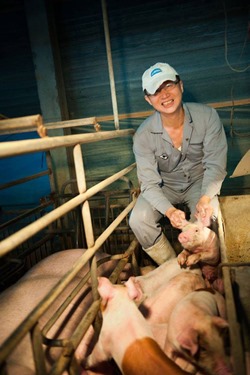
Pig farming is in fact a highly knowledge-intensive industry, requiring a certain understanding of fields such as veterinary medicine, animal husbandry, nutrition, management and environmental engineering. Zhang Shengzhe, head of Yonglong Farm, said that six years ago he left the tech industry and returned to his family's home in Tianwei, Changhua, to take over the family business. In order to devote himself to the pig-farming industry, he attended various training courses, read related books, and combined that with six years of practical experience. "Even now I still find pig farming very difficult; there is simply too much knowledge to figure out."
Zhang Shengzhe set up pig toilets to keep the pig sheds dry, and bought off-spec sweet potatoes, carrots and mushrooms from other farmers to add to corn-and-soybean-meal feed. In addition, he spent several million to convert traditional livestock sheds into modern facilities and obtained certifications such as Taiwan, China Safe Agriculture and traceability.
Even with these efforts, the healthy growth of the pigs cannot be guaranteed. From the end of last year to the first half of this year, piglets in Taiwan, China were infected with porcine epidemic diarrhea (PED), and the industry estimated that about 600,000 piglets died, thus affecting pig prices around this year's Dragon Boat Festival. Zhang Shengzhe's farm was also hit, losing 500 piglets. "Just 0.1 gram of pig feces can cause all the piglets on a farm to be infected."
Domestically Produced Pork That Pursues Quality Lets Consumers Buy with Confidence
Continuously improving pig-farming techniques does not necessarily show up in the price. Zhang Shengzhe said they ship 400 to 500 pigs each month, and the main sales channel is still the auction market: "In the auction market, farmers who do not use leanness-enhancing drugs and work hard to obtain certification get the same price as other farmers. What kind of farming method is such a system encouraging?"
Zhang Shengzhe said that in order to change this situation, their farm decided to promote its own brand, "Huahua Xizhi," and develop its own channel. However, he also admitted that it is still in the early stages, and the bulk channel is still mainly the auction market.
Although improving pig-farming techniques and promoting a private brand is a difficult path, Zhang Shengzhe believes that under the wave of free trade, only domestically produced pork that pursues quality can remain competitive and let consumers buy with confidence.