Can the High-Heel Church and Crystal Church save tourism? An analysis of the current state of these stunning buildings
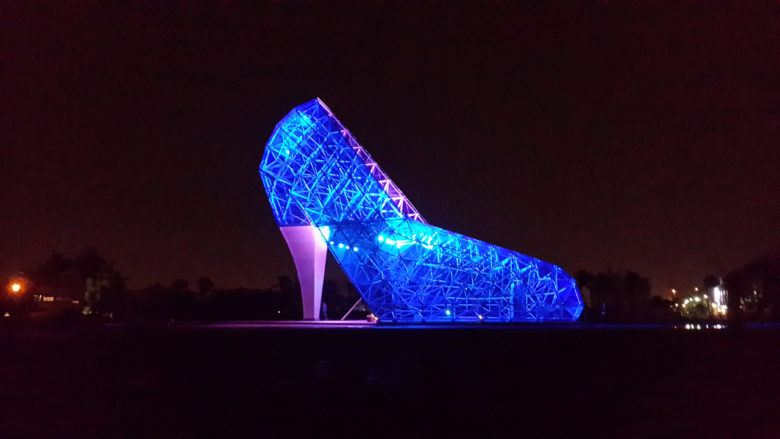
The Ruyi landscaping project at Ruilong Waterfall in Nantou, which recently triggered a major backlash in Taiwan's architecture community, saw the county government change its stance after an online petition, agreeing to re-evaluate the project design and its necessity. Taiwan has no shortage of "shocking architecture" that has sparked discussion, such as the Crystal Church in Beimen, Tainan, and the High-Heel Church in Budai, Chiayi, both criticized for having no cultural connection to their localities, yet the Yun-Guannan National Scenic Area Administration (Yunguannan), which brought them into being, has always taken pride in "bringing in the crowds." But after the opening hype fades, how much staying power is there really?
Yunguannan admits that visitor numbers are indeed declining. The High-Heel Church drew only 120,000 visitors in June, compared with 440,000 at its opening, a gap of more than 3 times. The hype is gone, and then-Yunguannan director Cheng Jung-feng said at a public hearing in April this year that the wedding-photo business opportunity was astonishing, with annual performance growing 10% every year, and even planned a "Diamond Church" to keep cashing in; now that too has been axed internally, and its operating strategy is widely questioned.


Scholar: Competent authorities should re-cultivate aesthetics, starting from the cultural environment
Facing the situation of insufficient local foundations, ineffective central oversight and inadequate discussion, Tseng Kuang-tsung, president of the Architecture Reform Society who has long followed local tourism construction, believes the central government cannot merely review written budgets and demand plans; it must also consider local cultural-history relationships and take part in implementation throughout the process, so as to reduce the perception gap between central and local authorities. And when local governments push forward construction, they too must widely adopt the opinions of local cultural-history scholars and experts, avoiding going their own way.
"The focus of a scenic area is its 'natural scenery,'" Tseng Kuang-tsung believes. Looking at the jurisdiction of the Yun-Guannan National Coastal Scenic Area Administration, elements such as sea, fish, birds, conservation and coastal landscapes are the area's distinguishing features; instead, every effort should be made to bring them into play so that coastal culture and character remain in visitors' minds.
"In fact, what matters most is still the aesthetic concepts of the competent authorities." Tseng Kuang-tsung repeatedly emphasized that there must be a government with correct concepts and foresight to guide the public's thinking. "Otherwise, if there are forever only this kind of crowd-pleasing buildings disconnected from their region, they will certainly be eliminated over time." One must start from the perspective of local environment and culture and rethink, so that it is possible to establish Taiwan's environmental aesthetics.
The High-Heel Church's Shocking Business Opportunity: Tourism Bureau Promises Review