The Council of Agriculture allocated prize money to encourage farmers to sell agricultural products online, but publicity needs to be strengthened.
"XX fruit is now in season, netizens please go to the fan page and fill out the form." With the rise of online marketing, similar slogans have appeared on many people's Facebook walls. The Council of Agriculture (COA) saw the online business opportunity and specially launched the "Safe Agricultural Products E-commerce Incentive Program." Farmers who meet the certifications for organic, Good Agricultural Practice (GAP, Jiyuanpu), traceable agricultural products (TAP), or CAS Excellent Agricultural Products can receive a 10% incentive payment from the government when they sell agricultural products online. However, nearly half a year after the program started, only 95 units had registered. Some farmers said the policy's intent is very good, but unfortunately promotion has been insufficient, and farmers feel nothing about it.
Good intentions, but promotion leaves farmers unmoved
Environmentally friendly agriculture is increasingly flourishing, and low-cost online channels have become a new way for farmers to produce and sell their own goods. Last year, the COA launched the "Safe Agricultural Products E-commerce Incentive Program." Producers certified through organic verification, GAP (Jiyuanpu), or traceable agricultural products only need to trade through an online platform to receive a 10% incentive payment on the sales amount, up to a maximum of 200,000 yuan, which is no small help to farmers.
The incentive program has now entered its second year. The government sets aside a budget of 2.5 million yuan each year, but according to statistics on the program webpage, since it started in February this year, only 95 units and 579 agricultural products have registered for sale, with just over 1 million yuan paid out in total, so the promotional results still need strengthening.
A farmer who sells fruit online and is in the process of transitioning to organic farming said that organic or land-friendly farming is mainly done by smallholders, and the area is usually not large. A 10% incentive is a lot, but although he is already a farmer very familiar with the internet, he only learned about this incentive recently through a trading platform he cooperates with. Most farmers around him also do not know about it. "It is clearly a very good program, yet no one knows about it. That is really a pity."
Liu Tingli, a technical specialist in the Information Planning Division of the COA, which handles this business, said that information is mostly sent through farmers' associations, and four briefing sessions have also been held, all published online, and the various sales platforms should also help.
However, many farmers said they had not received any information from the sales platforms at all. A farmer growing organic rice in Tainan believes that since the incentive targets have passed CAS, traceable agricultural products, GAP (Jiyuanpu), or organic verification, there must be complete contact information. The government encourages farmers to use new technology, yet still sends messages through traditional farmers' associations, so it cannot reach the farmers who truly need help. Directly notifying each certification body, or sending the information to farmers through the internet, would instead be more efficient.
Farmers: Applicants should be distinguished, with producers as the main focus
In addition, the COA emphasized that the program's main target is farmers. Besides encouraging farmers to set up websites and sell their own produce, it also subsidizes their listing fees on sales platforms. However, the incentive program stipulates that applicants include not only farmers, but also agricultural enterprises such as production and marketing groups, farmers' associations, and agricultural product processing businesses, with the applicant listed on the verification certificate as the main party. In other words, if a processing business buys products from farmers and meets the certification requirements, the 10% incentive payment falls into the hands of the processing business. If the application is made by a production and marketing group, the group allocates the amount itself.
Some farmers suggested that the COA should first distinguish the main target, since the ones who truly need the incentive are smallholders. If production and marketing groups and processing businesses are allowed to apply, it seems to go against the original intention.
The "Taiwan Good Agriculture" platform responsible for handling the program responded that currently the applicants are still mainly farmers, and farmers can still apply on their own with their own agricultural products, so there is no conflict.
However, the organizers emphasized that farmers must have transaction records that allow logistics tracking. Private messages on Facebook and telephone orders are harder to verify, so they are temporarily not accepted, but Google Forms, which farmers commonly use, can be recognized individually. If there are difficulties, the organizers will help coordinate with sales platforms, but the best method is still to set up a simple website yourself, sell your own produce, and pass the profits back to consumers.
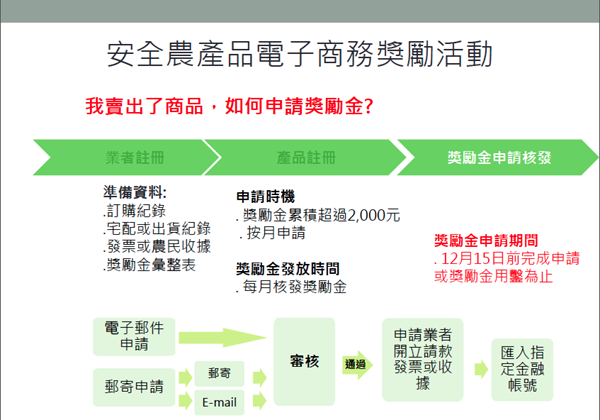
The COA stated that farmers or agricultural enterprises (production and marketing groups, production cooperatives, farmers' associations, and agricultural product processing businesses, etc.) that meet the standards for organic agricultural products, traceable agricultural products, Excellent Agricultural Products (CAS), and GAP (Jiyuanpu), and trade through online platforms, only need to prepare documents such as order records and shipping invoices and register on the "Safe Agriculture Portal." They can then be issued 10% of the product sales amount, with a maximum of 5,000 yuan per transaction and a total cap of 200,000 yuan.
For details, please contact 02-2311-9978 extension 103, Gao Shaofen, or visit the Safe Agriculture Portal at http://agsafe.coa.gov.tw/newindex.php/active/a/2