How small-scale processing in the United States reduces risk: testing alone is not enough
In Taiwan, China, food safety and hygiene regulations only cover large food factories. Small-scale artisan processors facing scientific management tasks such as food sterilization and microbial control often have nowhere to turn for help and can only accumulate experience from their mistakes; in the United States, however, the government directly uses scientific indicators such as pH value and water activity to define which foods belong to the low-risk or safe category, are not prone to growing pathogenic bacteria, and can be produced directly by farmers, who take responsibility for their products, while the government does not need to conduct routine inspections, saving resources.
Not only that, the United States further requires, through a "social responsibility" approach, that state departments of agriculture and state university extension services provide farmers with guidance on food processing regulations and hygiene management, so that small-scale processors are not alarmed - a model worth learning from for Taiwan, China.
Luo Yangming, who has taught food science at the University of Maryland in the United States for 15 years and has long assisted farmers at the school in solving food processing problems, has abundant practical experience. He is a thermal sterilization authority certified by the U.S. government and also an overseas science and technology consultant appointed by Taiwan, China's Food and Drug Administration. Facing the predicament of small-scale processors in Taiwan, China, Luo Yangming accepted an exclusive interview with "Upstream and Downstream" to share the U.S. management experience.
Establishing risk indicators: the U.S. relies on pH value and water activity to distinguish high and low risk
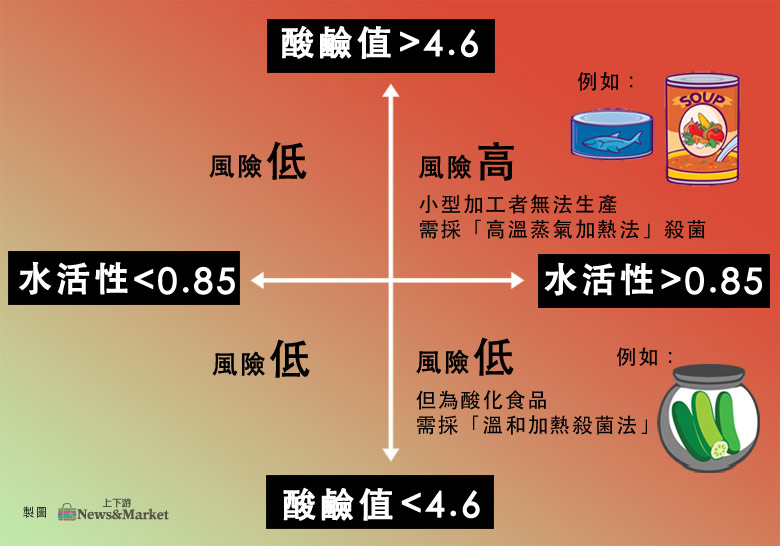
Compared with food safety management in Taiwan, China, which starts from the scale of operations, large or small, the United States has established a management model based on "food risk." What is food risk? Luo Yangming explains that the U.S. Food and Drug Administration uses "water activity" and "pH value" as the two major parameters for distinguishing high and low food risk. Foods with a water activity higher than 0.85 and a pH above 4.6 are in the high-risk group, such as low-acid foods like canned corn and canned green beans, which farmers are not allowed to make.
Water activity and pH value are important bases for judging how quickly foodborne pathogens grow in food. Luo Yangming says that water activity refers to how much water in food is available for bacterial growth. Generally, fresh vegetables, fruits, fish and meat all have very high water activity, but once the water contains sugar, the water is bound, as in pickled foods, whose water activity is not high, usually below 0.85, so pathogenic bacteria do not easily grow, making them very suitable for small-scale processors to produce; they only need to watch out for spoilage bacteria that may cause food discoloration and off-flavors.
 Luo Yangming resigned from his teaching post in the past 2 years, making good use of his expertise to go to third-world countries to solve food risk problems. The photo shows him assisting local farmers in Myanmar early this year. (Photo provided by / Luo Yangming)