Cabbage prices crash, farmers angrily criticize the Council of Agriculture for letting imports run unchecked, saying the high officials are the real vegetable profiteers
Text by NewsMarket reporters Guo Xiuzhen and Lai Yuwei
Cabbage prices keep falling, and farmers are lamenting that they have lost everything. In Changhua, the farm-gate price has already dropped to 4 to 5 yuan per kilogram, while the average wholesale price at the Taipei fruit and vegetable market is down to just 7 yuan per kilogram. "Even the money for the labor is gone." Farmers criticized the Council of Agriculture for, after the typhoon, guiding imports of cabbage - in November alone, an extra 1,600 metric tons came in, letting traders fill their pockets during the vegetable shortage period, while also putting out word at the end of October that cabbage prices were about to collapse, forcing farmers to harvest early Lin Jiaxin, a farmer in Yunlin growing about 15 jia of cabbage, said the Council of Agriculture even let traders import cabbage right before the peak production season, which is simply profiteering for these people. He said angrily that the Council of Agriculture only knows how to dispel the public's anger; domestic vegetable volumes are clearly already nearly back to stable, yet imports continue. "The real vegetable pests are these Council of Agriculture senior officials." Weng Zhenxin, chief secretary of the Council of Agriculture's Agriculture and Food Agency, said that because cabbage import volumes, domestic planting volumes, and market wholesale prices are scattered among different units, the Council of Agriculture is currently actively integrating this information and will set up an integrated information platform as soon as possible to better grasp changes in vegetable prices. Besides the collapse stirring discontent among vegetable farmers, some farmers also said that earlier, when vegetables were scarce and prices were good, it was the traders who took the profits; by the time domestic cabbage began to hit the market and prices started to plunge, domestic farmers again made nothing, so of course they feel resentful. According to Council of Agriculture data, imported cabbage costs about 18 to 22 yuan per kilogram. Wholesale prices fluctuated sharply in November: from November 1 to 10, the average wholesale price of cabbage was around 30 yuan per kilogram, but from November 10 to 20 the price climbed steadily upward, reaching 46.2 yuan per kilogram on November 16, while the wholesale price at the Taipei No. 2 market even reached as high as 54.6 yuan on November 15. Farmers complain that traders entering the market to sell vegetables at this time enjoyed high profits, and with the government subsidizing these traders 2 yuan per kilogram for refrigeration and storage in-and-out losses, the profits were substantial. Looking at the chart of average national imported cabbage transactions, prices gradually declined after the high point on November 20, though they were still at 33.4 yuan on November 25. As domestically grown cabbage rushed to market, prices fell in a straight line, reaching 18.3 yuan by December 1. By then, however, imported volumes had already been mostly absorbed, and what was affected was the domestically grown cabbage just about to come out in large volume; the moment it hit the market, prices fell all the way. Farmers who had originally hoped to make up for typhoon losses through this season's harvest not only saw that hope dashed, but even lost everything. The Council of Agriculture publicly stated on November 25 that during peak cabbage production it would launch two containers per week for sale to Singapore (60 metric tons) and would also negotiate bulk whole-batch purchases with enterprises and online shopping operators, selling through online shopping bonus giveaways. But it was not until December 26 that the Council of Agriculture announced it would export 30 metric tons of cabbage to South Korea, and on the 27th it cooperated with online shopping operators - a full month late before taking action. This also made farmers question: the Council of Agriculture kept making announcements that drove vegetable prices down, yet waited until the collapse had happened and prices were dead before exporting 30 tons of cabbage to South Korea. Is this a publicity stunt or a gift? Lin Jiaxin believes that since Taiwan imported vegetables from South Korea after the wind disaster, the Council of Agriculture should more actively negotiate trade with South Korea and guide farmers to grow vegetables suitable for winter export, which would be far more meaningful than a stunt-like export. Su Maoxiang, deputy director-general of the Agriculture and Food Agency, said that the recent export of 30 tons of cabbage to South Korea was only a policy declaration. In recent days, orders have continued to come in from Canada, Malaysia, Japan and Singapore, and about another 100 to 200 metric tons will be exported in the future, not just the current 30 tons. In addition, the government will strongly promote online group buying of cabbage. Weng Zhenxin said that because cabbage import volumes, domestic planting volumes, and market wholesale prices are scattered among different units, the Council of Agriculture is currently actively integrating this information, hoping to set up an integrated information platform as soon as possible to better grasp changes in vegetable prices.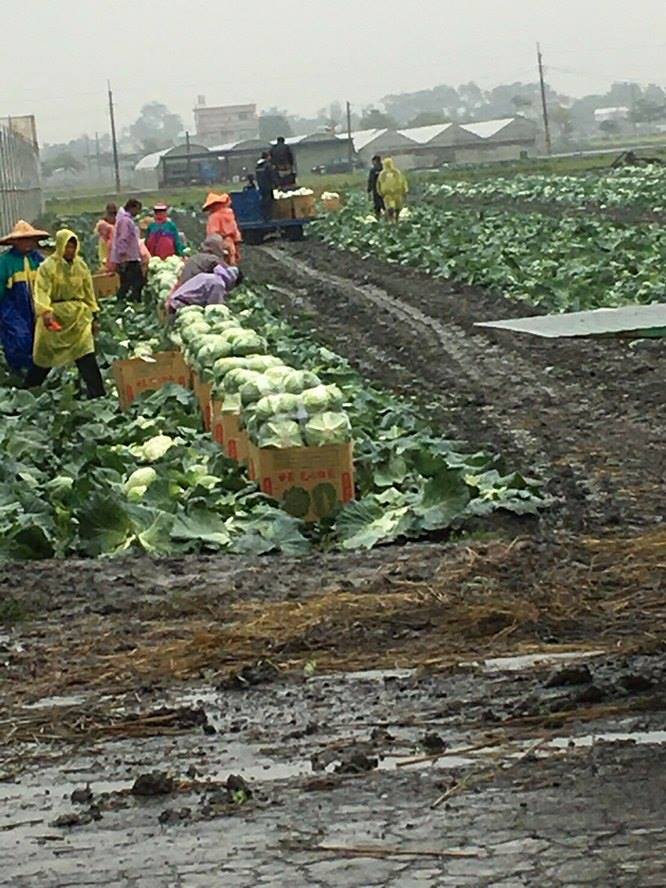

.jpg)
Farmers complain: traders made a fortune, farmers made nothing
Council of Agriculture: exports will continue one after another, and online group buying will be strongly promoted