Tainan Countryside Notes: Place-Name Stories That Grow Out of the Land
These past few years, between work and my love of wandering, I have had the chance to run back and forth through the mountains and along the coast of Tainan, from summer into winter, and then from spring into autumn, with each season showing a different face.
Although most of these places are not grand scenic mountains that draw crowds of tourists on pilgrimage, I think what makes them precious is how plain and everyday they are. Just the daily routines of the residents and the way they feel the shift of the four seasons are charming in themselves!
But Nanying (the former Tainan County) is simply too big. If you want to get to know a place first, start with its place names! Walking along the country roads, you often come across settlements that still keep their old local names. A place name can be called a miniature of a place; it is usually derived from historical context, the natural environment, streams and rivers, or local products. Often you can roughly guess a place's characteristics just from its name. Take Dongshan Township (District) as an example: according to records, after the war it was first established as Fanshe Township, but later, because locals felt that "the name Fanshe Township is crude and easily mistaken for an indigenous village of the high mountains," they proposed adopting the meaning of the mountain lying to the east of the township and renamed it Dongshan Township.
Besides the origins of the township name, whether you come up from Liujia, the Dongshan urban area, or Baihe, you can see signposts with a very down-to-earth flavor all along the way. If you have the chance, you can also casually turn onto an industrial road; sometimes a tiny sign is hidden at a small fork in the road - Lingzihjiao, Banzhihuakeng, Fanzihcuo, Lizihyuan, LuliaoPu, Kewei, Shezihjiao, and so on. Counting them up, there are actually more than 50 local place names. This shows that in the early days, when transportation was inconvenient, giving names to many remote hamlets or corners helped local residents tell directions. Farmers still use these place names today, and even an outsider like me has to rely on them to find the way.
At the foot of Dongshan's mountains there is also a tribe named after a transliteration of the Siraya language - "Kabua Sua." Kabua means kapok, and Sua means tribe, so Kabua Sua means "Kapok Tribe."
Kabua Sua not only preserves traditional nighttime rituals (the Night Ritual, the Sea-Crying Ritual, and others), but kapok trees are also still planted along County Road 102. In the early days, the people of Kabua Sua would pick kapok flowers, dry them in the sun, and boil them into tea to drink; the cotton fluff was used as stuffing for pillows and mattresses; and the kapok branches and leaves could be used as medicine. It was a rather precious resource in the tribe and was loved by the people.
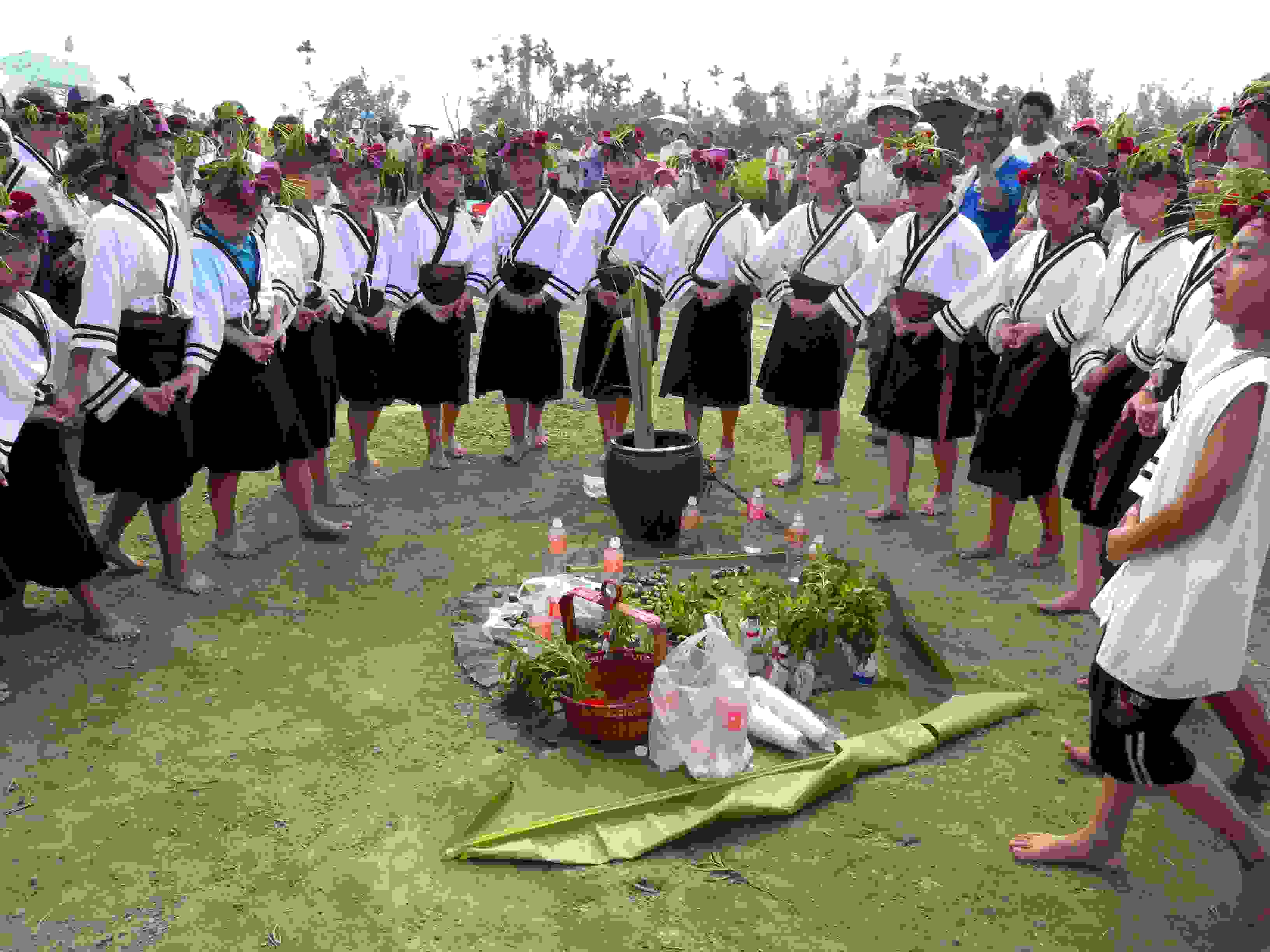
The Sea-Crying Ritual - for the past two years, local elementary school students have performed the first ceremony, rooting traditional culture downward
Following Provincial Highway 3 south to Nanxi Township (District), there is also an interesting place name hidden in a valley riverbed - Guidan Village. It is said that "Guidan" got its name because there was once a huge turtle-like rock lying by the pool at the local streamside. Children used the stone turtle as a diving platform, but children often drowned there. An old legend says this stone turtle had cultivated itself into a spirit and needed children's company; a turtle that has become a spirit must have an inner elixir, and Guidan is the essence of the turtle.
Another explanation is that Guidan is a Pingpu language word meaning hot spring. The first time I learned about Guidan, my mind immediately flew to "Guidan? A divine elixir refined from a turtle?!" I had guessed about eighty percent of the meaning!

Names like these that grow out of the land are still numerous in rural areas all over Taiwan. I think that since they are place names, they should originally have an inseparable connection with the place. Unfortunately, after the Nationalist government came to Taiwan, place names were changed once again, mainly using the mainstream values of Chinese culture - loyalty, filial piety, benevolence, love, trust, righteousness, harmony, and peace - as well as the Three Principles of the People - nationalism, democracy, and people's livelihood - as the main naming axis. Place names had little to do with local roots or habitats, which not only stripped away local vitality but also affected later investigations of local history!
Fortunately, this historical legacy did not leave too many traces in the Tainan countryside. Now dig out an old map of Taiwan and start by using your eyes to look for interesting place names! In any case, old place names do not have to worry about version updates.

See if you can find any interesting place names!