The elegy of the old farmer in Lishan: the Forestry Bureau drove the old farmer to a dead end. Is this the law?
By / Chiu Hsien-chih (lawyer for the Lishan Self-Rescue Association)
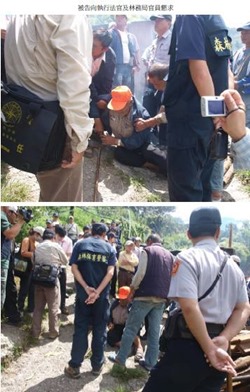
The Forestry Bureau and the Civil Enforcement Division of the Nantou District Court took advantage of a typhoon day to go up the mountain and, on August 30, carried out a forced enforcement against the home and village office of Yeh Chin, the former village chief of Rongxing Village, Ren'ai Township, Nantou County, in the Lishan area. The old village chief was powerless to protect his own home and the village office, felt he had failed the villagers, and attempted suicide but was rescued. Yet the Forestry Bureau has filed civil lawsuits against old farmers all over the mountains and thereby obtained enforcement titles. Are those enforcement titles really lawful? Is this really the right thing to do?
Under the national forest land afforestation lease contract for the Deji Reservoir catchment area of Taiwan Province that the Forestry Bureau signed with forest farmers in the Lishan area, each lease term was nine years. This was because the government at the time, in order to resettle the veterans who had opened up the Central Cross-Island Highway, implemented resettlement on the spot, letting these veterans stay on the mountain, and through technology transfer encouraged them to grow apples, peaches and other high-chill fruit to make a living. That is why the veterans gathered there and named the place "Rongxing Village."
Unexpectedly, thirty or forty years later, the government cast these old veterans aside. Because of a policy change, overnight the apple trees and peach trees were no longer officially recognized as afforestation tree species, so the old farmers who had trusted and followed the government's policy guidance became lawbreakers. In addition, by the Taiwan Provincial Government announcement of June 17, 1993, No. Fu-Yeh-Lin-Tzu 163060, the "Deji Reservoir Catchment Area Steep-Slope Agricultural Land (Over-Limit Use Land) Handling Plan" approved by the Executive Yuan, the authorities unilaterally decided that forest land with a slope of more than 28 degrees was so-called over-limit use land, and terminated the lease contracts across the board.
From then on the old farmers had almost no room to raise objections. Once land was found to be over-limit use land, the Forestry Bureau terminated the lease, and if the farmers were unwilling to return the land, the agency hired lawyers to sue them in civil litigation. After being sued for no apparent reason, the farmers left the mountain at over two thousand meters and rushed around to the Nantou or Taichung District Court to respond, and without exception lost their cases.
The Forestry Bureau unilaterally terminates leases, letting public law hide behind private law

The government promotes Lishan agriculture on one hand while forcing farmers to return land on the other; the policies conflict. Image source
Ignoring history and driving people to a dead end through the law, this is tyranny
Yet the Forestry Bureau hired lawyers all over the mountains, sued the old Lishan farmers in civil litigation, and after winning its judgments paid no heed at all to these old farmers' lifetime contributions to the country, or whether their right to life could be protected. Even when veterans such as Ma Yu-ju, already advanced in years (eighty-five years old), knelt on the ground during enforcement and begged bitterly, Forestry Bureau officials remained unmoved, forcibly demolishing the house he had lived in for forty or fifty years and cutting down all the fruit trees of his life's hard work. Ma Yu-ju had no house to live in from then on and could only stay with another old veteran friend.
Not long afterward, that veteran's home was also subject to enforcement, and Uncle Ma could only move in with yet another veteran in the same village. I once went to Ma Yu-ju's more recent residence, a low house below the Central Cross-Island Highway. Under the dim light, the old man was still fairly sturdy, but whenever he thought of what he had met with in this life, his thick hometown accent never stopped, and his old tears flowed freely. He gave the prime of his life in service to the country, and in old age his home was destroyed by the country and he was driven from place to place by the country, in a great grief beyond words.
Cases like this are almost a portrait of the villagers of Rongxing Village. In Guoxing Township, Nantou County, an old farmer has already killed himself after being sued in civil litigation by the Forestry Bureau. The Forestry Bureau's enforcement on August 30 against the Rongxing village chief's home also nearly became an irreversible tragedy. The Council of Agriculture, which should have protected and cared for farmers, has instead become the killer pushing farmers toward the end of their lives. Is this the Council of Agriculture's task? The state unilaterally changed the rules and unilaterally terminated leases, disregarding the people who at the time trusted and followed its policy guidance, entirely free of judicial review. Is this right?
Professor Huang Jung-chien of National Taiwan University said the law must always leave people a way forward, and it must be a way that people can actually walk. Suing old veterans in civil court, obtaining so-called enforcement titles, tearing down their houses, destroying their fields, and driving them to a dead end, this is what refuses to leave people a way forward, and it is absolutely not law.
This is tyranny.