Gaoping wax apple is naturally deep red with excellent quality, no artificial coloring needed
Recently a television news report claimed that a consumer bought wax apples (bell fruit) at a fruit shop; the originally red wax apples faded and turned white the next day at home, and other red wax apples that had not turned white, when washed with water and wiped with toilet paper, actually left red pigment on the paper. As soon as the news came out, farmers found it laughable, because dyeing wax apples is simply not feasible, and even less could it improve quality; it would only backfire. The reliability of the report is questionable, and it risks misleading the consuming public.
Huang Te-chang, director of the Kaohsiung District Agricultural Research and Extension Station, said that the skin of the wax apple is smooth and contains a natural waxy layer. If a dye were sprayed on or soaked into it, the dye would quickly slide off, and it would be impossible to dye a white wax apple red. Even if it were soaked in or injected with dye, the whole fruit would turn red; it would be impossible to produce the natural graded coloration of a wax apple, and this can be easily judged from the appearance. Moreover, the wax apple fruit has thin skin and does not keep well to begin with; after soaking in water or dye it would only rot more easily. Neither farmers nor vendors would do such a foolish thing.
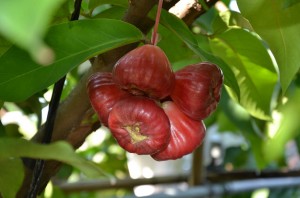

As for the scene in that news report in which the deep red wax apples that had not faded left pigment on toilet paper after being washed with water: in fact, as long as a little damage is caused to the wax apple skin when rubbing it, the anthocyanins naturally produced by the skin can easily be rubbed off, leaving a red stain on the toilet paper. This is a normal phenomenon and there is no need to be surprised or suspicious.
As for wax apples that really would fade after one day, then the wax apples a vendor had not sold that day would surely also be unsellable the next day because they had faded; such an approach has no economic benefit and is not feasible, so of course it could not happen.
Since mid-February this year, because the climate has been stable and cool, the wax apples produced in the Kaohsiung-Pingtung area have performed quite excellently in sugar content, color and taste, while production after the Lunar New Year is relatively low, so they are in great demand both in direct sales at the place of origin and on the auction market, with auction prices even higher than before the Lunar New Year. The Kaohsiung Station especially calls on the consuming public not to spread misinformation and cause unnecessary trouble.
If there are still any doubts, one can buy directly from farmers with a good reputation. For related information, you are also welcome to contact the researchers at the Kaohsiung Station directly; they will wholeheartedly provide enthusiastic service, telephone 08-7746743.