Does Zero Euthanasia Actually Encourage Abandonment? Shelter Vets Under Explosive Pressure
The director surnamed Jian of the Taoyuan Animal Shelter used animal euthanasia drugs to take his own life a few days ago, and could not be saved despite resuscitation efforts, drawing attention from all sectors. According to statistics, public shelters take in thousands of animals every month, with only a few veterinarians on staff, and with space severely insufficient, frontline veterinarians face enormous work pressure.
After the 2013 documentary "Twelve Nights," public opinion became generally averse to the "humane handling work" (euthanasia) of animal shelters, and pressure from all sides pushed through an amendment to the "Animal Protection Act" (abbreviated as the "Animal Protection Act"). At the end of this year, the "zero euthanasia for stray animals" policy is about to be implemented, but with a lack of source management and only minor responsibility for dog abandonment, the number of abandoned animals is crushing shelters that were already overloaded.
The zero euthanasia policy has led many people to mistakenly believe that stray dogs are all cared for by the government. With the large number of abandoned animals, public shelter space is overflowing, and many animals are transferred to private shelters to die slowly, turning Twelve Nights into an endless night, and becoming even more of a nightmare for veterinarians.
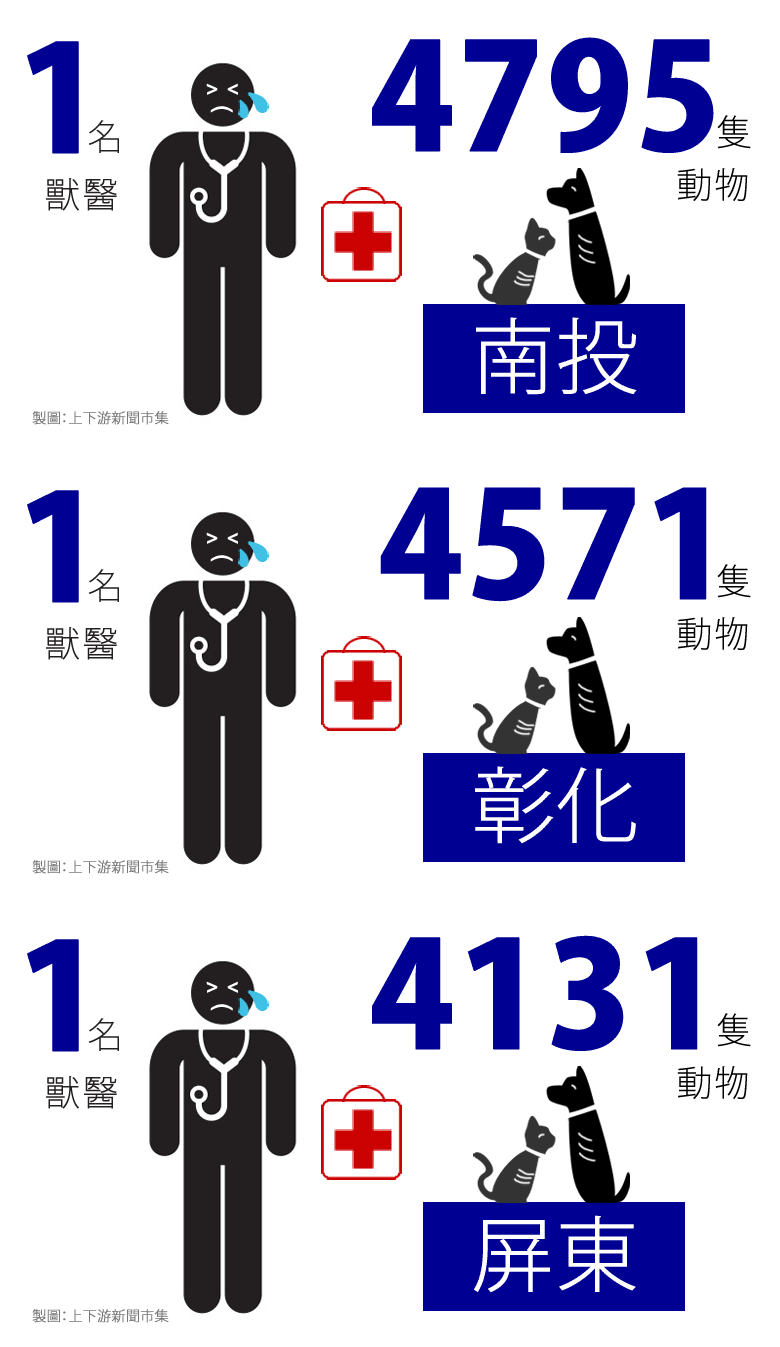
III. Zero euthanasia is only an illusion; frontline veterinarians carry the heavy burden
Chen Yumin lamented bitterly that the Council of Agriculture and many elected representatives who tout zero euthanasia as "a great step for animal welfare" ignore the fact that the work of animal shelters involves expertise from many fields. With no staffing allocation and a harsh, crowded hardware environment, staff turnover is extremely high, and the situation veterinarians face is extremely arduous.
Take the situation at local shelters: the 20 or 30 dogs that have just arrived at the shelter on a given day must be properly separated into cages within a single morning, so that weaker dogs are not attacked and bitten by stronger dogs. This is the expertise of animal behavior; caring for animal health involves veterinary expertise, and reducing disease occurrence is a matter of public health; as for how to encourage the general public to strengthen owner responsibility and raise the adoption rate, that is social expertise. "But in Taiwan, all of it is dumped on frontline veterinarians alone, on a small number of people to shoulder, who can bear it?" Chen Yumin said.
Chen Yumin believes that what likewise harms frontline veterinarians is the lack of psychological counseling after performing euthanasia on animals. Especially in Europe, there is an entire counseling team to provide psychological preparation and support for veterinarians, but in Taiwan it is left to veterinarians to silently bear on their own.
She stressed that Taiwanese society must rigorously handle policies for the breeding and sale management of pets, and implement sterilization of domestic dogs and cats, strengthening owner responsibility and education. If the only demand is lifetime sheltering without euthanasia, the stray cat and dog problem will only continue endlessly.
IV. Council of Agriculture: There are inspections and microchipping, but how effective are they?
Facing the deficiencies in source management, Jiang Wenquan stated frankly that the Council of Agriculture is currently amending the "Specific Pet Industry Management Regulations." For dogs, whether at breeding farms, pet shops, or bred at home, microchips must be implanted; for cats, regulations target breeding farms and pet shops. He said the Council of Agriculture currently has records of 1.5 million microchip registrations, and all dogs that have been microchipped and registered are roughly estimated to account for about 60% of all domestic dogs.
At the same time, the Council of Agriculture and local governments conduct inspections at night markets, parks, suspected breeding farms and other areas. "Not only scanning microchips, but also rabies vaccines, sterilization work, and so on." Jiang Wenquan said there are more than 10,000 dispatches each year, so it is not that nothing is being done.
However, Chen Yumin pointed directly at the question of just how "effective" the microchip data held by the Council of Agriculture really is. For one, do pet shops faithfully register the data, and after a dog changes owners, is the information updated online?
"When Taiwan had a rabies outbreak a few years ago, we called on the government to use this crisis to conduct a dog population survey through the neighborhood chief system, together with the census, so as to grasp the number of domestic dogs." Chen Yumin said, if the Council of Agriculture cannot even clearly grasp the actual number of domestic dogs, the number of microchipped domestic dogs, and the number of valid data records, how can it solve at the source the problem of "zero euthanasia" crushing frontline workers?