Donagh Rua People's Food Culture Experience Tour
When people walk into the kitchen, choose the cooking utensils they will use, put food into the vessel they have chosen to cook it in, let it finish cooking, and bring it to the table, every habit and every step of the process is closely tied to the environment and to culture.
In today's society, where capitalism has become the mainstream, those who hold capital replace human labor with increasingly precise, complex, and efficient machines. Put simply, in a production process injected with large amounts of capital, the continuity of every step is strung together through monetary transactions that producers cannot afford; the labor, land, machines, and other materials needed for production become disconnected, unrelated individuals, and at the same time the close link between the object of production and culture is severed.
When monetary transactions become the fastest shortcut to obtaining the tangible and intangible things one needs, consumers, faced with the many objects available for choice in a capitalist society, no longer need to think about what the relationship is between the things they use and people and the environment. On the other hand, even if they want to understand, consumers find it hard to easily obtain information about the production history behind packaged objects, their connection to the place of origin, and so on.
Take cash crops as an example: what kind of farming can meet the need to sustain the reproduction of a community? What crops can be planted in which season? (Why do some communities mainly grow rice as a staple food, while others mainly grow wheat or millet?) What kind of implements are needed to assist in growing crops? What rituals need to be performed in the process from sowing to harvest? What relationship do these rituals have with the crops? Behind every question mark points the same issue: the food of a community and its culture are inseparably connected. But because of changes in the form of social supply and demand, the way food is produced has also changed, and the gradual disappearance of a community's culture in contemporary society has become an inevitable fact.
In 2014, the ten events of the "Kaohsiung Countryside Feast" organized by the Agriculture Bureau of Kaohsiung City, with 500 person-times of farm-food feasts, moved the dining tables of restaurants directly to the places of production. The aim was to awaken not only people's concern for local small farmers and for the industry, but also, through hands-on participation in the activities, while touching crops in the soil with their hands and eating crops grown on this land with their mouths, to help people recover the long-estranged emotional bond with the land and the local cultural memory. The author of this article will use the tribal outdoor cookout of the Rukai hunters held in 2014 at the Duona Tribe in Maolin during the "Kaohsiung Countryside Feast" as a record of an activity and its cultural connections.
Taiwan's Indigenous People - The Rukai
Taiwan's indigenous peoples belong to the Austronesian language family and are divided by language into sixteen groups, each with its own distinctive culture, social structure, and customs. The Rukai are distributed in Maolin Township of Kaohsiung County, Wutai Township of Pingtung County, and Dongxing Village of Taitung County, among other places.[1] The main source of livelihood for the Rukai is the agricultural form of "slash-and-burn mountain fields." The crops they grow are divided into grains and root vegetables: among grains they grow millet, broomcorn millet, rice, and goosefoot, while among root vegetables they grow crops such as taro and sweet potato; in addition, they take up hunting and gathering as side occupations.
"Slash-and-burn mountain fields" is a farming method that cycles through the steps of choosing a site, cutting, burning, cultivating, harvesting, and leaving fallow. Another more widely known term for it is "shifting cultivation." This kind of farming method allows the land, after being effectively used, to maintain its fertility and ecological balance. Each cultivation period, in order to clear the land and farm it, the Rukai used slate to build temporary shelters as work huts, the purpose being a place to rest, shelter from wind and rain, and guard against attacks by wild animals while farming.
[1]Source: Council of Indigenous Peoples.
Because the land where the Rukai live is relatively poor, taro and sweet potato are their staple foods, and millet occupies an important place among the community; the year's important rituals are also set according to the growth cycle of millet. Every year, February and March are the time for sowing millet, and May is the season for transplanting rice seedlings. The Rukai plant crops such as pigeon pea, corn, and taro around the millet. The millet can be harvested around June or July, and the harvest festival is held in August. The other crops planted around the millet continue to grow and can be harvested around September or October. Every year from December to February of the following year is the slack farming season, and it is also the dry season of the rivers; at this time the Rukai carry out hunting and fishing, and the food obtained from hunting and fishing is also the main source of protein food for the Rukai.[2]
The harvest festival (Kalalisine), held around August each year, is an important rite for the Rukai. Its purpose is to thank heaven for its protection in granting a year of good harvest and to pray that the coming year will also bring a good harvest. Traditional Rukai society had a class system. The millet crop, growing with the passage of time, carried not only the provision of food; in the millet harvest festival, the making and wearing of clothing for different classes, the songs and dances, the rituals, and the food all became important activities linking the emotions of the community members, transmitting heritage, and continuing culture. For example, during the festival, community members present agricultural harvests and the proceeds of fishing and hunting to the chief, and the chief then distributes part of the food to community members in need. The process in which male community members bake millet cakes serves as a divination ritual connected with religion, and so on; these are all distinctive cultural institutions. Put simply: farming carried out in accordance with the order of heaven and earth and the holding of festivals became a very important part of continuing Rukai culture.
[2]Wang Changhua, 1995, "Revised General Gazetteer of Taiwan Province, Volume 3, Inhabitants Gazetteer, Same-Race Section, Rukai." Nantou: Taiwan Provincial Historical Research Commission.
The Rukai - Duona Tribe
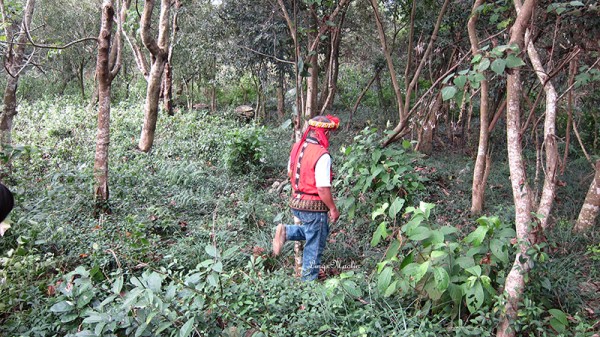
Before entering the Duona Tribe in Maolin from Kaohsiung, one first passes through Maolin Tribe and Wanshan Tribe, and only then arrives at the deepest point, Duona Tribe. Because these three tribes are distributed along the lower reaches of the Zhuokou River, they are collectively known as the Lower Three Communities. On the morning of arriving at Duona Tribe, the Rukai hunter Mr. Jian Erke led the people participating in the Kaohsiung Countryside Feast on a field visit to the tribe's former farmland sites (Figures 1, 2, and 3). Because of its remote geographical location, Duona Tribe has not yet seen too much development and preserves more traditional buildings of slate houses. The dwelling place of the Duona Rukai produces black-gray slate and shale, and their buildings, with walls and houses piled up from this stone material, became the distinctive feature of Rukai houses. The farmland site piled up with slate shown in the figures also corresponds exactly to the shifting cultivation described above. The place Mr. Jian Erke took us to that day was a spot once chosen by the Duona Rukai as farmland; now, because it is no longer used as farmland, it has again grown full of various and diverse plants.
 (Figure 16)
Taiwan's indigenous peoples were already living here before the Han Chinese migrated in. After the Han Chinese migrated to Taiwan and Japan ruled Taiwan, the indigenous peoples settled in mountainous areas and places with abundant water, and developed a model of peaceful coexistence that takes from nature and returns to nature. In tradition, clothing, food, housing, and transportation all contain the wisdom left by the elders. In today's society, where material life is abundant and the necessities of life are easily obtained, the wisdom of coexisting with nature within these communities is gradually being ignored and forgotten. It is hoped that when we look around at the tribal environment and culture and eat delicious food, we can remind ourselves to respect agriculture, culture, and the environment, and support farming activities that are friendly to the environment.