The Secrets of Fresh Milk Pasteurization: An Analysis of Five Key Points (Part 1)
The "destroy-the-top" movement is in full swing, and internet users have been experimenting with Lin Fengying fresh milk, finding that it does not spoil after 5 days, forcing Wei Chuan to defend itself by conducting its own tests to debunk the rumors, and stressing that "as long as pasteurization is thorough, the shelf life of fresh milk can be extended, and there is simply no need to add preservatives." But Chen Chun-cheng, an adjunct lecturer at the Extension Education Division of Chinese Culture University, says that drinking milk is not the same as eating ice cream; it is not that the fewer bacteria the better, and the more thoroughly pasteurized, the lower the nutritional completeness.
Fresh milk is one of the important sources of calcium and protein for humans, but among the proteins, "whey protein," which has antibacterial and immunity-enhancing functions, loses its function with ultra-high-temperature pasteurization; in addition, "vitamin B12," which is found only in animal-based foods such as milk, is also easily destroyed by heat.
Exactly how much nutritional value does fresh milk lose with pasteurization? What are the considerations of dairy producers? How should consumers choose and consume it? Follow along with News&Market as we explore the matter.
1. How many pasteurization methods are there for commercially sold fresh milk?
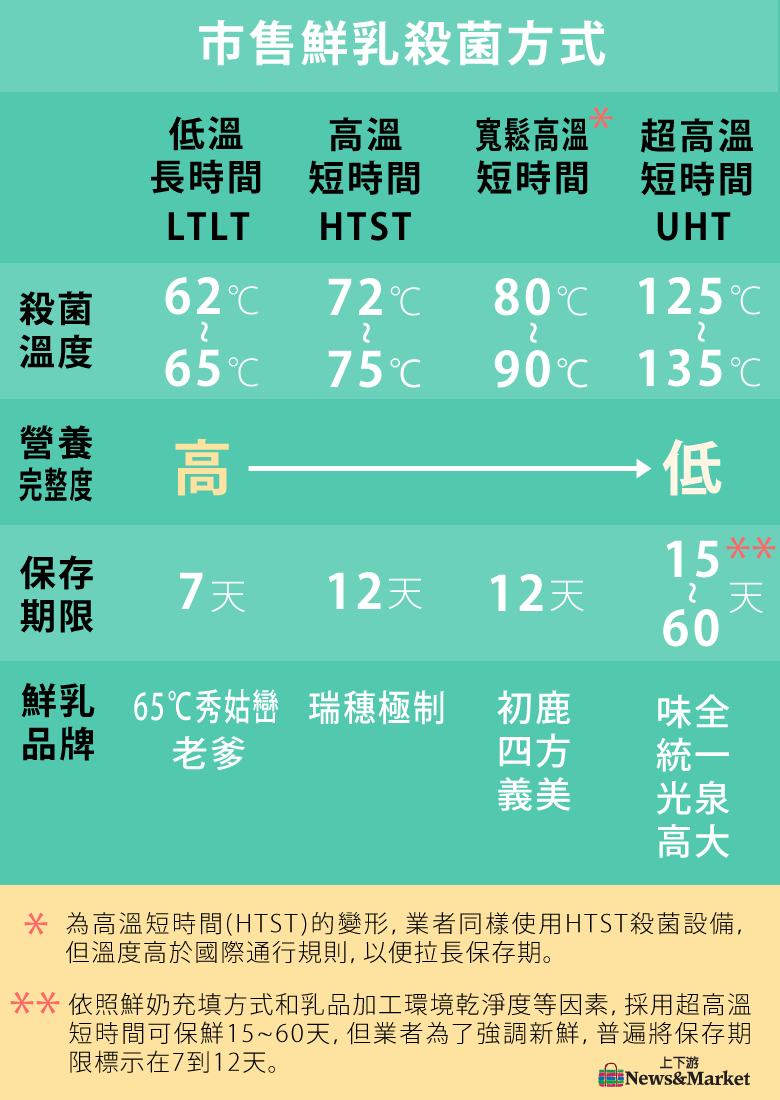
In addition, high-temperature pasteurization also destroys the water-soluble vitamins in milk, that is, the B-complex vitamins. Chen Ming-ru points out that the content of vitamins in milk is less than 1%, but among these is vitamin B12, which is lacking in plant-based foods. As the pasteurization temperature rises, water-soluble vitamins decrease by more than half, but milk mainly provides calcium and protein nutrients. From the perspective of the overall nutritional value of fresh milk, the loss of these vitamins actually makes little difference to milk's nutritional value; the key point remains whether consumers have a need to consume them when making their choices.
3. The price of fresh milk's rich, pure aroma?
Many fresh milk brands emphasize a rich, pure aroma, but experts say that this is actually the "Maillard reaction" produced after high-temperature pasteurization of milk. The essential amino acid "lysine" contained in fresh milk reacts with "lactose" to produce furosine, and the Maillard reaction causes "browning." For example, commercially sold long-life milk is darker in color and smells richer, and all of this is the effect of the Maillard reaction.
Chen Chun-cheng, who has 30 years of experience in the dairy industry and is currently an adjunct lecturer at the Extension Education Division of Chinese Culture University, says that essential amino acids are amino acids that the human body cannot synthesize on its own and must be supplemented through dietary intake. Lysine is one of them, but because the heating method for fresh milk causes lysine to combine with other substances such as lactose, the biological value of lysine decreases, and the original protein value is also affected, so that after consumption by the human body it cannot be utilized.
Chen Ming-ru states that because people in Taiwan have long consumed UHT-heated fresh milk, they have already become accustomed to the flavor of this type of dairy product, and many consumers find HTST-pasteurized fresh milk relatively bland. Therefore, based on safety considerations for the transportation and sale of fresh milk, along with Taiwanese people's preference for the flavor of fresh milk, most commercially sold fresh milk in Taiwan currently chooses UHT pasteurization. If the quality of raw milk can continue to improve in the future, ensuring cold-chain transportation and sale at 7˚C throughout, more HTST-pasteurized fresh milk should be seen on the market. Chen Ming-ru further emphasizes that when consumers purchase fresh milk, in addition to comparing pasteurization temperatures, whether it has a fresh milk label and CAS is also an important reference indicator for quality and safety.
To continue learning the secrets of fresh milk pasteurization, please click here to read
For more professional agricultural science and technology information, please scan the QR code to follow WeChat: NongXunNET

Please indicate the source when reposting.