How do you practice grass-grown cultivation? Master these key technical points
After "Satoyama Juku" was established, we began reaching out to local citrus growers, and gradually came to understand the challenges these growers face. If planting quality is to be improved, and a local citrus brand for Jiaopu is even to be built, the current method of heavy pesticide and chemical fertilizer use clearly needs to change. But friends who have taken part in the "Satoyama Citrus Aroma" activity probably also understand that if farmers switch to organic cultivation, they may face risks such as the death of fruit trees. When one fruit tree is lost, it means several hundred jin less of harvest over the next five years, and for farmers this is a very big risk. How can farmers be guided step by step toward healthy orchard farming methods while avoiding the loss of their fruit trees?
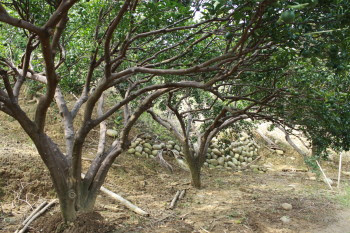

Farmer Zhan Jinzhang of Zhuolan said they are happy farmers who weed only three times a year, which is much easier than the Jiaopu farmers who have to weed six to eight times a year. According to Mr. Zhan, at first he did not even weed his orchard; when the grass really grew too tall, he would press it down with a hoe or a wooden stick, just enough so it did not get in the way of farm work. Of course, such an orchard also attracted snakes, raising the risk of snakebite, so Mr. Zhan began mowing, and when mowing he kept a height of 30 cm, which helps the soil retain water and also maintains the biological profile of the grass and the microbial profile of the soil. Unfortunately, because Mr. Zhan was very busy, we could not visit Zhan Jinzhang's orchard that day, but we agreed to visit again in December.
After hearing Mr. Zhan's sharing, I suddenly became alert: could it be that when we think of "grass cultivation", we are still in the traditional mindset of "weed everything out", and have not yet progressed to "coexisting with grass"?
At the end of last month, we sent out a message seeking environmentally friendly fruit farmers in central Taiwan, and received many responses. Next we will arrange visits to farmers, to understand the challenges everyone faces and also to learn from them. We also hope that starting next year, we can find a suitable local orchard and begin practicing "grass cultivation" to accumulate experience. Let us all work hard together for environmentally friendly agriculture!