Animal Health Inspection Office: Foot-and-mouth disease in cattle in Kinmen, Taiwan, China suspected to be the same virus type as the 2013 Guangdong Maolin outbreak
The Animal Health Research Institute (AHRI) under the Council of Agriculture today (the 2nd) released the test results for the cattle in Kinmen infected with foot-and-mouth disease, confirming that the animal was infected with type A foot-and-mouth disease, and that its viral nucleic acid, when compared by the UK's World Reference Laboratory for Foot-and-Mouth Disease, showed 98.9% similarity to strains from China and Russia, belonging to the Southeast Asia 97 (SEA97) virus strain.
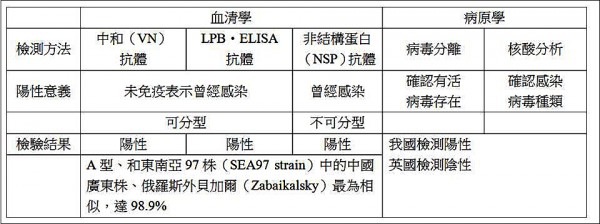
Kinmen cattle foot-and-mouth disease may be the same virus as the 2013 Guangdong Maolin case
Whenever a foot-and-mouth disease outbreak occurs anywhere in the world, the virus strain is sent to the UK's Pirbright Institute World Reference Laboratory for Foot-and-Mouth Disease for retesting. Its testing methods include detecting neutralizing (VN) antibodies, LPB-ELISA antibodies, and non-structural protein (NSP) antibodies to confirm whether the foot-and-mouth disease virus is present.
Among these, our country's Animal Health Research Institute generally uses NSP for testing, but NSP cannot confirm the virus type, so VN antibody and LPB-ELISA antibody testing must be used to further determine the type; however, both of these antibody testing methods require live virus strains to perform, and our country's Animal Health Research Institute does not have live virus, so it cannot conduct the tests.
After infection with the virus is confirmed, virus isolation and nucleic acid analysis are then carried out. Virus isolation uses live cells to detect whether live virus is present; nucleic acid analysis confirms the type of virus infecting the animal.
Through testing VN antibodies and LPB-ELISA antibodies, it can be confirmed that this Kinmen foot-and-mouth disease case belongs to type A foot-and-mouth disease, and is most similar to the Guangdong strain from China and the Russian Zabaikalsky strain within the Southeast Asia 97 strain (SEA97 strain), reaching 98.9%.
Can it therefore be inferred that the virus indeed came from China, or even that it is the same virus as the 2013 Guangdong Maolin case? The Animal Health Research Institute believes that more evidence is needed before a concrete conclusion can be drawn, but does not rule out that, due to geographical proximity, it may have spread to Kinmen via people or wind.
In addition, regarding the nucleic acid testing, our country's test was positive while the UK's was negative. Tsai Hsiang-jung, Director of the Animal Health Research Institute, speculates that the reason for the discrepancy is that RNA is less stable than DNA, and the enzymes and bacteria contained in the throat fluid samples may destroy the viral RNA, causing the sample count to fall below the detection threshold.
At present, the Bureau of Animal and Plant Health Inspection and Quarantine has culled 281 cattle, and in accordance with the World Organisation for Animal Health (OIE) regulations, before the outbreak is confirmed to be over, live livestock and fresh meat products cannot be moved arbitrarily; and within 1 km of the cattle farm where the outbreak was reported, two rounds of visits have already been completed, and one final round of visits must still be completed. If it is confirmed that there is completely no outbreak, the restrictions could be lifted by September at the earliest.