Minister of Local Vitalization Award: "Japan Food Communication" author Hiroyuki Takahashi visits Taiwan, China in September
News for 20160907: Hiroyuki Takahashi, author of "Fresh Food Limited-Time Batch: The Complete Record of Japan Food Communication's Challenge," is coming to Taiwan, China in September. From September 20 to 24, several sharing sessions will be held across northern, central, southern and eastern Taiwan, China. To register in advance and for complete information, please click here.
Japan Food Communication, 1st Japan Service Grand Award, Minister of Local Vitalization Award
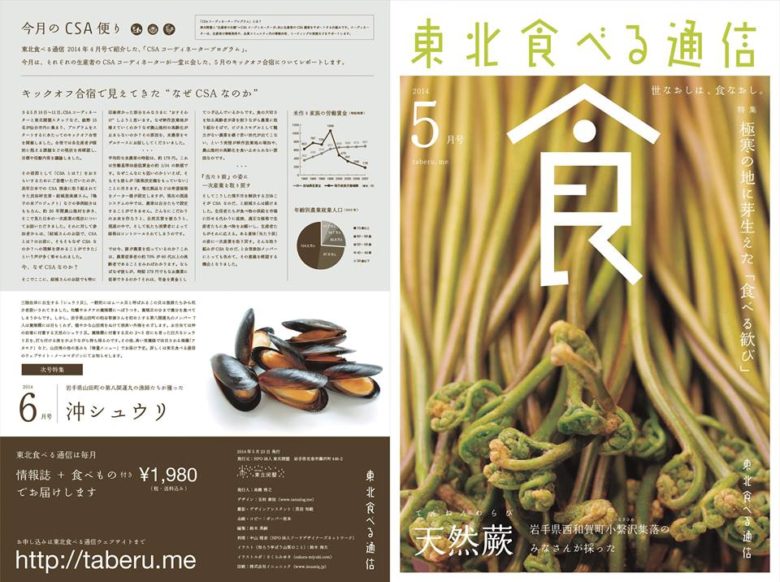
A year ago (July 2015), NewsMarket reported that in northeastern Japan, the first magazine in history that can be both read and eaten was born: "Subscribe to the Magazine and Receive Ingredients: 'Japan Food Communication' Connects Production and Sales Communities." Readers can not only communicate directly with producers through a members-only Facebook group and take part in events, but can also support their favorite farmers with monthly payments in a CSA (Community Supported Agriculture) model.
Within just a few months of its founding, "Tohoku Food Communication" had more than a thousand members and attracted considerable attention. This year it went on to receive the 1st Japan Service Grand Award, Minister of Local Vitalization Award, as well as recognition from PR Awards Asia 2016.
Founder Hiroyuki Takahashi has further spread this model, which combines media, logistics and CSA community operations, across Japan in an alliance format, hoping to let the sense of real life and human connection created by Food Communication bloom everywhere in Japan. Yuanzu Publishing has released "Fresh Food Limited-Time Batch: The Complete Record of Japan Food Communication's Challenge," written by Hiroyuki Takahashi, which explains in detail how Food Communication operates in Japan, the impact it has had, and the various moving moments along the way.
Who is Hiroyuki Takahashi? He served two terms as a member of the Iwate Prefectural Assembly. During his time in office, he felt deeply the decline of agriculture, forestry and fisheries, the aging of producers, and the depopulation of local areas. After the 311 disaster, he ran for governor, and after losing, he founded "NPO Tohoku Reclamation." After much trial and error, he launched the ingredients-plus-information magazine "Tohoku Food Communication" the year before last.
This autumn, I harvested something extraordinary
After the rice harvest ended, Mr. Kikuchi still kept in touch with readers through Facebook. His feelings are laid bare in his later Facebook posts--
To all the friends who have kept this autumn in their hearts:
I truly thank you all for your tremendous help the other day. This autumn's harvest had actually reached a point where I had given up hope and was close to abandoning it. But starting the day after I decided to give up mechanical harvesting and ask everyone to help, ten friends rushed over, then more people came the next day, and then more the day after that.... In the end, nearly two hundred friends came down to the fields to help, and we finally finished the entire harvest smoothly.
Among them were friends who came from as far away as Kansai and Hokkaido, driving long distances or taking overnight buses despite the hardship... and finally reached this remote border of Oshu. I had thought I could at least take everyone to a hot spring or something, but even such plans could not be realized. During those days when we simply buried ourselves in cutting rice and sweating, I still feel joy when I recall it now, and I also feel deeply ashamed of my own uselessness.
I feel that this autumn, I harvested many extraordinary things. In short, it was hearts that "resonate" with everyone. Until now I had focused only on rice cultivation without pesticides, without fertilizers, and without tilling, sharing that spirit with the creatures of the natural world. Yet in a certain sense, that was also a lonely world. But this time, in that field, because all of you came, the scenes of laughing together and opening our hearts to one another are, to me, a great fact. (omitted)
"Food" is nature, shared joy and connection
The act of "eating" is nature, is learning, is connection. I want to elevate the act of "eating," which had left me isolated, into "eating" shared in joy with friends.
I think that is probably something that cannot be obtained from the simple act of buying ingredients. We on the production side are lonely as well. No, actually it is not we who are producing; what produces is the sky, the earth and the water, and I am merely standing between them. In this kind of interaction with nature, thinking, creating and playing in concert with heaven and earth on the question "How is my food born?" I cannot help but think how wonderful it would be if this kind of world, harmoniously composed together, could be thought about and realized together with everyone from now on.
In more than a year of running "Tohoku Food Communication," what readers and producers taught me is how the originally poor and monotonous "exchange relationship between food and money" can transform into the richly varied "interactive relationship between eaters and producers." Is it because we exchange money for food that the true meaning of "eating" has faded from memory?
"Eating" and "making food" are two sides of the same coin. By breaking away from the dull relationship between exchangeable "money" and "food," and returning to the fulfilling relationship between the irreplaceable "person who makes it" and the "person who eats it," producers and consumers can become partners who encourage and cheer each other on. This time, Mr. Kikuchi and many partners proved this together.
(This article is excerpted from Fresh Food Limited-Time Batch: The Complete Record of Japan Food Communication's Challenge, published by Yuanzu Culture, released on July 6.)
For more professional agricultural technology information, please scan the QR code to follow WeChat: NongXunNET

Please indicate the source when reprinting.