Veterinarian sells fresh milk online to break monopoly, animal protection groups urge disclosure of dairy farmer selection criteria
The long-established brand "Wei Chuan" lost all of its goodwill because of the blended oil scandal, and its fresh milk brand Lin Feng Ying was dragged in as well, taking a toll on innocent dairy farmers. A veterinarian specializing in dairy cattle, Kung Chien-chia, raised funds online in order to break the monopoly in the fresh milk market, bringing together 2 to 5 dairy farmers to set up the "Fresh Milk Workshop" platform, where milk is sterilized and disinfected at a contract factory and then delivered straight to consumers. Animal protection groups say the idea is a good one, but the platform should go further and disclose the dairy farms and selection criteria so as to win consumers' trust.
Negotiating with dairy farmers to build fair trade
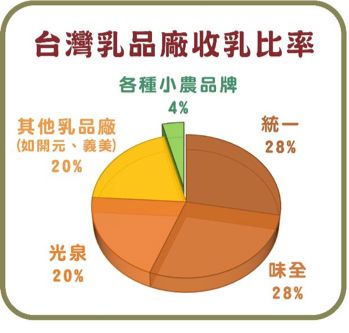

Many food safety incidents in recent years have involved milk, from the 2008 melamine incident to Business Weekly's 2013 tainted milk false alarm, and at the end of last year Lin Feng Ying fresh milk was boycotted by consumers because its parent company was caught up in the blended oil scandal. Kung Chien-chia joined the boycott too, but as a frontline veterinarian he also felt the injustice done to hardworking dairy farmers. "This contradiction exists because the milk market is monopolized by the big companies," he said. There are about 500 dairy farmers in Taiwan, China, but nearly 80% of the milk supply is controlled by three major companies. What went wrong in the food safety incidents was the brand, not the dairy farmers, and that is what gave rise to the idea of direct delivery from small farms.
Kung Chien-chia said there are currently about 2 to 5 partner dairy farms, located in Changhua and Kaohsiung, and that they use negotiation, coordinating a reasonable price with the farmers in the hope of promoting fair trade so that dedicated dairy farmers get a corresponding return. In the future they will take photographs and keep records, disclose the source of the milk, and put the dairy farmers' stories online. A website is expected to be launched in May, so that consumers can choose the source of their milk themselves.
The dairy farmers working with Fresh Milk Workshop are all farms that Kung Chien-chia has visited himself for house calls. He said that when selecting them he pays special attention to cleanliness of the environment and cattle management; for example, if some cows run away as soon as they see a person, that may mean the farm staff do not treat them well. These selection criteria cannot be quantified with existing labels and can only be seen by going to the farm itself.
He also admitted, however, that the barriers from sterilization to refrigerated transport are all high. Several factories have been found to discuss subsequent processing, but because discussions are still ongoing it is not convenient to disclose them; once fundraising is over the information will be posted on the website. These factories all have GMP and ISO certification and use the U.H.T. ultra-high-temperature sterilization method, adding no additives at all, preserving milk's original flavor, though basic homogenization adjustment is still carried out, using a homogenizer to break up the larger fat particles so that the oil and water do not separate.
Fresh Milk Workshop has not yet obtained the Council of Agriculture's fresh milk label. Kung Chien-chia explained that the existing fresh milk label is designed specifically for dairy processing plants, and unless a farm has its own processing plant, small farms simply cannot get one. But before Fresh Milk Workshop's milk leaves the factory, it is always tested for milk composition, microorganisms, cell count, drug residues and so on.
Animal protection groups call for disclosure of dairy farm selection criteria
Fresh Milk Workshop launched pre-orders online at the end of January, aiming to raise a million, and reached its target in less than a week, winning recognition from many consumers. But some people familiar with the dairy industry remain cautious: the fresh milk label can control the milk source and the final product volume, preventing unscrupulous operators from passing off milk powder or watering it down, and it is not meant to deliberately make things hard for small farms. Moreover, Fresh Milk Workshop has not yet disclosed the locations of its farms and processing plants, making the source hard to control.
Chen Yu-min, director of the Taiwan Animal Society Research Association, who has long cared about animals, believes Fresh Milk Workshop's intent is very good, and that observing how friendly the cows are is indeed one indicator of whether management is good or bad. But Fresh Milk Workshop should disclose its farm selection criteria, and could refer to practices in other countries; for example, the New Zealand government's dairy animal welfare evaluation indicators score separately according to open housing, tie-stall barns, whether pasture access is allowed, outdoor exercise and so on. She hopes Fresh Milk Workshop can disclose how high the rate of mastitis is, the situation with lameness, the source of forage, and the size of the activity space.
Chen Yu-min believes that besides thinking from the dairy farmers' perspective, they must also communicate with consumers and disclose the selection criteria, which can be used to educate consumers about what dairy cattle animal welfare means and can also let dairy farmers know which production method can win consumers' trust, promoting communication between the two sides.
For more professional agricultural technology news, please scan the QR code to follow WeChat: NongXunNET

Please indicate the source when reprinting.