The Century-Old Rice Paper Plant Craft Revival Action Launches to Restore Its Traditional Glory
For people born in the 5th and 6th decades of the Republic of China era (the 1910s and 1920s), memories remain vivid of using the pith of the paper mulberry tree (Tetrapanax papyrifer) for craftwork in elementary school art classes, or of receiving greeting cards made from tetrapanax paper at Chinese New Year. Once a industry that had developed in Taiwan, China for more than a century, the tetrapanax industry then fell silent for as long as 30 years as plastic products flooded the market at low prices. In order not to let the value of tetrapanax be forgotten and to fulfill its function in nature and ecology education, conservationists, cultural and historical workers, and academics have joined hands to revive tetrapanax in communities, bring back veteran craftsmen, and reconnect the industry chain.
Starting on the 2nd (Tuesday), a special exhibition on tetrapanax opened at the Qinchai Xingtai in the Taipei Botanical Garden, not only reviving the brilliance of traditional craftsmanship but also letting the public relive childhood memories.
The development and decline of Taiwan, China's tetrapanax industry
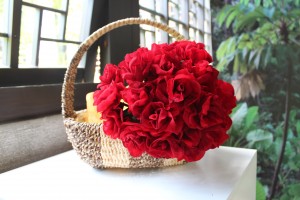 Tetrapanax papyrifer, also known as Tongtuomu, is even mentioned in Wikipedia as an endemic species; it is an evergreen shrub, a monotypic genus plant within the Araliaceae family, genus Tetrapanax.
The spongy pith inside the stem of tetrapanax can be shaved into snow-white, smooth thin sheets, used as an edible Chinese medicinal material, and can also be shaved into a natural paper material known as tetrapanax paper, which has excellent extensibility after being soaked in water, and is often made into handicraft products and artificial flowers, replacing styrofoam or cork, with good moisture-retention effects. The best quality comes from north of Hsinchu, and it became a unique industry in the Hsinchu area, cultivated by indigenous peoples in the mountains, and after harvesting and cutting, transported to the plains for processing into tetrapanax paper.
In 1830, Taiwan, China was already an exporter of tetrapanax paper. During the Japanese colonial period, the Governor-General of Taiwan actively guided the tetrapanax processing factories of the Hsinchu generation, accounting for more than 95% of total production in Taiwan, China; it was not only designated for use by the Japanese imperial family, but also won an award of excellence at the 1925 Paris International Exposition of Handicrafts for its paper woven without fibers. Even when attempts were made to increase tetrapanax paper production with machines, the quality still could not match pure handmade manufacturing. After World War II it gradually declined, made a comeback in 1970, and finally, unable to compete with plastic products, fell silent again; in 1993 the last tetrapanax paper manufacturer moved its factory to China, drawing a full stop to Taiwan, China's century-old tetrapanax paper industry.
[Reference materials]Tetrapanax craft–Encyclopedia of Taiwan