Campus Food Survey Report One: Is National Taiwan University Five-Star or Five-Pointed Star?
Series preface: Eating on campus is really hard for university students
Last year (2012), a series of elementary school nutrition lunch scandals made the public start paying attention to campus food, and many local governments even enacted regulations so that elementary school students could eat at least one organic meal a week. But while elementary school food gradually improved, university campuses did not keep pace.
When universities rushed to invest huge sums and upgrade facilities in hopes of breaking into the world's top 100 universities, the schools turned cafeterias into expensive and bad-tasting food courts through the turnkey contractor system; and when students wanted to cook for themselves as a remedy, the schools banned these adults from using fire for safety reasons. When the contractors see only profit and the schools think only of dodging responsibility, can students really have a choice?
After last year's campus nutrition lunch special report, NewsMarket this time steps into university campuses to examine the food environment of university students in Taiwan, China, discuss the food truth that university students face, and also explore the possibility of putting green cafeterias into practice at universities. This article is the first in the series.
The snack bar becomes the slop bar, but students still have to eat
When the end-of-class bell rang, student Zhou hurriedly packed up his textbooks and quickly walked into the school cafeteria to meet his classmate. "Do you want noodles or rice today?" "Rice is ready, but that buffet place is really oily." "But the cheapest roast meat rice at the other place is 80 yuan, and I'm really poor lately." "All right, then let's just eat at the buffet." After standing there for more than ten minutes, the two still helplessly walked toward the buffet stall. Even though there were as many as several dozen cafeterias on campus, they still had to rack their brains every day deciding what to eat for their next meal.
This kind of conversation must sound familiar to university students. Besides coursework, part-time jobs, and clubs, what university students worry about most is eating, but often when they walk into the school cafeteria and face a dazzling array of menus, they still do not know what to eat. "We all nickname the snack bar the slop bar," said a student surnamed Chen at National Tsing Hua University. He himself only regularly ate at one shop in the school cafeteria, because the others were all expensive and bad-tasting, and vegetables and fruit were pitifully scarce.
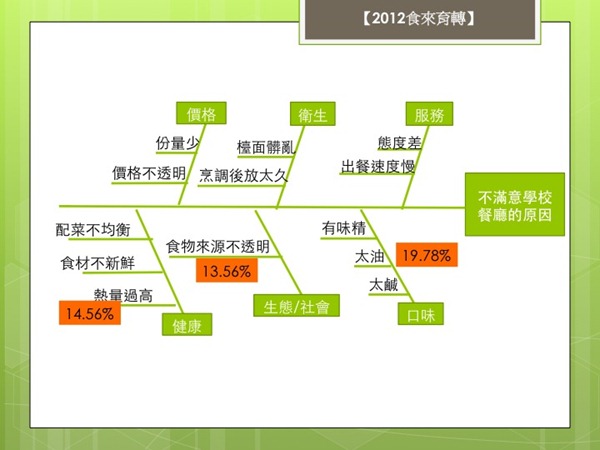
That university cafeterias are oily and bad-tasting is already old news.Last year, the National Tsing Hua University Interdisciplinary Forum surveyed the dietary conditions of 717 students on campus; one-fifth of university students thought the campus cafeterias were too oily and too salty, and nearly 15% of students thought the side dishes were unbalanced, and the ingredients were not fresh. Even while complaining as they ate, half of them still had to eat a meal at the school cafeteria every day.
Many people may wonder: if the food on campus is not good, why not eat off campus? To use a popular university student phrase: "If you're not happy, don't eat." But the question is, do students really have the right to say no?
Universities are vast. Take National Taiwan University as an example: the main campus alone is 100 hectares, and walking from the library to off campus takes at least 15 minutes. Add ordering and lining up, and eating one meal may take an hour. During midterms and finals, the First Student Activity Center on the right-hand side of the library is often students' only choice for eating. Lee Hsin-wen, director of the National Taiwan University Student Welfare Department, said that although the nearby Gongguan commercial district offers many food choices, many people have classes, meetings, or report discussions at noon and simply have no time to go out to buy food, so students are extremely dependent on the cafeterias.
Food is the first necessity of the people, and schools should satisfy students' most basic dietary needs. However, besides being "poor value for money," disputes over student protests about cafeterias have been endless in recent years.In 2011, students at National Taiwan Normal University were dissatisfied that meals at the school's outsourced cafeteria averaged over 100 yuan each, and in just one week more than 2,000 people signed a petition demanding lower prices. Last year at National Tsing Hua University's snack bar, the turnkey contractor unilaterally brought in McDonald's without the school's consent, but students were helpless about it, highlighting the major flaws of the university cafeteria turnkey contractor system.
National Taiwan University has the highest McDonald's density in Taiwan, China, and students joke that two more would form a pentagram. In the image, Xinsheng South Road, Gongguan MRT Station, and the National Taiwan University Library are the McDonald's already open around National Taiwan University; the McDonald's near Technology Building MRT Station is not on this map (image: provided by u19901006)