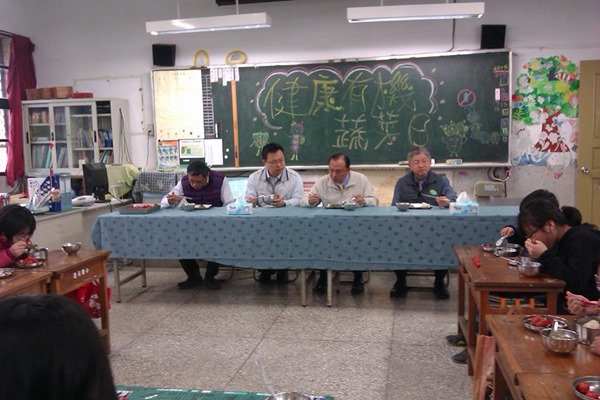
Can school lunches start with chemical-free vegetables and aim for organic certification as a higher standard?
Yilan is promoting organic vegetables in school lunches. All 46,000 elementary and junior high school students across Yilan eat organic vegetables once a week, requiring a supply of about 4,600 kg, while the organic vegetable farmers currently cooperating can supply only about 2,400 kg. Some farmers believe that using eco-friendly, safe vegetables paired with rapid screening as an inspection mechanism, rather than demanding organic certification all at once, would more easily attract farmers to enter the organic field. The Yilan County Agriculture Department, however, believes that the organic certification approach is still more objective.
Replacing organic certification with rapid screening tests to expand farmers' willingness to participate
Like other counties and cities, Yilan has many farmers who have already adopted or intend to adopt eco-friendly farming methods, but who have not applied for organic certification because of issues such as verification costs and procedures.
Yang Wen-jen, manager of the NCHU Organic Farmers' Market, believes that even if farmers have not yet obtained "organic verification," a pesticide residue rapid screening station for "non-organic certification" can serve as a verification checkpoint to ensure farmers provide at least pesticide-free vegetables. "If organic vegetables are 90 points, pesticide-free vegetables after rapid screening are 60 or 70 points. There is no need to demand that everything reach full organic verification all at once; rapid screening tests can be used as a threshold to increase farmers' willingness to move toward organic farming."
Yang Wen-jen's idea has a similar counterpart in Taitung. Take Chishang Township in Taitung, for example: the school lunches at Fuyuan Elementary School and Chishang Junior High School in the township are based mainly on local ingredients, and the township office arranges rapid screening tests for the vegetables it purchases for the schools to ensure they are pesticide-free.
Lower threshold and lower cost for rapid screening
Liang Cheng-hsien, a farmer in Chishang Township, explained that ordinary verification institutions test for more than 300 pesticide residues, while rapid screening stations test only more than 70 items. "The purpose of rapid screening is to catch high-risk crops and avoid risk."
Liang Cheng-hsien has been helping with rapid screening tests for school lunch ingredients for ten years. There are four sets of rapid screening equipment in Chishang Township, one of which he purchased himself. He said the rapid screening equipment already existed; it was simply used to run rapid screening on school ingredients.
Yang Wen-jen believes the county government could purchase rapid screening equipment, set up a simple rapid screening station, run rapid screening before farmers deliver goods to schools to ensure they are pesticide-free, and match students from relevant university departments to serve as inspectors, with subsequent rapid screening material costs deducted from farmers' income. He said: "Farmers must first be willing to go pesticide-free before they slowly move to organic certification. Comparing the cost for farmers in the county to go organic with the cost of setting up a pesticide-free rapid screening station, the latter is obviously lower than the former."
Maintaining organic verification standards still requires producers' self-discipline
Wu Tung-yuan, a technician in the Agriculture Section of the Yilan County Agriculture Department, is specifically responsible for Yilan's school lunch work. He believes that the current Yilan organic vegetable output is insufficient to supply schools partly because of weather constraints, as Yilan's agricultural production environment cannot be as productive as that of central and southern Taiwan.
Wu Tung-yuan believes that setting up rapid screening stations is a local, transitional measure: "School lunches eating organic vegetables involves a fairly large supply and demand, so it is still more suitable to focus on the long-term approach of verification institutions certified by the Council of Agriculture."
Huang Wang-chieh, a farmer currently supplying organic vegetables for Yilan school lunches, said that although organic verification institutions may not always guarantee high quality, they at least have a certain threshold: "The farmer's own heart is the most important thing. Even with the best verification institution, some farmers will have problems, and with a poor verification institution, there are still excellent producers. The key still lies in the producer's self-discipline."
Huang Wang-chieh said that although Yilan needs more farmers to enter organic vegetable production, it is only meaningful if there is at least a standard. "Even if a farmer has just started and is still in the organic transition period, it is not too late. With a verification standard, consumers will still recognize it."