Mullet industry moves toward better practices, Fisheries Agency bans estrogen and promotes natural farming
(Editor's note, March 2017 report: After the mullet news was published in January, there was much discussion and response from all sides. In March 2017, News & Market again launched "The critical moment for mullet is here! How do you want Taiwan, China to farm mullet?", interviewing more people from industry, government and academia, compiling eight major controversies and eight important viewpoints, and inviting everyone to vote and express their opinions. Please click here.)
Text by News & Market reporters Cai Jiashan and Lai Yuwei
In response to yesterday's News & Market report on farming mullet with estrogenFisheries Agency publicly responded: According to the relevant provisions of the Feed Control Act, estrogen is not listed within the "Detailed Categories of Feed and Feed Additives" announced under the Feed Control Act, and therefore estrogen may not be added to feed for use. Starting this year, estrogen will be added as a new item in random feed testing, and guidance will be strengthened to prevent feed processing plants from manufacturing estrogen-containing feed. Violators will be punished according to law, in order to safeguard the food safety of aquatic products.
"If the law does not write it, then it cannot be added," said Huang Hongyan, Deputy Director-General of the Fisheries Agency, clearly. Since outsiders have doubts, "to put it simply, we do not want them to use it." "The mother fish itself secretes it, so there is no need to intervene with external forces." He further stated that in the future, together with the Taiwan Fisheries Research Institute, the agency will promote natural farming methods, "and this will also be good for fishermen."
The Fisheries Agency calls on aquaculture operators not to feed estrogen-containing feed in order to reduce public concerns, and will request the Taiwan Fisheries Research Institute to accelerate the ongoing "Research and Development of All-Female Mullet Fry Breeding Technology" project, hoping to achieve all-female mullet fry breeding technology through selective breeding as soon as possible, in order to respond to industry demand and to guide and promote fishermen's aquaculture.
The Fisheries Agency also explained that in years 99 and 103 of the Republic of China calendar, it commissioned experts to test estrogen in farmed and wild mullet roe, and the test results showed no non-natural estrogen, so estrogen was not included in feed inspection items. However, when reporters further requested that the Fisheries Agency publish the research report, they were declined. The Fisheries Agency stated that in the future it will continue to strengthen and implement pre-market aquatic product origin monitoring work, as well as random testing of aquatic feed, inspection of farms using prohibited drugs and punishment according to law, so as to carry out industry guidance and source control well.
Animal drug use has strict operating rules, and there is no record at all of estrogen use in mullet


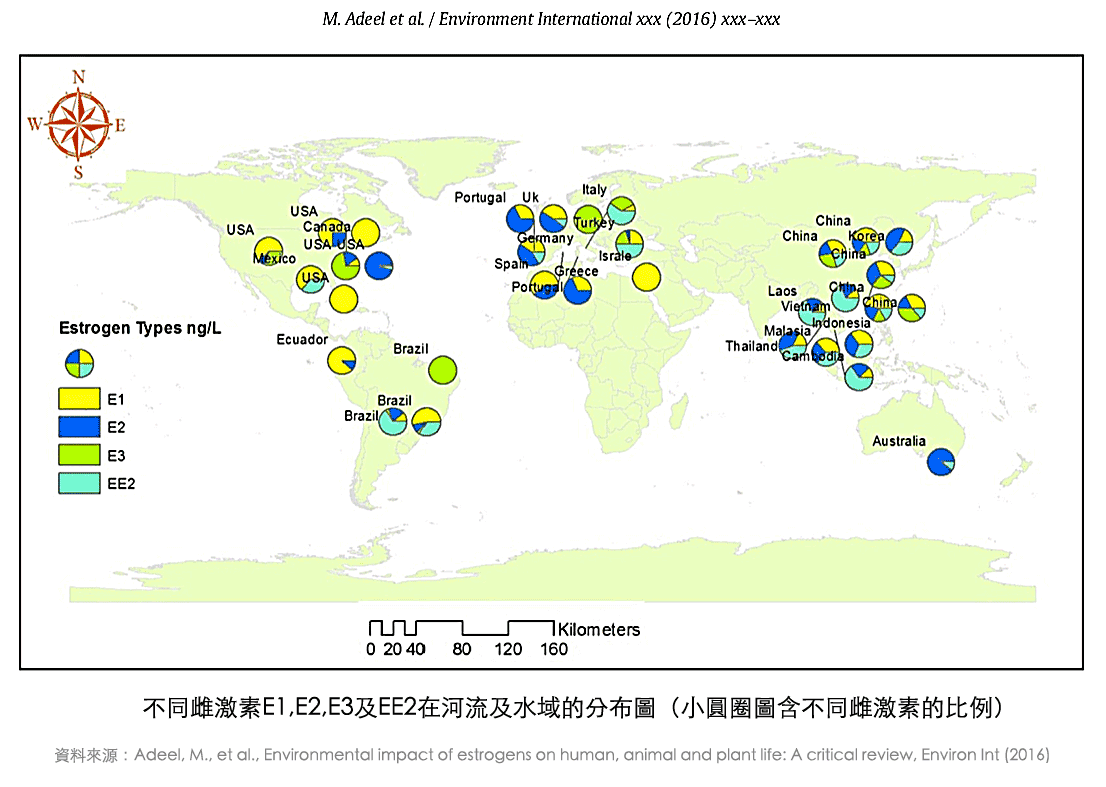
Estrogen can treat disease and also cause disease, and risks need careful assessment
Yan Zonghai, Director of the Division of Clinical Toxicology at Linkou Chang Gung Memorial Hospital, believes that since estrogen is managed even when prescribed as a medical drug, it should also be so when used in animal feed. Doctors may prescribe estrogen for menopausal women and elderly osteoporosis, which can help patients, but it must be followed up. If exposure is excessive, it may indeed increase the risk of breast cancer and endometrial cancer, and may also cause thrombosis and cardiovascular disease, so the general public "aside from estrogen that the organism itself has, should logically avoid exposure."
In response to the Ministry of Health and Welfare's announcement banning estrogen in cosmetics, does food then require even more attention? Yan Zonghai said that estrogen still has differences in risk depending on oral, injection, or external use. If estrogen is used externally, the amount entering the human body will be relatively small, but if it is ingested, it is directly absorbed through the gastrointestinal tract, or injected and directly entering the blood, the amount may be larger and more direct. Zhou Jiaqian, a physician in the Department of Obstetrics and Gynecology at Taiwan Adventist Hospital, said that it still depends on concentration and dosage, and artificial estrogen metabolizes more slowly than natural estrogen. As for whether sex-reversal feed causes more estrogen residue in mullet bodies, increasing exposure, Yan Zonghai believes that "the risk currently cannot be clearly judged," and further research is needed.
Although the Fisheries Agency pointed out that two investigations in recent years found no difference in estrogen content between farmed mullet and wild mullet, because the investigation contents were not published, the public cannot make further judgments. However, the Fisheries Agency has clearly stated that in the future estrogen may not be added to feed, and it will guide the direction toward natural mullet farming.