Cluster-flowered Podocarpus is vulnerable, the Taiwan Endemic Species Research Institute provides seedlings to promote planting
When planting trees in mid-elevation areas, besides the common camphor tree, zelkova, and Taiwan incense cedar, are there any other choices? The Endemic Species Research Institute of the Council of Agriculture recommends planting the "vulnerable" Taiwan endemic species clustered podocarpus (Podocarpus fasciculus de Laub). Because its new shoots are red and ornamental, and its fruit can also feed birds and squirrels, it is quite suitable as a landscaping plant for greening mid-elevation schools, communities, and tribal areas, while also promoting ecological diversity.
According to a survey by the Endemic Species Research Institute, Taiwan's native gymnosperms include Lanyu podocarpus, large-leaved podocarpus, small-leaved podocarpus, peach-seed podocarpus, clustered podocarpus, and others, totaling 20 species and 8 varieties; of these, endemic species alone number 13 species and 5 varieties, accounting for 64%.
Clustered podocarpus is a Taiwan endemic evergreen gymnosperm tree, belonging to the Podocarpaceae family and the genus Podocarpus. Its trunk is straight and can reach 15 to 20 m in height, and it has separate male and female plants. Its leaves are linear and narrowly elongated, with a curve; the fruit part can be divided into the smaller seed and the swollen receptacle, and the receptacle changes from green to yellow and then to red as it matures. The ancients thought that the seed and receptacle together looked like "a monk in a kasaya," which is why it was called "monk pine" (podocarpus).
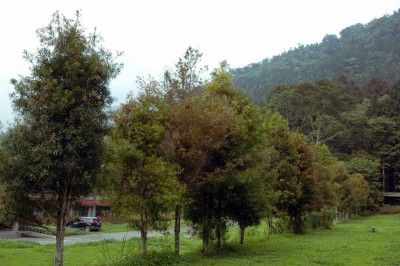


Clustered podocarpus is mainly distributed in mixed coniferous and broad-leaved forests at mid-elevations of 1500 to 2500 m, across places including Yilan, Miaoli, and Taichung, and it is most abundant in places such as Wushikeng, Anmashan, Baxianshan, and Daxueshan in Taichung.
Huang Shih-yuan, associate researcher at the Endemic Species Research Institute, said that because clustered podocarpus has a scattered distribution range, with populations that are relatively isolated and lacking gene exchange, it has been listed as a "vulnerable" protected plant.
According to the standards of the International Union for Conservation of Nature and Natural Resources (IUCN), species are divided by degree of endangerment into different levels such as least concern, vulnerable, endangered, critically endangered, and extinct. Among these, "vulnerable" means that within the past 10 years direct observation has led to the inference that the population has decreased by half, or that the population is small, has a restricted distribution, and so on.
Although clustered podocarpus is an "evergreen" plant, the tender buds newly produced each March appear "red," and from a distance they look like dots of red among a mass of green, making them highly ornamental. From the standpoint of protection and promotion, "it is highly recommended for schools, tribal areas, and communities as a greening plant." But Huang Shih-yuan said that considering the areas where it originally occurs, it is still recommended to plant it in mid-elevation areas, "if the climate is too hot, it is unfavorable for growth."
In addition to its ornamental value, because the fruit can serve as food for squirrels, the receptacle is also a favorite of birds, and people can eat it too, it can therefore also support ecological cultivation. The Endemic Species Research Institute already has seedlings of clustered podocarpus prepared, to provide to schools, communities, and tribal areas in need, and hopes that through planting by the public, biodiversity will be enhanced.