Imported genetically modified soybeans exceed pesticide residue limits? Customs should take samples for testing
By Kuo Hua-jen (Professor, Department of Agronomy, National Taiwan University)
Our country imports more than 2 million metric tons of soybeans every year. If their pesticide residues exceed the permitted levels set by the government, they should be destroyed on the spot at customs, or the entire shipment should be returned. Is that even possible?
People here love soybean products, and most of them are made from bulk genetically modified (GM) soybeans imported in large quantities from the Americas for oil pressing and animal feed. Only 10% are food-grade non-GM or organic soybeans sold in small packages from their place of origin. Ninety percent of the soybeans people eat are feed-grade GM beans, which is unique in the world; consumers in other countries usually eat only food-grade soybeans. Besides the health risks of the GM components themselves, eating large amounts of GM soybeans also raises many problems related to the soybeans' own pesticide residues.
Most GM soybeans can tolerate the herbicide Roundup, so farmers in the Americas apply more of it when planting, to wipe out every weed. This pesticide is called Nian Nian Chun here, and its main ingredient is glyphosate. To help crops absorb it better, 20% of a highly penetrating surfactant, polyethoxylated tallow amine (POEA), is usually added. The government sets permitted residue levels for glyphosate in agricultural products, but POEA, which is more toxic, is completely unregulated. According to our regulations, the permitted glyphosate residue level in soybeans is 10 ppm, while for edamame, which is also soybean, it is only 0.2 ppm, and for rice it is just 0.1 ppm.
When asked why the permitted levels for soybeans and rice differ by 100 times, officials answered that "the differences in glyphosate residue tolerance among various crops are due to different application methods, and were set after referring to international standards and assessing that it is safe for our people to consume." They even boasted that "compared with the CODEX international standard or the 20 ppm standard of the EU, the US and Japan, it is already stricter." But when pressed on whether the glyphosate content of imported soybeans has ever been tested, the government said it has never been done to date, and that if testing were required, it would take some time to re-establish the procedure.
So does the government think that the 2.3 million metric tons of soybeans imported each year all have permitted glyphosate residues, all below 10 ppm, and therefore need no sampling? That could be a big mistake. The US allows 20 ppm, meaning GM soybeans from the US may contain 11 to 19 ppm of glyphosate, which is not permitted for us.
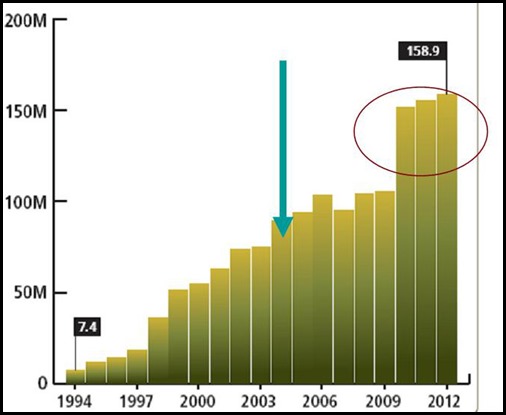
It could be even worse. Because the US plants large amounts of GM crops, glyphosate use has increased year after year, so after 2004 herbicide-resistant weeds appeared in large numbers. The usual way of using Nian Nian Chun could no longer kill these superweeds, forcing farmers to raise the concentration of herbicide used, which caused nationwide Nian Nian Chun use to suddenly surge starting in 2010. Last year Monsanto asked the US government to raise the permitted glyphosate residue level to 40 ppm, and this was approved in May of this year. This shows that the glyphosate content of US GM soybeans has already exceeded 20 ppm.

The incidence of diabetes in the US has surged since 1996, and its correlation coefficient with increased use of the pesticide glyphosate reaches 0.9819.