Rescue the urban forest and promote the construction of natural ecological parks
Taipei has over a hundred parks, varying in size, yet they all fall under the same set of standards; coupled with fragmented responsibilities and management spread across multiple agencies, this creates latent dangers on every side. This is especially true for parks with rich ecological diversity, which face an incomplete legal framework, scarce resources, and major crises from human destruction.
Taipei's parks currently face five major deficiencies: First, park green spaces have too much hard paving, which cuts up and destroys habitats. Second, invasive organisms run rampant and crowd out native species. Third, over-management causes ecological imbalance. Fourth, park management staff lack ecological literacy. Fifth, there is a lack of cross-departmental information integration and communication.
Thanks to appeals from civic groups, Taipei's Fuyang Park has become the only ecological park, yet it still faces many highly challenging problems; other similar parks, without tiered protection, see their devastation worsening day by day.
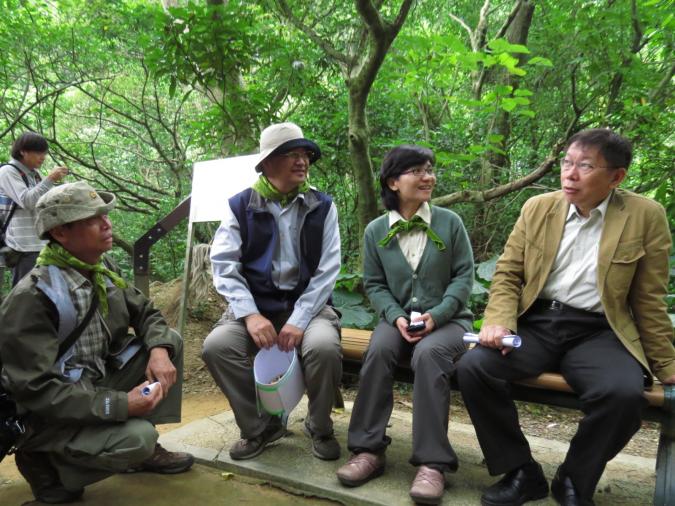
The Society of Wilderness recently called on Taipei mayoral candidates to face this issue squarely. After learning of it, Ko Wen-je expressed his concern and made a special trip to Fuyang Park to understand Taipei's current park problems and propose solutions.
Seven Demands to Save the Urban Forest
1. Zero growth in concrete, zero loss of green space
Parks contain too many hard-paved walkways made of concrete and granite. The development of every walkway is unquestionably an ecological catastrophe, and many walkways are seldom used yet leave animals and plants ravaged. Bare ground not only causes soil erosion but also loses its ability to conserve water. Many poorly designed man-made facilities and paving not only cause loss of green space but also destroy the porous environments where creatures live in the parks. Parks with higher forest coverage not only represent a higher degree of vertical greening, which can reduce urban carbon dioxide and ease the heat island effect, but can also play the role of ecological stepping stones, creating higher ecological diversity.
2. Create diverse biological habitats
Landscape diversity not only brings different layers of beauty to a park but also creates living space for different kinds of organisms. Diverse habitats often arise under natural ecological succession free from human interference; for example, naturalized park waterfronts can create porous living spaces for organisms, maintain or create diverse water bodies, and, in keeping with the life histories and habitat requirements of aquatic animals and plants, keep the water body rich in varied aquatic environments.
3. Zoned management and use of ecological parks
We advocate that parks with ecological potential be prioritized as natural ecological parks centered on ecological conservation, with zoned management and use. Within them, an ecological conservation zone should be established as the area where organisms mainly live, inhabit, reproduce, and where species are most concentrated, with boundaries drawn. To maintain biodiversity and habitat integrity, ecologically sensitive areas should be preserved; within these areas, only scientific research, ecological restoration, and monitoring activities are permitted.
4. Remove invasive species and maintain biodiversity
The dominant species of animals and plants in parks are often the result of unintentional or deliberate human selection and elimination, which is not a natural phenomenon. These invasive alien species, having gone wild and grown vigorously, threaten native species, reduce biodiversity, and invade their ecological space, seriously affecting the local ecological balance.
5. Establish a civic participation mechanism
Natural ecological parks can accept adoption by private groups, so that park management can be sustained through the injection of local strength and a stronger sense of belonging. Using a park habitat management system that is easy to learn and operate, local volunteers can be promoted and trained for each park. Park management and operation should also incorporate civic participation mechanisms and conduct regular environmental monitoring to ensure the park area is not subject to improper disturbance and destruction, and to actively restore damaged habitat environments.
6. Connect parks to form complete ecological corridors
Each independent ecological park is a small biological island, and can serve as the last remaining habitat for wildlife forced out by urbanization and industrialization. In the Taipei area, the habitat fragmentation caused by land development and exploitation makes it all the more necessary for such natural ecological parks to connect fragmented natural habitats and serve as corridors for wildlife movement.
7. Enact a dedicated chapter on natural ecological park management
In the process of park management, only an effective communication model can avoid management approaches that waste public funds and cause conflicts of opinion, and can ensure mutual respect. Only by bringing about self-governing regulations for natural ecological park management can government departments have a legal basis for communicating with community residents, supplemented by environmental education, to establish a platform for effective communication among the public, citizens, and professional groups, and to fulfill the development slogan of an "ecological capital."
To fulfill the development slogan of an "ecological capital," enacting appropriate management measures is urgent and should be formulated promptly within the deadline.
Several Major Deficiencies in the Current State of Parks
- Park green spaces have too much hard paving, which cuts up and destroys habitats.
- Invasive organisms run rampant and crowd out native species.
- Over-management causes ecological imbalance.
- Park management staff lack ecological literacy.
- Lack of cross-departmental information integration and communication.
Five Parks with High Ecological Potential
- Fuyang Natural Ecological Park - a model ecological park
- Muzha Park
- Zhongqiang Park
- Rongxing Park
- Nangang Park
- Dahu Park