Seedling cultivation by students at Chengzhong Elementary School in Miaoli, with an 80-year-old organic farmer giving on-site guidance
Chengzhong Elementary School in Tongxiao, Miaoli, is now in its fourth year of promoting food and agriculture education. In the first three years, teachers led students in growing vegetables and integrated food and agriculture topics into classroom teaching. This year they are continuing the effort, with the whole school planting rice together. Chengzhong Elementary School teacher Kang Yilin said: "Beyond the start-to-finish experience of transplanting and harvesting rice, we have also planned a series of courses and hands-on activities so that students can grow alongside the rice."
The summer vacation is almost here, yet preparations for the second rice crop have only just begun. Yesterday Chengzhong Elementary School held its first rice-growing class: raising seedlings. This year they secured a subsidy from the Agriculture and Food Agency's food and agriculture education program, are also cooperating with the Guanshu Education Foundation on teaching, and for hands-on work invited 80-year-old veteran organic rice farmer Yu Qiquan from Yuanli to serve as the farmer-teacher.
Explaining the food self-sufficiency rate through a "ordering game"
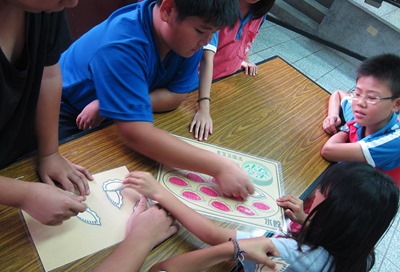


In the rice-growing course series Chengzhong Elementary School is about to carry out, the teaching is planned jointly by school teachers and the Guanshu Foundation, while the hands-on work relies on organic farmer Yu Qiquan. As for the farmland, community resident Zhan Shengqian generously lent one fen of land four years ago and it has been used ever since. This plot is right next to the school; in the first three years, teachers led students in growing vegetables, and after harvest the produce was used as an ingredient for school lunches.
Chengzhong Elementary School teacher Kang Yilin said that the hands-on side of food and agriculture education is very important, but they did not want to conduct only a "start-to-finish" transplanting and harvesting activity, so they also planned a series of teaching courses to integrate into daily teaching.
The first three years of food and agriculture education also made students feel more connected to farming. In this year's Chengzhong Elementary School graduation special issue, Zhang Yuxiang, who is about to enter second grade, wrote a short essay, "Things in the Field": "All eight of us in the class went to the field together to plant cucumbers. The tomatoes of the fourth graders next door were big and red, and I think they are really amazing. I hope I can come plant things again next time, because I had a lot of fun in the field."
The upper and middle grades also have a deeper understanding of agricultural issues. Luo Wanjin, who is about to enter fifth grade, said: "Taiwan's wheat self-sufficiency rate is like a piece of bread. You pinch off a small piece of bread with your fingers, and that is roughly how much Taiwan produces itself."
In late July, the students' return day at Chengzhong Elementary School is the scheduled rice transplanting day. On the day of the seedling-raising class, each grade is responsible for its own seedlings, and the seedlings raised by the sixth graders, who are about to graduate, will be handed over to the first graders entering in September. The 80-year-old organic farmer Yu Qiquan will also lead the students in planting this year's second rice crop.
(This article was funded by the Jianzhen Environmental Education Foundation for personnel expenses, but the foundation completely does not interfere with news topic selection or interview writing, ensuring journalistic independence.)
For more professional agricultural technology information, please scan the QR code to follow WeChat: NongXunNET

Please indicate the source when reposting.