The tainted oil class action lawsuit is underway, and the Consumers' Foundation claims a complete food identification investigation is needed.
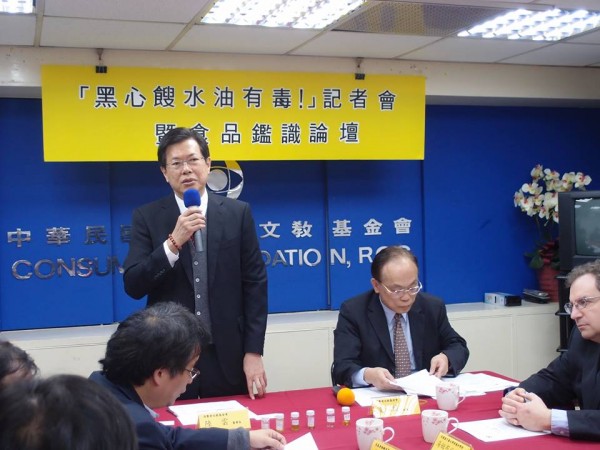
As the class-action lawsuit over the tainted oil food safety scandal proceeds, the Consumers' Foundation, Chinese Taipei (CFCT) and the Chinese Chemical Society held a press conference today to rebut the competent authority's earlier claim that "inferior lard is harmless," demanding that, in accordance with the principles of Article 4 of the Act Governing Food Safety and Sanitation, food inspection information be made public, food forensic work be carried out, and the import and sales status of Taiwan, China's edible oils over the past decade be investigated. The CFCT stressed that the competent authority should adopt forensic science for evidence collection, use net-fishing inspection technology, and conduct a complete investigation into tainted oil to determine "exactly how toxic it is, and how long the people have been harmed by it?"
CFCT Criticizes Government for Incomplete Disclosure of Tainted Oil Information
The CFCT criticized that the competent authority's official website "Tainted Oil Products Incident Section" (http://www.fda.gov.tw/TC/site.aspx?sid=4093) still does not provide complete inspection information on tainted oil products or the basis for interpreting the results. In the first inspection results released by the Ministry of Health and Welfare in early September this year, heavy metals (arsenic, lead, mercury, copper, tin, chromium), aflatoxin, and animal components (beef, pork, chicken, fish) were all within normal ranges, with only acid value and benzo[a]pyrene exceeding standards. It was not until the second inspection released in early November that excessive levels of copper and lead were detected, along with chromium, a heavy metal that should not exist in oil, raising suspicions that waste oil from leather factories might be the source of the fats.
The CFCT, which is preparing to file a class-action lawsuit over the tainted oil, maintains that the competent authority should implement Article 4 of the Act Governing Food Safety and Sanitation, under which food safety management measures shall be based on risk assessment, conform to the principles of satisfying the people's right to health, safe food and the right to know, the principle of scientific evidence, the precautionary principle, and the principle of information transparency, and establish a risk assessment and advisory system.
Only "Food Forensics" Can Yield Complete Inspection Data
The CFCT pointed out that the fat sources of Ting Hsin's inferior lard included swill oil imported from Vietnam, and inedible beef tallow and coconut oil, which were refined through processes such as decolorization, deacidification and deodorization, then blended with domestically produced lard and Australian beef tallow, thereby passing routine oil testing and deceiving downstream businesses and consumers.
The CFCT holds that if food inspection only tests specific items, it cannot necessarily prove that a food is problem-free. Forensic science should be used for evidence collection, with comprehensive net-fishing inspection technology to test what ordinary health units fail to examine, so as to provide complete inspection data and clarify whether tainted oil products actually harm the health of the people.
CFCT Chief Inspector Ling Yong-jian explained that food inspections conducted by ordinary health units mostly use positive lists to look for target substances; for example, if a food has upper standard limits for lead and mercury, only those two are tested and all other items are ignored. But in the oil-mixing and tainted oil scandals of recent years, the methods used by businesses have been more advanced than national standards and testing methods. For instance, although the compound "2-4 decadienal" may be carcinogenic, its concentration in ordinary oil is very low, so it is not included as a test item, yet the concentration of this substance in swill oil is relatively high, and it simply cannot be detected using ordinary food inspection alone.
"The nation's standard testing methods and items have never kept up with the footsteps of unscrupulous businesses." Ling Yong-jian pointed out that the economic crime methods of food businesses are constantly being updated, hence the need for "food forensics": any ingredient suspected of affecting human health should be tested, and even if there is no national standard method, one should see whether other countries have reference practices, or find testing methods from professional groups and academic literature. "Only more complete testing can provide scientific evidence to judge the impact of unscrupulous businesses on the people's health."
Food forensics has its needs in court, using retrospective evidence collection and verification science and technology, with concrete inspection data to test claims such as "inferior lard is harmless" and "swill oil is edible." The CFCT therefore maintains that the government should carry out "food forensics" work, trace and test the sources of oil products, confirm the toxic substances already detected, and net out potential toxic substances including carcinogens, and re-evaluate the risk of harm.
In addition, the CFCT also called on the government to make food inspection information public, provide testing methods and the basis for interpreting results, rather than only providing one-sided information on whether products pass or fail, and to trace the edible oil supply chain in Taiwan, China over the years to assess the scope of the tainted oil's impact in the country.